
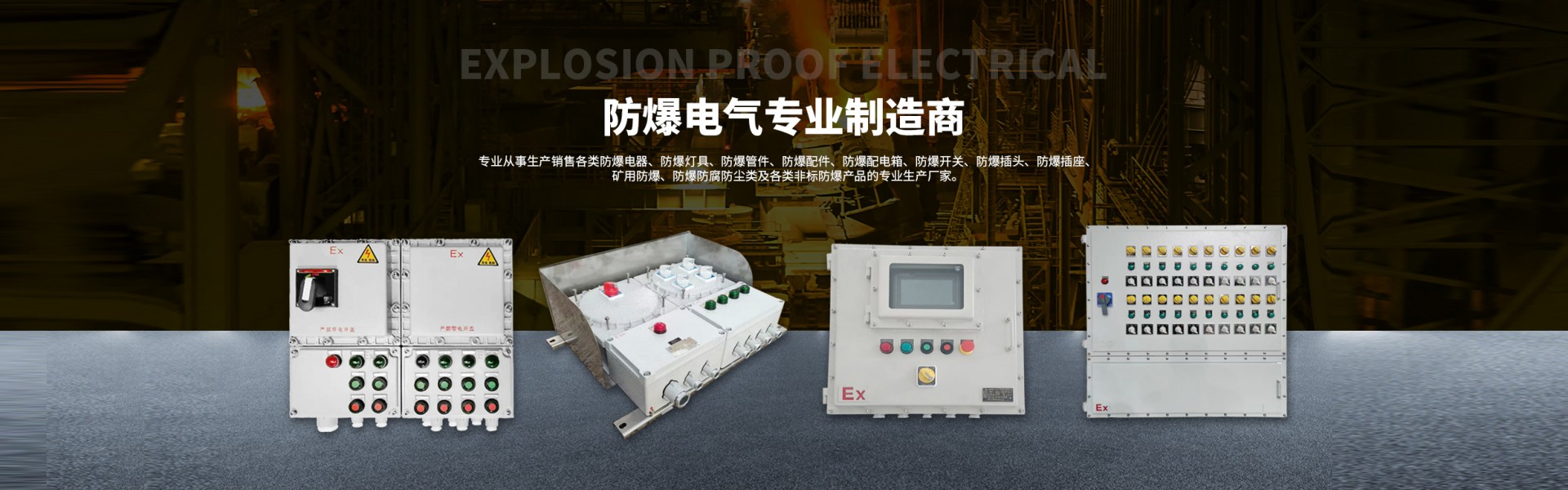


Positive Pressure Explosion-Proof Cabinets, also known as positive pressure explosion-proof cabinets, operate on the principle of: by injecting compressed air or inert gas into the cabinet, creating a pressure difference between the inside and outside. This prevents hazardous gases and combustible dust from entering the cabinet. Since there is no source of ignition inside, an explosive environment cannot form, thereby greatly protecting the equipment and components within the cabinet.
The explosion-proof distribution box, also known as the explosion-proof maintenance box or explosion-proof power supply box, is a type of explosion-proof product with airtight design. Its explosion-proof principle is as follows: within the airtight cabinet, dangerous gases or combustible dust are allowed to enter, and possible explosions are permitted. After an explosion, the heat and spark intensity are controlled by the length, gap, and roughness of the explosion-proof surface, preventing the spread of the explosion within the cabinet. However, the equipment inside the cabinet may suffer corresponding damage.
Product Features of Explosion-Proof Positive Pressure Cabinets:
1. The explosion-proof positive pressure cabinet is composed of the cabinet body, automatic control system, air distribution system, alarm system, and power distribution system; the cabinet body consists of a positive pressure chamber and a secondary chamber, with the positive pressure chamber housing the user's power distribution system components and the secondary chamber housing the automatic control system.
2. The cabinet products utilize the GGD cabinet frame, with the main and auxiliary disks arranged in a left-right structure. They are installed with cable trench seats, featuring lower entry and front door operation, with the rear door for maintenance.
3. The box-type products feature a steel plate welding structure, with the main and auxiliary plates in an up-and-down configuration. They are mounted for hanging installation, facilitating line entry at the bottom, operation through the front door, and maintenance.
4. The Qintai-style products are made by folding and welding steel plates, featuring a front and rear structure for the main and auxiliary disks, with a pedestal installation, bottom-line entry, grand piano operation, and rear door for maintenance.
5. Divided into ventilation and compensation types based on the intake method. The ventilation type provides continuous gas supply without interruption, allowing the working heat of the components inside the positive pressure chamber to be carried away by the gas circuit, offering excellent heat dissipation capabilities. It is suitable for addressing the heat dissipation issues of high-power explosion-proof variable frequency drives. The compensation type features intermittent gas supply, requiring the positive pressure chamber to have good sealing to ensure minimal gas consumption.
6. Customers must provide a gas source, which should be either purified air or nitrogen, with a pressure range of 0.2 to 0.8 Mpa. Typically, the仪表风 at the customer's site is sufficient to meet these requirements.
7. Steel plate materials generally use GB710-88 cold-rolled steel plate, or stainless steel material GB3280-84 can be selected according to customer requirements.
Features of Explosion-proof Distribution Boxes:
The explosion-proof distribution box with a composite structure features a flameproof main bus box and a reinforced explosion-proof outlet box.
2. The main materials for the cabinet include cast aluminum alloy, Q235 carbon steel, 304, and 316 stainless steel.
3. The casing houses a high-analysis miniature circuit breaker with overload and short-circuit protection features, and additional functions such as leakage protection can be added upon request.
4. Various circuits can be freely selected and combined using a modular structure.
Meets the requirements of GB3836-2000 IEC60079 standards.
