
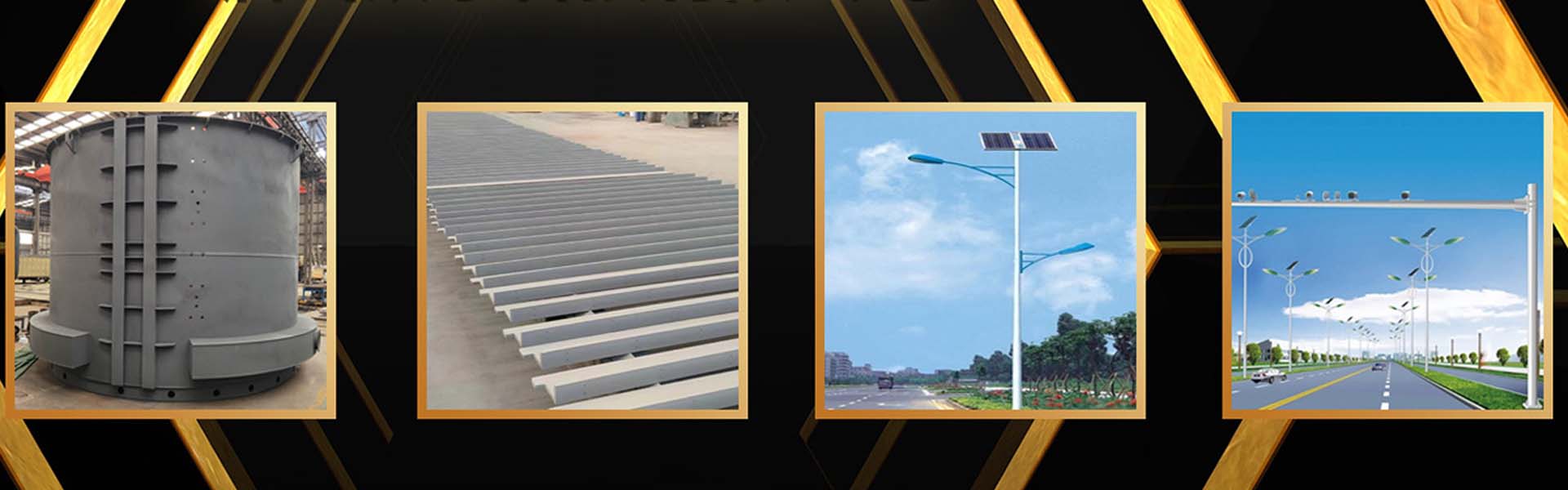


T-beam steel: The process of cold drawing T-beam steel, with the aim of saving steel and enhancing the yield strength of T-beam steel, involves stretching the T-beam steel under tensile stress that exceeds the yield strength yet is less than the limiting strength, causing it to deform plastically. By applying tensile stress to the T-beam steel, it undergoes deformation (and creates a stress-strain curve). As the tensile stress increases, the internal stress within the T-beam steel gradually rises. When the internal stress in the T-beam steel exceeds its yield point A and reaches C, the cold drawing is halted and the load is released. At this point, it can be observed that the T-beam steel has undergone plastic deformation. During the unloading process, the stress-strain curve shows a change, with the line O1C being less steep than line OA. By reapplying tensile stress and stretching the T-beam steel to failure, the stress-strain curve exhibits a new change, with a new yield point near C, which is significantly higher than the original yield point A. This change indicates that the plasticity of the T-beam steel has changed; it has become less plastic and more rigid, leading to an increased strength in the T-beam steel. This phenomenon is known as "work hardening."
The above two processes have completed the cold drawn steel (rebar) production.
Alternative cold drawing control for different situations:
1) Cold Drawing Stress Control: For Grade II, III, IV T-beams and No. 5 T-beams, after cold drawing, those used as prestressed T-beams require cold drawing stress control. However, if the cold drawing rate exceeds the specified value (Table 3-1) after inspection of the T-beams, further mechanical energy tests must be conducted.
2) Cold Drawing Rate Measurement and Control Requirements: When controlling the cold drawing rate of T-section steel, the control value must be determined through testing. During the testing, the following requirements must be met: There should be no fewer than 4 specimens tested from the same furnace and batch. Each specimen must be measured for the corresponding cold drawing rate according to the specified cold drawing stress, and the average value of the specimens should be taken as the actual cold drawing rate for that furnace and batch of T-section steel. If the strength of the T-section steel is excessively high and the average cold drawing rate is below 1, the cold drawing rate should still be controlled at 1 during the cold drawing process.
3) Cold Drawing Control for Different Batch of Furnaces: For mixed, indistinguishable T-shaped steel from different furnace batches, during cold drawing, cold drawing rate cannot be used for control. Instead, multiple connected T-shaped steels should be cold drawn, with each piece adhering to the specified cold drawing rate and control stress as per regulations (Table 3-1).
4) Cold Drawing Speed Control: To fully deform T-shaped steel, it is necessary to control the cold drawing speed appropriately, generally at 0.5-1.0 mm/min. Additionally, after the specified stress and cold drawing rate are reached, the drawing should be stopped for 2-3 minutes, then the T-shaped steel should be relaxed to complete the cold drawing, allowing sufficient time for deformation.
5) Cold Drawing Control Methods: Single control refers to using either the cold drawing rate or cold drawing stress during cold drawing. Double control is when both the cold drawing rate and stress are applied simultaneously. Single control is simple and convenient for construction. However, for T-section steel with uneven material, it is impossible to test each piece individually (individual testing is labor-intensive and material-consuming, and it's not feasible; in some cases, the cold drawing rate for a single T-section steel piece can vary). This ensures that the quality of cold drawing cannot be guaranteed. The double control method can avoid these issues. During cold drawing, if the control stress has been reached and the cold drawing rate has not exceeded the allowable value, it can be considered qualified. Double control should be used for prestressed T-section steel. However, if the cold drawing rate has been reached but the cold drawing stress has not reached the control stress, this type of T-section steel should be used with reduced strength.
News Center Co., Ltd.
