

Traffic Facility Classification
According to the needs of traffic flow and the conditions of terrain and objects, pedestrian overpasses (including underground pedestrian crossings) should be set up on roads as necessary, along with fences, lighting facilities, sight guidance signs, emergency communication facilities, and other similar installations.
Pedestrian overpass
2. Fence
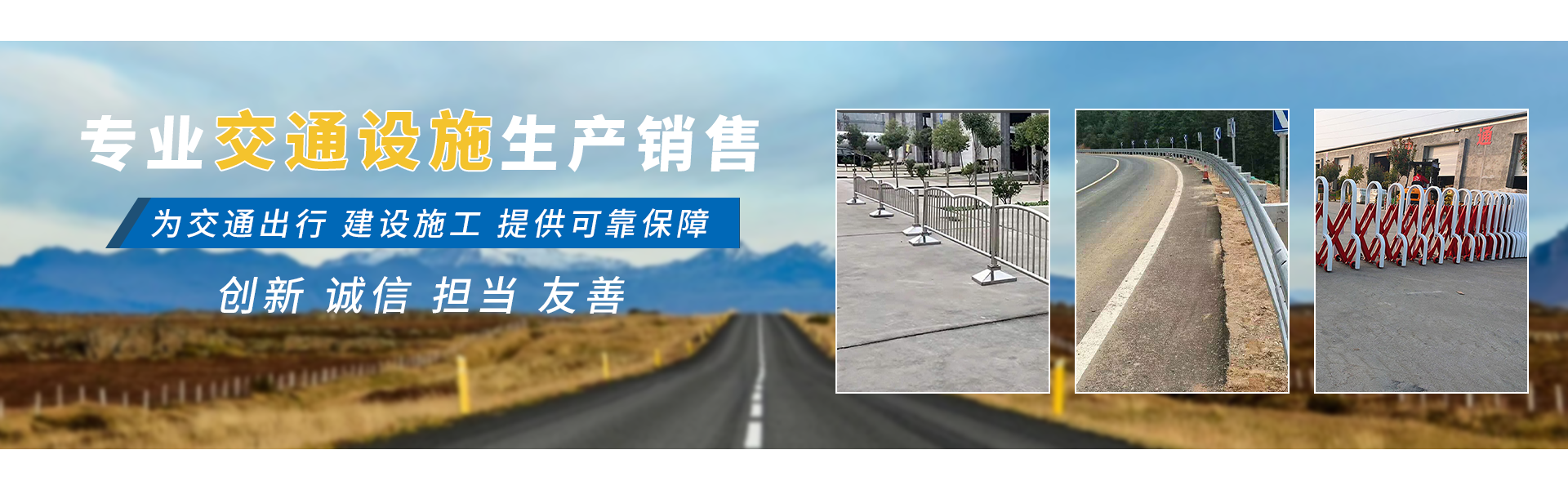
The vehicle veers off the road due to a mistake, thereby protecting pedestrians, residential areas, structures, and more, while also directing the driver's gaze. Additionally, it is used to deter pedestrians from crossing the road, separating pedestrians and bicycles from vehicles, and providing protection. Protective barriers come in various forms such as guardrails, cables, trusses, and pipes. The choice of barrier type should be harmonious with the environment and consider its function; for the sole purpose of deterring pedestrians, options like pipes and chain-link fences can be selected.
3. Lighting Facilities
To prevent traffic accidents during night driving and enhance driving comfort, lighting facilities should be continuously or partially installed on necessary roads. Lighting equipment can reduce traffic accidents; Japanese statistics show that on roads with night lighting, accidents can be reduced by 14% to 54%, while statistics from countries in Europe and the US indicate a reduction of 30% to 40%. Lighting equipment can also improve road utilization rates, with实测 data from the United States showing that after installing lighting facilities, vehicle speeds can increase by 1.1 to 4.6 km/h. Additionally, lighting equipment can alleviate pedestrians' sense of insecurity, ensuring drivers have the necessary visual distance for safe driving and eliminating their sense of insecurity.
4. Visual Guidance Sign
To indicate road edges and alignments, guiding signs are required on special sections to direct drivers' attention, such as snow stakes on sections with excessive snowfall. Moreover, guiding signs should also be placed at the ends of the median and at the front of diversions to mark their positions.
5. Highway Reflectors
Reflectors should be installed at locations prone to accidents, such as sharp curves and narrow-radius sections, including poorly visible intersections and crossings. Highway reflectors come in circular and square shapes, generally employing convex mirrors. The mirror surface should have high reflective efficiency, free from defects like blurring, warping, bubbles, and ripples.
6. Highway Information Board
To promptly inform road users of highway, weather, and traffic conditions, as well as related traffic restrictions, variable message signs are strategically placed at appropriate locations. These signs come in three types: Type A signs are used on major highways, featuring suspended designs, controlled by computer, with internal illuminated displays; Type B signs are located alongside the road, equipped with manually operated illuminated displays; and Type C signs are used at traffic restriction sites, featuring insertable boards with concise and clear messages for easy accurate understanding.
7. Highway Surveillance System
At locations and sections that may significantly endanger pedestrian safety, or where traffic congestion may occur on routes, traffic surveillance facilities should be installed as needed. These facilities should monitor regular traffic flow and, in the event of an emergency, immediate countermeasures should be taken. Surveillance equipment includes standard industrial cameras, traffic flow detectors, and automatic recorders of traffic volume, density, and speed.
8. Parking lot
The parking lot is a facility for parking vehicles and for passengers to disembark, consisting of two parts: parking areas and lanes. The lanes connect to ramps and other access roads, guiding cars into the parking areas while also providing space necessary for turning around or reversing during parking. The connecting roads are designed according to the highway standards they serve and the local area, either as interchanges with elevated intersections and rest areas or as flat intersections based on the design standards for those sections.
9. Bus Stop
Parking areas and stops are designated separate from the mainline lanes for public transportation passengers to board and alight. These parking areas, as dedicated zones, are mandatory on all primary highways, with their linear shapes being either straight or segments with a curve radius exceeding the standard and a gentle grade. Stops are located on the outer lanes of the trunk line for passenger boarding and alighting.
