

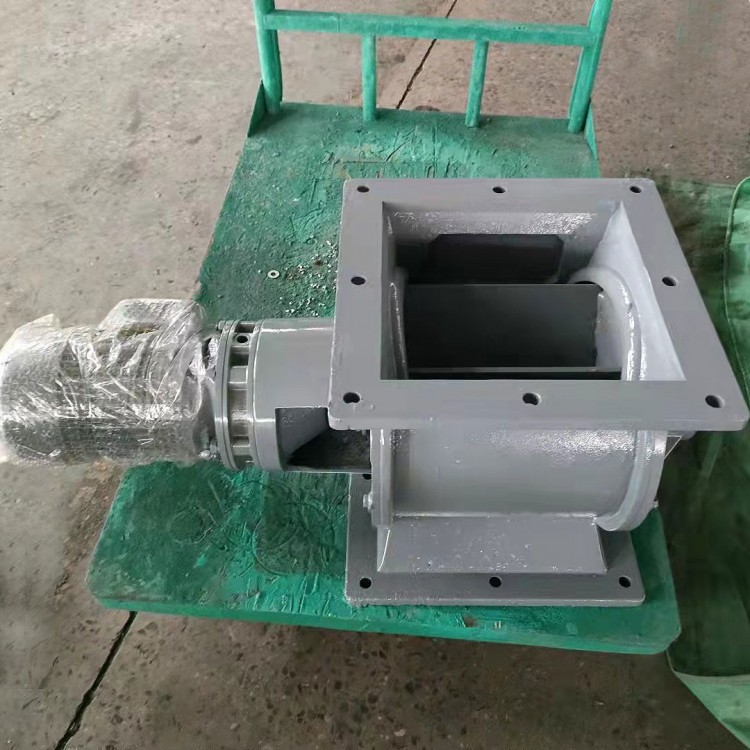

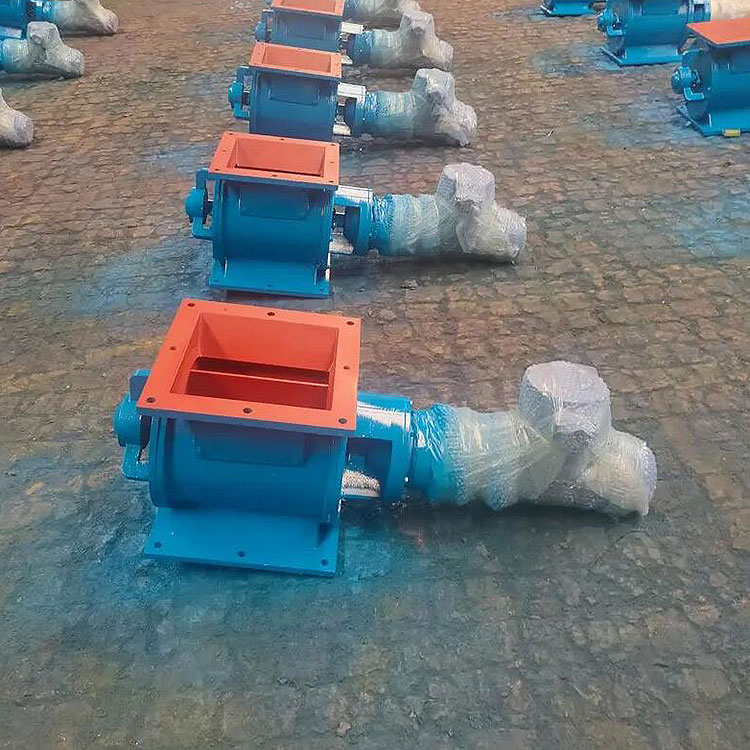
The rigid impeller feeder is designed for continuously and evenly feeding dry powdered or small granular materials from the upper storage bin to the next equipment. The rigid impeller feeders are widely used as feeding equipment in material conveying systems for industries such as cement, building materials, chemicals, metallurgy, and light industry. They can be customized with round flange openings and square flange openings.
A rigid impeller feeder is a quantitative feeding machine. This unit is equipped with a harmonic drive reducer, which directly connects to the main shaft with rigidity through the reducer's output shaft, thus rotating the main shaft and impeller. The impeller is fitted with several blades, each with a rubber sealing strip, which is clamped tightly by a pressure plate and adheres to the inner wall of the housing. As the motor rotates, the main shaft and impeller rotate simultaneously, and the material is fed into the impeller groove from the upper storage bin through the feeding opening. The rotating impeller carries the material to the discharge opening. The amount of powder fed by the impeller feeder is adjusted by changing the speed of the electromagnetic variable-speed asynchronous motor. The variable speed system is composed of a worm and worm gear set. When changing speeds, the worm gear set, via a scraper installed on the same main shaft, supplies the impeller and the measuring impeller with coal powder, which rotates 180° inside the feeding impeller housing to the gap, falls into the tooth slots of the measuring impeller. The measuring impeller then rotates another 180°, bringing the coal powder to the gap at the lower body, where it falls into the powder discharge pipe. This process achieves continuous and even feeding and prevents the coal powder from flowing out when the machine stops.
The rigid impeller feed machine, in addition to being characterized by even feeding, compact structure, and excellent sealing performance, also boasts the following features:
1. The feed at the higher ends during operation is less, thus resulting in lower wear and tear, and offering a significant energy-saving effect compared to general impeller feeders.
2. The bearings at both ends are extended outside the body, making it less prone to dust inside the bearings and thus avoiding unnecessary wear. We have replaced the old-style sliding bearings with rolling bearings for use.


