

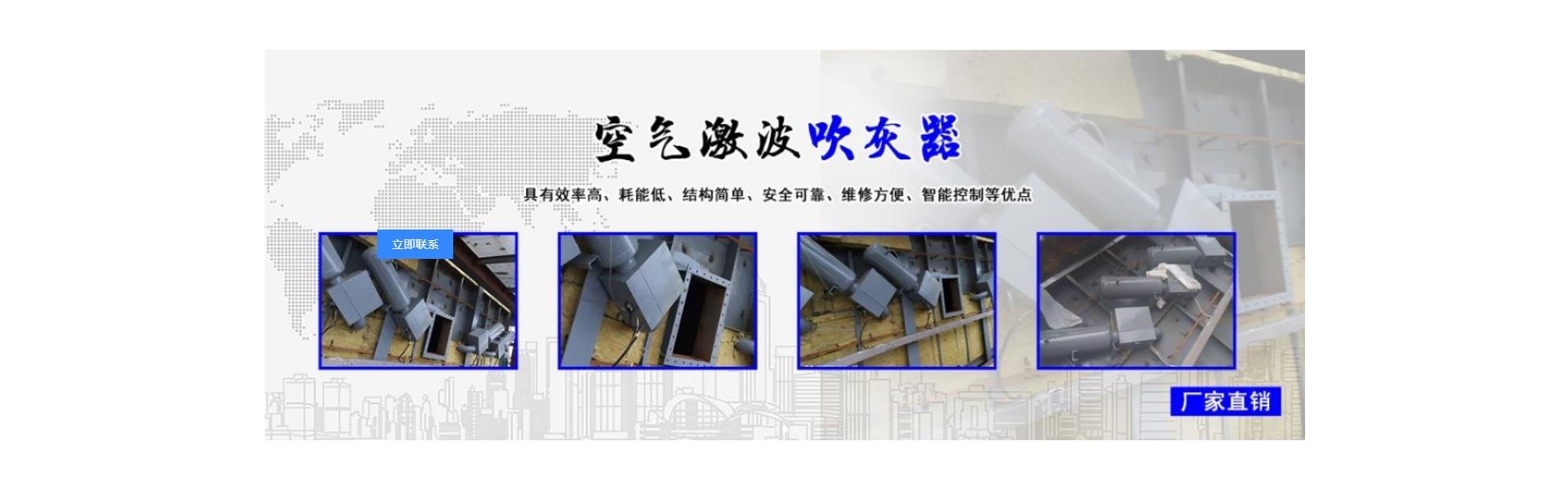

Do You Really Understand the Difference Between Ultrasonic and Steam Descaling Devices? In recent years, with the rapid development of the power industry, environmental protection issues have become increasingly concerning to everyone. Topics like "sustainable development," "energy conservation and emission reduction," and "air quality index" are frequently mentioned. The main forms of power generation currently include hydropower, wind power, solar power, and thermal power. The first three are relatively environmentally friendly forms of power generation. Here, let's share the descaling system equipment used in the tail flue of the scale unit boiler of a thermal power plant that uses coal as fuel. Currently, the descaling equipment installed in power plant boilers mainly includes ultrasonic descalers and steam descalers. The main difference between ultrasonic and steam descalers lies in their respective advantages and limitations under different operating conditions. Difference 1: Steam descalers are traditional descalers, widely used at present. Ultrasonic descalers utilize a sound wave generator to convert the energy carried by compressed air into high-intensity sound waves. These sound waves exert a high acceleration剥离 effect and vibration fatigue fracturing effect on the accumulated ash, causing it to loosen and detach from the catalyst surface, allowing flue gas or gravity to carry it away. Under the high-energy action of the sound waves, dust cannot accumulate on the heat exchange surface, effectively preventing the growth of ash. Due to the multi-directional propagation of sound waves and the high-speed periodic oscillation of air particles, the ash particles on the surface can be removed from the catalyst and remain in a suspended state, ready to be carried away by the flue gas flow. The mechanism of ultrasonic ash removal is "wave action," with the energy carrier of the descaler being "sound waves." This energy exchange between the sound field and the accumulated ash on the catalyst surface achieves the effect of removing slag. This method is suitable for the removal of loose ash but is ineffective for sticky ash, severe blockages, and hard ash deposits. After more than two decades of development and improvement, ultrasonic descaler technology has gradually matured. The main advantages of ultrasonic descalers are as follows: (1) Utilizes vibration and resonance between sound waves, ash particles, and accumulated ash, suitable for loose ash. (2) Simple and reliable, without rotating machinery, with a programmed operation and minimal maintenance. (3) Sound waves can reach locations that other descalers cannot, leaving no blind spots. (4) No damage or corrosion to the heat exchange tube walls, with low operating costs. Difference 2: Steam descalers, as a traditional descaling method, directly use high-temperature, high-pressure steam to sweep the heat exchange surface, which is effective for removing ash and slag from the heat exchange surface. It also works well on ash with strong slagging properties and low melting points. Its main advantages are as follows: (1) Can be installed at various parts of the boiler, allowing direct descaling of the furnace, horizontal smoke edges, and tail vertical shaft heat exchange surfaces. (2) Effective on ash with strong slagging properties, low melting points, and stickiness. (3) Steam is directly connected from the boiler and runs the descaling according to a set program. (4) Short-term descalers operate reliably, and long-term descalers are also relatively reliable. This is the complete content we have compiled about the differences between ultrasonic and steam descalers. We hope it helps those interested and that in future production and operation, considering the characteristics of the equipment and the working conditions, we can reduce equipment damage. Therefore, continuous learning and research on various descaling equipment are necessary.
News Center Co., Ltd.


