
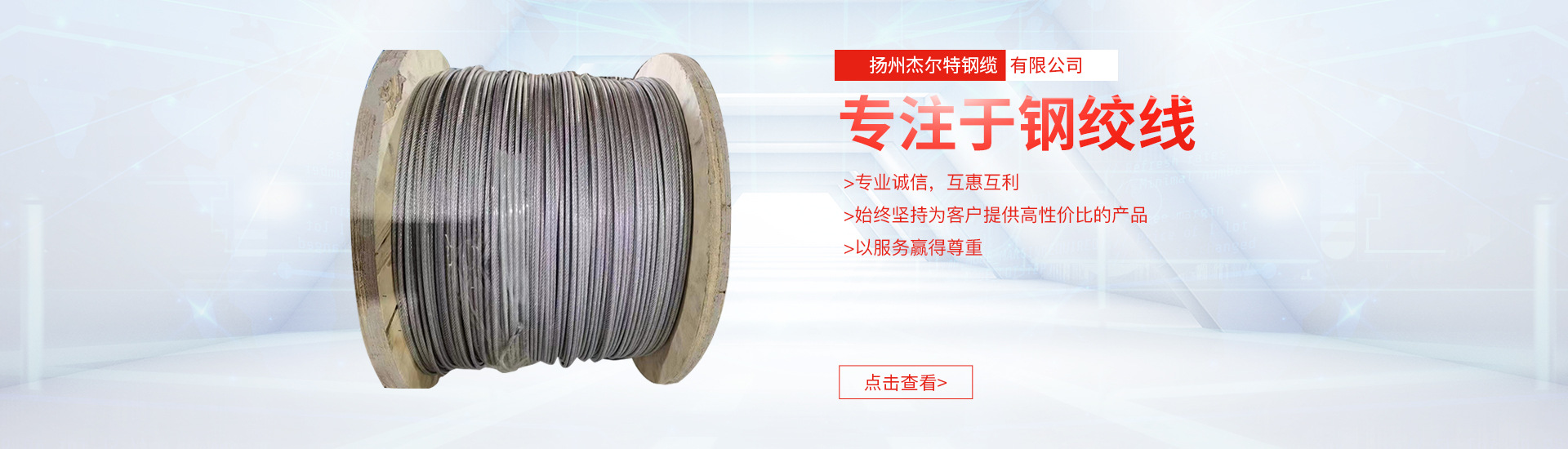

Wire ropeCharacterized by features such as identical cross-sections, high strength, great elasticity, good toughness, wear resistance, smooth high-speed operation, and the ability to withstand impact loads. Wire ropes typically exhibit signs of breaking, such as broken wires or strands, before failure, making them easy to inspect and conducive to preventing accidents. As a result, they are widely used in lifting operations, serving as the primary rope for hoisting, towing, and binding purposes.
Construction and Types of Wire Rope
Rope wires are twisted in three methods: single lay, double lay, and triple lay. Among them, double lay rope wires have more strands and greater flexibility, making them easy to wrap around sheaves and drums. Therefore, double lay rope wires are generally used in lifting operations.
Double twisted steel wire ropes are categorized based on the direction of lay, including concurrent lay, interlay, and hybrid lay. When the direction of twist of the steel wires in the rope is the same as that of the strands, it is called concurrent lay (right lay). Concurrent lay ropes are softer, with a smooth surface, and have a larger contact area with pulleys, resulting in lighter wear but a tendency to loosen and form twists. They are easy to rotate during lifting. Interlay (reverse lay) steel wire ropes have the direction of twist of the steel wires opposite to that of the strands. Interlay ropes are highly durable, with a reduced tendency to twist and curl, and are more commonly used in hoisting applications. Hybrid lay steel wire ropes have adjacent strands with opposite lay directions, meaning half are right lay and half are reverse lay. Hybrid lay ropes offer better performance but are more complicated to manufacture and costly, so they are rarely used in general situations.
Ropes are categorized by the number of strands and the number of wires per strand, such as 6 strands with 19 wires, 6 strands with 37 wires, and 6 strands with 61 wires. In the case of ropes with the same diameter, the more wires in the strand, the thinner the diameter of the wires, the softer the wire, and the greater the flexibility.
