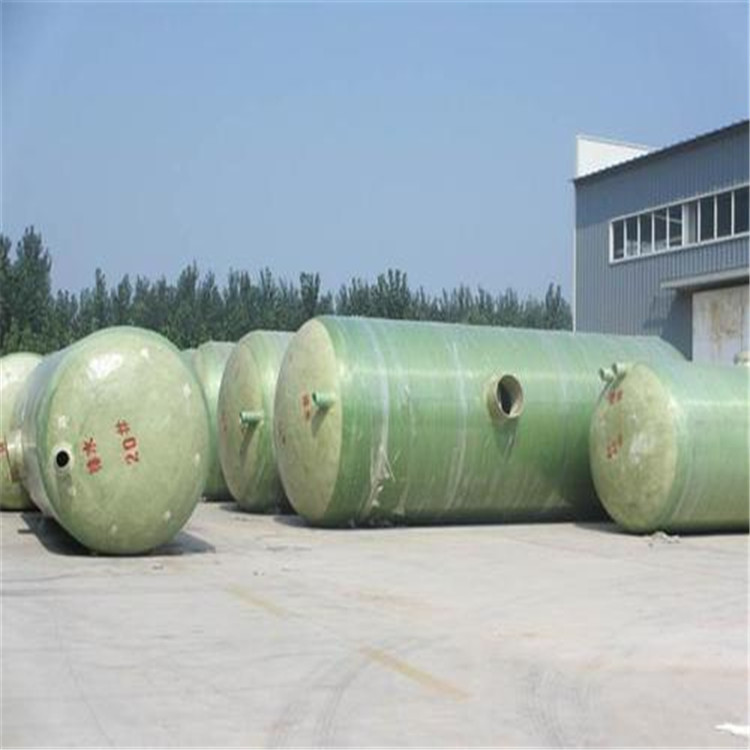


Tank Classification: Glass fiber reinforced plastic (FRP) tanks can be categorized into vertical tanks, horizontal tanks, FRP tanks, chemical storage tanks, corrosion-resistant tanks, hydrochloric acid tanks, sulfuric acid tanks, food tanks, fermentation tanks, transport storage tanks, storage tanks, adhesive tanks, chemical tanks, pressure tanks, soy sauce tanks, and nitric acid tanks, etc. Excellent Physical Properties of FRP Containers and Tanks: The density of FRP is typically 1.8-2.1, which is 1/4-1/5 of steel, yet its specific strength is higher than that of steel, cast iron, and plastic. The coefficient of thermal expansion of FRP is roughly equivalent to that of steel, with a thermal conductivity only 0.5% of steel. FRP Containers and Tanks Have Excellent Chemical Resistance and Long Service Life: FRP possesses unique corrosion resistance, demonstrating superior properties compared to other materials when storing corrosive media. It can withstand various acids, bases, salts, and organic solvents. Design Flexibility and Excellent Structural Performance of FRP Containers and Tanks: The fiber-wound FRP can alter the resin system or reinforcing materials to rapidly adjust the physical and chemical properties of FRP storage tanks and non-standard equipment to meet the needs of different media and working conditions. By adjusting the thickness of the structural layers, winding angles, and wall thickness structures and designs, the load-bearing capacity of the tank can be modified to produce tanks with different pressure ratings or specific performance requirements, which is unmatched by isotropic metallic materials. Characteristics of FRP: (1) Lightweight and High Strength: Relative density is between 1.5~2.0, only 1/4~1/5 of carbon steel, yet the tensile strength is close to, or even exceeds, carbon steel, with specific strength comparable to high-grade alloy steel. (2) Good Corrosion Resistance: FRP is an excellent corrosion-resistant material, offering good resistance to atmospheric, water, and general concentrations of acids, bases, salts, as well as various oils and solvents. It has been applied in all aspects of chemical corrosion protection and is replacing carbon steel, stainless steel, wood, non-ferrous metals, etc. (3) Good Electrical Properties: FRP is an excellent insulating material, used to manufacture insulators. It maintains good dielectric properties under high frequencies and has good microwave permeability, widely used in radar antenna covers. (5) Good Design Flexibility: ① Can be designed flexibly to meet various structural product requirements, ensuring good overall integrity. ② Can select materials to meet product performance, such as corrosion resistance, resistance to high temperatures, high strength in specific directions, good dielectric properties, etc. (6) Excellent Processability: ① Can flexibly choose molding processes based on product shape, technical requirements, usage, and quantity. ② Simple processes allow for one-time molding, with significant economic benefits, especially for complex shapes, difficult-to-mold products in small quantities. Application Range: Vertical FRP Tanks and Containers are suitable for: FRP containers are widely used in: chemical, petrochemical, papermaking, food, electronics, packaging, and transportation sectors. They can withstand corrosion from various acids, bases, salts, and organic solvents.