




- AllProduct Category
-
Ceramic Whirlwind Child
Wet Electricity and Ultra-Clean Emission
Dust, desulfurization, and denitrification integrated system
Water Film Dust Collector Series
Baghouse Series
De-NOx Series
Desulfurization Series
Bag Dust Collector Series


详情描述
Principle of SCR Denitrification
SCR (Selective Catalytic Reduction) technology involves injecting a reductant (ammonia) into an SCR reactor at temperatures ranging from 300 to 420°C, in the presence of a catalyst and oxygen, selectively reducing NOx in exhaust gases to form N2 and H2O to minimize NOx emissions.
The primary reactions are as follows: 4NO + 4NH3 + O2 = 4N2 + 6H2O; 4NH3 + 2NO2 + O2 = 3N2 + 6H2O
SCR Denitrification System Composition:
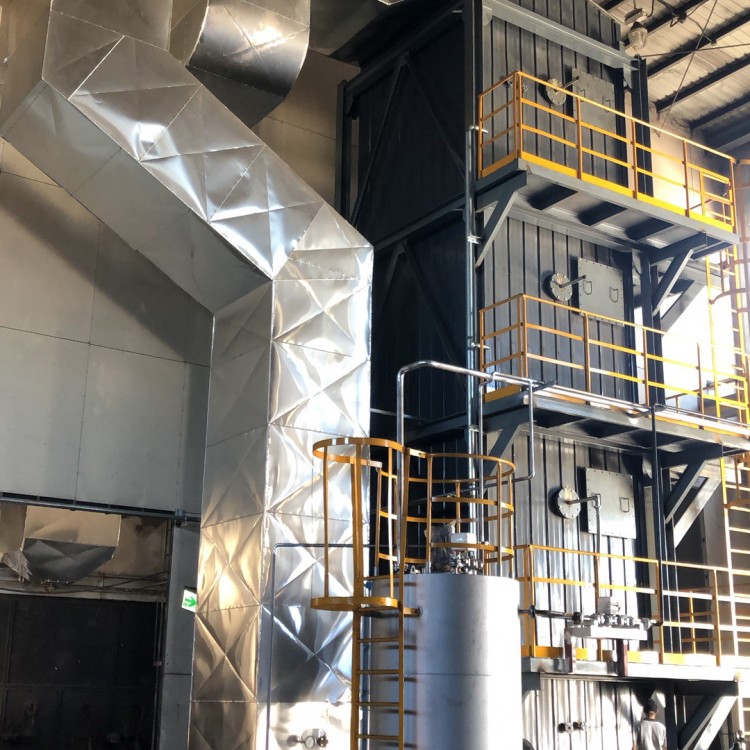
The SCR denitrification system primarily includes: reductant storage system, reductant conveying/measuring system, reactor and external framework structure, denitrification catalyst, ash blowing box and electrical control system, etc.
The SCR denitrification reactor takes full consideration of various boiler system characteristics, employing a unique layout that can stably remove ammonia oxides from flue gas. It significantly reduces the clogging, wear, and poisoning of catalysts caused by dust, thereby extending the lifespan of the catalysts and lowering operation costs. It is capable of supporting different types of catalysts, including new ones. These new catalysts are based on ultra-fine TiO2, with vanadium oxide as the active component and tungsten, molybdenum, and other oxides as additives. They feature high activity, high denitrification efficiency, strong resistance to poisoning, wear resistance, and a long service life. The typical SCR denitrification process flowchart is as follows:
Denitrification Catalyst:
The catalyst on the SCR denitrification system promotes the selective chemical reaction of the reductant with ammonia oxides in flue gas at a certain temperature during the SCR reaction. Currently, SCR catalysts are primarily based on TiO2, with V2O5 as the main active ingredient, and WO3 and MoO3 as auxiliary components for oxidation and toxicity resistance.


