




- AllProduct Category
-
Ceramic Whirlwind Child
Wet Electricity and Ultra-Clean Emission
Dust, desulfurization, and denitrification integrated system
Water Film Dust Collector Series
Baghouse Series
De-NOx Series
Desulfurization Series
Bag Dust Collector Series


详情描述
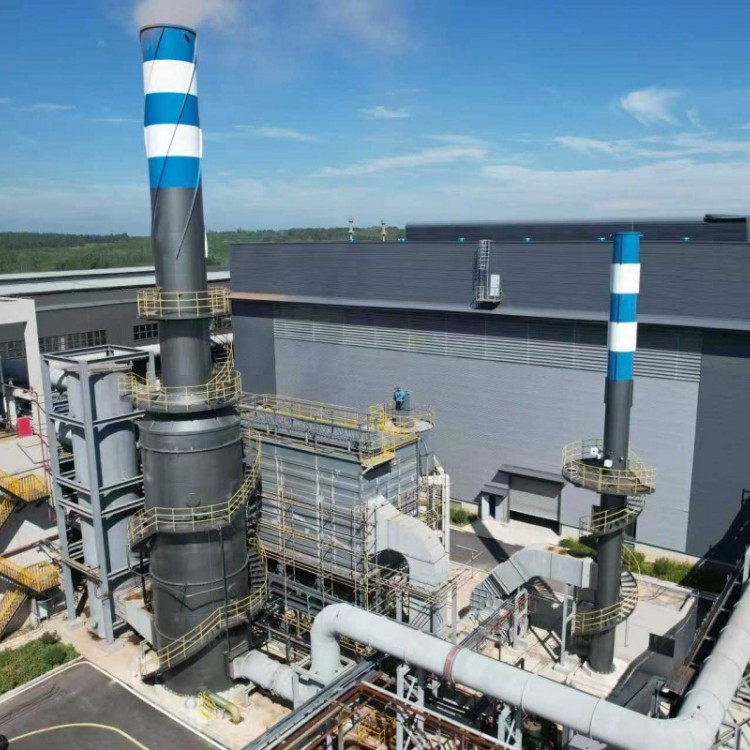
One, Desulfurization spray tower is a tower-type equipment for desulfurizing waste gas. Desulfurization towers are commonly constructed with granite and are widely used. By using different desulfurizing agents, they can achieve both dust removal and desulfurization. They are applicable for desulfurizing flue gas from coal-fired industrial boilers and kilns. In the desulfurization tower, flue gas containing SO2 should undergo chemical absorption of SO2. To enhance the absorption process, improve desulfurization efficiency, and reduce equipment investment and operating costs.
Section 2: Desulfurization Spray Tower Structure
Desulfurization spray towers are particularly crucial for internal corrosion prevention, as they determine the equipment's stability and service life. The interior can be lined with flake resin. Our company's desulfurization spray towers are equipped with heavy-duty corrosion-resistant structures: After internal shot blasting and rust removal, glass fiber reinforced plastic is used for lining, and after curing, it is lined with epoxy ethylene mortar and granite, which boasts high corrosion resistance, temperature resistance, wear resistance, and bonding performance.
The desulfurization tower employs a spray tower with an internal FRP (fiberglass reinforced plastic) trunk-type spray distributor for the spray atomization layer, ensuring a wide coverage of the spray in the tower. This design enhances the contact between flue gas and slurry with no blind spots, thereby promoting the absorption of alkali into sulfides.
The top features a two-layer baffle demister to effectively dehydrate and demist flue gas after desulfurization. The purified flue gas is then discharged into the atmosphere through the chimney. The demister is equipped with a regular backwashing system to prevent crystallization and dust accumulation on the demister plates. The backwashing utilizes factory process water (or tap water) and can be set to flush at specific intervals.
Desulfurization spray tower manufacturing, adaptable to local conditions, can be customized according to customer requirements. Available for full factory shipment or modularized shipment. III. Features of the desulfurization spray tower:
(1) There is a considerable contact area and a certain contact time between the gas waves.
(2) Strong disturbance between gas waves, low absorption resistance, and high efficiency in absorbing SO2.
(3) Operation stable with appropriate operational flexibility;
(4) Low pressure drop when air flow passes through.
(5) Simple structure, easy to manufacture and maintain, low cost, and long service life.
(6) Non-scaling, non-blocking, wear-resistant, and corrosion-resistant.
(7) Excellent temperature and wear resistance.
Section 4: Sodium Carbonate Desulfurization Process
The sodium alkali method uses a solution of Na2CO3 or NaOH as the absorbent to remove and purify SO2 and some dust from flue gas. The treated wastewater is then flowed into a circulating pool for sedimentation, sulfur removal agent is added, and it is sent back to the absorption tower for recirculation.
Process Principle:
1. Absorption Reaction
-→s02 (Bo) s02 Soluble s02 (Gas)
s02(l) + H2O === HSO3- + H+
hso3-===h++so32-
2na0h+s02===na2s03+h20
na2c03+s02===na2s03+c02
na2s03+s02+h20===2nahso3
During this process, as sodium alkali is used as the absorbent, no precipitate will be produced in the absorption system. The main side reaction in this process is an oxidation reaction, resulting in the formation of Na2SO4.
2nahs03+02===2na2s04


