


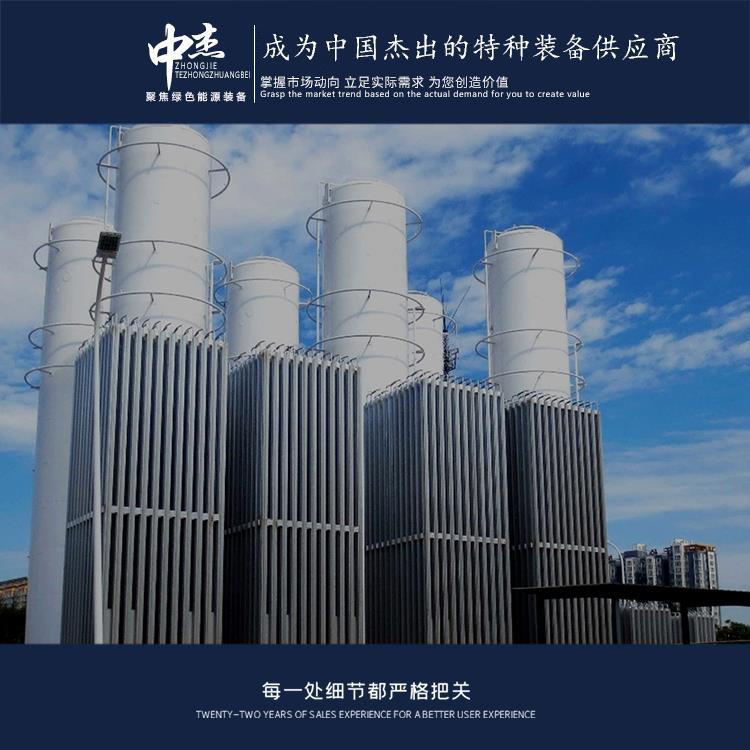
Shandong Zhongjie Special Equipment (formerly Heze Boiler Factory Co., Ltd.) holds an A-grade boiler manufacturing license, an A2-grade pressure vessel manufacturing license, an A2-grade pressure vessel design license, a B-grade boiler installation license, and GB2/Class, GC2/Class pressure pipeline installation licenses, as well as a mechanical and electrical equipment installation contracting qualification. It is a member of the China Boiler and Water Treatment Association, the China Chemical Equipment Association, and the council member of the Shandong Equipment Manufacturing Association. The company has also passed the ISO9001 Quality Management System, ISO14001 Environmental Management System, OHSAS18001 Occupational Health and Safety Management System certifications, and the American ASME/U2 certification.
Liquid oxygen storage tanks have the following characteristics:
High Purity: The liquid oxygen storage tank contains high-purity liquid oxygen, typically exceeding 99.5% purity. This makes the liquid oxygen storage tank essential for applications requiring high-purity oxygen, such as medical, industrial, and research fields.
Low Temperature: As the boiling point of liquid oxygen is -183°C, liquid oxygen storage tanks must have excellent insulation properties to maintain the low temperature of the liquid oxygen. Tanks are typically designed with double or multi-layer structures, filled with insulating material in between to minimize heat transfer and evaporation of the liquid oxygen.
High Pressure: Liquid oxygen tanks typically need to withstand high pressure to maintain their liquid state. The design and material selection of the tank must consider the pressure requirements of liquid oxygen to ensure the tank's safety and reliability.
Flammability: Liquid oxygen is highly flammable and can support combustion. Therefore, during the design and use of liquid oxygen storage tanks, fire prevention measures must be implemented to ensure there are no ignition sources around the tank and appropriate fire extinguishing equipment is provided.
High Density: Liquid oxygen has a higher density than gaseous oxygen, allowing liquid oxygen tanks to store more oxygen. This gives liquid oxygen tanks an advantage in applications requiring large amounts of oxygen supply, such as in the field of and .
Corrosiveness: Liquid oxygen has certain
Prior to cooling the liquid oxygen tank, the following prerequisites must be met:
Clean Vessels: Ensure the interior of the tank is clean, free of impurities and contaminants. The tank should be properly cleaned and flushed to maintain its cleanliness.
Drainage and Exhaust: Empty the gas from the storage tank and expel it through the exhaust system to reduce the gas content within the tank. This helps minimize the interference of gas on the cooling process.
Safety Precautions: Prior to cooling the liquid oxygen tank, necessary safety precautions must be taken. Liquid oxygen is highly flammable and has low-temperature characteristics. Operators should wear appropriate protective suits, gloves, and other personal protective equipment to ensure safe operation.
Temperature Control: During the cooling process of the liquid oxygen storage tank, the tank temperature must be regulated. Typically, low-temperature mediums such as liquid nitrogen are used to cool the tank, ensuring the tank temperature gradually decreases below the boiling point of liquid oxygen.
Insulation and Heat Retention: Liquid oxygen tanks typically feature double or multi-layer construction, filled with insulating material in the middle to minimize heat transfer and evaporation of the liquid oxygen. Ensure the integrity and good insulation of the insulating layer to enhance the cooling efficiency of the tank.
Under the above preliminary conditions, cooling operations for liquid oxygen tanks can be performed. The cooling process must strictly adhere to relevant safety regulations and operating guidelines to ensure the safe operation and use of the tanks.
The filling of a low-temperature liquid nitrogen tank refers to the process of transferring liquid nitrogen from an external supply source into the tank. Below is an explanation of the filling process for low-temperature liquid nitrogen tanks:
Preparation: Prior to filling the liquid nitrogen tank, thorough preparation is required. This includes inspecting the tank's condition and safety to ensure it's clean, free of impurities and contaminants. Additionally, verify the quality of the liquid nitrogen from the supply source and the safety of the supply pipeline.
Connect supply source: Link the liquid nitrogen supply source to the liquid outlet of the storage tank. Ensure the connection is securely fastened to prevent leaks.
Control Liquid Level: During the bottling process, it is necessary to control the liquid nitrogen level to prevent overfilling or spillage. A liquid level gauge or a liquid level control system can be used to monitor and control the level.
Slow Injection: The injection of liquid nitrogen should be done slowly to prevent rapid vaporization and increased pressure. Appropriate valves and flow control devices can be used to regulate the injection rate.
Monitor Pressure: During the canning process, it's essential to monitor the pressure of the storage tank to ensure it remains within a safe range. Pressure gauges or pressure sensors can be used for monitoring.
Canning completed: Stop injecting liquid nitrogen when the level reaches the predetermined filling amount or the tank's capacity limit. Disconnect the connection with the supply source and ensure the sealing of the filling port.
Safe Operation: Throughout the canning process, relevant safety regulations and operational guidelines must be followed. Liquid nitrogen is highly flammable and extremely cold, so operators should wear appropriate personal protective equipment and ensure the operating environment is free of any ignition sources.
When bottling liquid nitrogen, be mindful of its low-temperature characteristics and safety. Ensure safe operation and control during the bottling process to guarantee the safe operation of the storage tank and the effective storage of liquid nitrogen.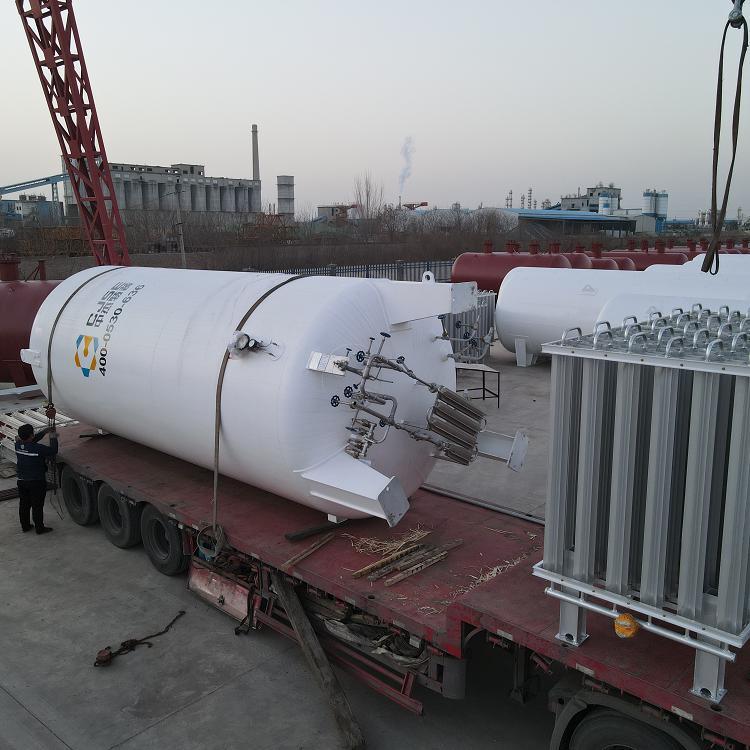
To maintain the stability of liquid argon tanks, the following details should be noted:
Basic Design: The foundation design of the storage tank must comply with relevant standards and regulations to ensure stability and load-bearing capacity. The foundation should be sufficiently robust and seismic-resistant to withstand external forces and natural disasters such as earthquakes.
Foundation Construction: During the foundation construction process, ensure the foundation is level and even, avoiding any tilting or uneven settlement. Additionally, the concrete pouring of the foundation should comply with construction specifications, guaranteeing the quality and strength of the concrete.
Installation Process: During the storage tank installation, appropriate lifting equipment and safety measures must be employed to ensure the vertical installation and stability of the tank. Avoid severe vibrations and impacts during the installation process to prevent damage or deformation to the tank.
Support Structure: The support structure of the tank should be designed reasonably to ensure the stability and load-bearing capacity of the tank. The structure should be made of sturdy materials and utilize appropriate connection methods to withstand external forces and the pressure from the liquid inside the tank.
Safety Devices: Tanks should be equipped with safety devices such as pressure relief valves and level alarms to ensure timely action can be taken in abnormal situations, safeguarding the tank's safety.
Regular Inspections and Maintenance: Conduct regular inspections and maintenance on liquid argon tanks, including visual inspections, pressure tests, leak detection, and as needed, non-destructive testing and material analysis. Promptly identify and address any issues with the tanks to ensure their stability and safety.
Note that the installation of liquid argon tanks should be carried out by experienced personnel and in accordance with relevant safety operating procedures and standards. During installation, strictly follow the manufacturer's installation guidelines and requirements to ensure the tank's stability and safety.
Our company attaches great importance to technological innovation and research and development, boasting one municipal-level enterprise technology center in Heze City. We have established testing facilities for non-destructive testing, physical and chemical testing, welding testing, hydrostatic testing, etc., and are equipped with over 600 types of instruments and equipment, including CNC machine tools, X-ray flaw detectors, digital ultrasonic flaw detectors, mechanical property testing machines, chemical analyzers, spectrometers, tensile testing machines, plasma welding machines, and more. The key products and technologies we have developed, such as welding for temperature and pressure vessels, emission reduction of biomass boilers, and waste heat utilization, have successively been selected for multiple Shandong Provincial Department of Industry and Information Technology science and technology innovation projects, Shandong Provincial key projects, and Heze City innovation and excellence projects. We have cumulatively obtained 27 authorized utility model patents, 16 authorized invention patents, participated in drafting 2 standards, 2 industry standards, and registered 15 trademarks. Our technical team, in collaboration with Professor Yajiang Li from Shandong University, has jointly developed deep cryogenic container processing technology using the internationally recognized plasma arc + filler wire tungsten inert gas arc welding (PAW-GTAW) technology. After provincial-level scientific and technological achievement assessment, the technology level has reached international standards in the field of deep cryogenic container manufacturing. Choose Zhongjie Special Equipment, let's create brilliance together!
Heilongjiang 5 cubic meter argon storage tank, various models available
