


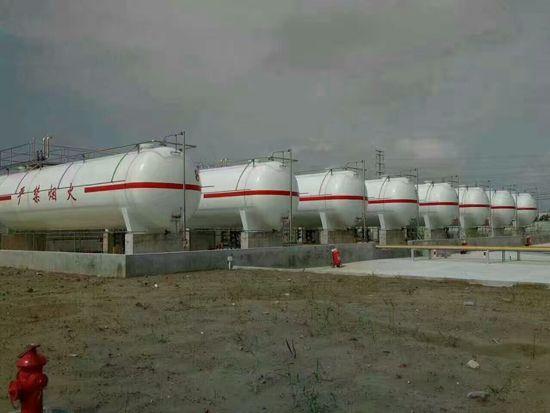


Product Description
Brand Hegu Group Model CFW-60/0.8
Material: Stainless Steel, Diameter: 2916mm
Application Range: -162℃; Volume: 60,000L
Heat Exchange Area - See drawing sq. m, Ambient Temperature - See drawing °C
Wall Thickness: 8mm; Outer Dimensions: φ2916*14929mm
Origin: Shandong Heze

LNG Storage Tank, Low Temperature Natural Gas Storage Tank, 60 Cubic Meter LNG Storage Tank, Imported Paint from the USA, High Vacuum Degree
1. Preparatory Work
Tanks should undergo a leak test, blow-down treatment, and valve and instrumentation inspection prior to being put into use.
1.1 Airtightness Test
The tank should undergo a system airtightness test after installation is complete or the inner cylinder returns to normal temperature, prior to filling with low-temperature liquid. The test pressure should be the tank's maximum working pressure, using oil-free dry air or dry nitrogen. The test duration is determined by the tank size but must not be less than 4 hours.
1.2 Blowing Treatment
After the airtightness test is passed, the inner tank system must be purged with oil-free dry air or dry nitrogen to remove moisture. After purging with dry air or nitrogen, the product gas should also be used for purging. During the purging, gases lighter than air are added from the top of the tank through the vent valve, and the bottom is vented through the liquid inlet and outlet valves. To accelerate the removal of moisture inside the tank, the purge gas can be heated to 80-100°C. Each pipe and valve should be purged individually, especially the level gauge and pressure gauge, which should vent gas from the joints to remove moisture from the pipes. This should continue until the dew point of the gas expelled from the inner tank system meets the requirements before liquid filling can begin.
1.3 Valve and Instrument Inspection
Before filling with low-temperature liquid, it is essential to carefully check that the valves are in the correct position, that the gauges are responsive and reliable, and that the liquid level gauge connections are clear and unobstructed.
2. Filling: Divided into initial filling and top-up filling.
2.1 Initial Refilling (referring to refilling while the inner cylinder is in a heated state). The steps are as follows:
2.1.1 Connect the filling pipeline.
2.1.2 Perform blow-out on the filling pipeline (this should be done before each filling), and before the upper liquid inlet and outlet valves are opened, place a small amount of liquid into the output pipeline from the liquid source valve. Simultaneously, open the pipeline residual liquid drain valve to clean the pipeline, removing moisture and dust impurities within.
2.1.3 Open the internal pipe vent valve and pressure gauge valve, and simultaneously start the level gauge.
2.1.4 Open the upper liquid inlet valve, allowing liquid to enter from the top. Since the inner cylinder is in a hot state, the upper liquid inlet valve should be partially open to allow the pipeline and inner cylinder to cool slowly to the temperature of the liquid being filled. Once the inner cylinder's exhaust valve stabilizes, you can open the upper liquid inlet valve wider and increase the filling speed.
2.1.5 When the liquid level gauge indicates a liquid level, open the liquid inlet and outlet valves, and close the upper liquid inlet valve to switch from upper to lower liquid inlet.
2.1.6 When the indicator valve (already opened) is filled with liquid and releases it, it indicates that the storage tank is full. Immediately close the liquid inlet and outlet valves, stop the filling process, and open the pipeline residual liquid discharge valve to expel any remaining liquid and gas in the filling pipeline.
2.1.7 Remove the filling pipeline upon completion of filling.
2.2. Replenishment of coolant (referring to the inner cylinder already containing low-temperature liquid, no longer requiring cooling of the inner cylinder)
2.2.1 Similar to the initial filling, the difference is that the filling volume can be increased from the start, and close attention must be paid to pressure changes during the filling process. If liquid is directly introduced through the liquid进出口 valves, when the pressure rises significantly, to reduce the pressure, switch from bottom (lower) filling to top (upper) filling.
2.2.2 Additionally, from a pressure perspective, it can be categorized into atmospheric filling and pressurized filling.
2.2.3 During the atmospheric filling process, the inner cylinder's exhaust valve remains open, allowing the inner cylinder to be in communication with the atmosphere, hence the term "atmospheric filling."
In pressurized filling, the vent valve is closed, and the pressure inside the tank is higher than atmospheric pressure, hence the term "pressurized filling." However, the working pressure of the storage tank should be greater than 2 Kg/cm2. Whether under standard atmospheric pressure or engineering atmospheric pressure, 1 Kg/cm2 = 98,100 Pa = 0.0981 MPa.
3. Boost Pressure
When transferring the liquid in the tank to other storage tanks or for vaporization, it is necessary to increase the internal cylinder pressure. The extent of the pressure increase should be determined based on the actual usage requirements of the user, but it must not exceed the maximum working pressure of the tank.
Its boost program is:
3.1 Check if the pressure gauge and level gauge are in working condition.
3.2 Ensure the gas valve is fully open.
3.3 Open the turbocharger's inlet valve (boost valve) slowly to allow the liquid to vaporize in the turbocharger. If the draining speed is rapid, the inner cylinder pressure drops quickly; in this case, open the boost valve wider. Once the pressure reaches the desired working pressure, partially or fully close the turbocharger's inlet valve. At this point, the liquid inside the turbocharger will continue to evaporate until the required pressure is reached. During the boosting process, closely monitor the pressure gauge for any changes in readings.
4. Liquid Discharge
There are three forms of liquid discharge.
4.1. Carburetor Drain
Once the pressure inside the tank reaches the required level, the drain valve can be opened to supply liquid to the evaporator, causing it to heat up and evaporate for use at the site. This is the primary drain method for tanks equipped with an evaporator.
4.2 Liquid drainage via进出口 valves
This draining process involves supplying liquid to tank trucks or larger storage tanks through输液软管 (infusion hoses), following a procedure similar to filling, with the only difference being that the liquid in and out valves switch from intake to discharge.
4.3 Drainage valve (also known as a liquid drainage valve) or draining directly through a Dewar tube
This type of drainage supplies liquid to portable small containers like Dewar flasks. Connect the metal hose from the small container to the drainage valve (or through a Dewar tube), open the liquid outlet valve, and the liquid will be supplied. This drainage amount is small, and for fixed storage tanks, it may not require pressurization based on specific conditions, allowing for liquid supply externally.
5. Storage
Liquid storage includes two methods: atmospheric storage and pressurized storage.
5.1 At atmospheric pressure storage
During atmospheric storage, the vent valve on the inner cylinder is always open, allowing gases to evaporate naturally and escape through this valve into the atmosphere, preventing the tank's pressure from rising. Since the natural evaporation is minimal, the vent valve only needs to be slightly open. (The opening should be adjusted to maintain constant internal pressure.)
5.2 Pressurized Storage
During the pressurized storage process, the vent valve is closed. However, the gas vapor left from natural evaporation remains inside the tank, causing the internal pressure to gradually increase. At this point, the pressure gauge indicates the pressure. When the internal pressure reaches the working pressure, the vent valve should be immediately opened to relieve the pressure.
6. Issues with simultaneous filling and draining of fluid
Many situations require a continuous supply of gas, which is met when there are two or more tanks. However, for a single storage tank, whether the gas supply can be continuous hinges on whether simultaneous filling and emptying can be achieved. Generally, for filling liquid into a fixed storage tank using tank trucks, simultaneous filling and emptying should meet the following conditions:
6.1 The working pressure of fixed storage tanks should be above 0.02 Mpa.
6.2 During the process of filling liquid, the upper liquid intake valve and the liquid inlet and outlet valves should be frequently adjusted, as filling from the top can decrease the pressure inside the tank, while filling from the bottom can increase the pressure.
6.3 When filling and draining simultaneously, if the liquid is being introduced from the bottom and the pressure requirements are still not met, you can open and adjust the size of the pressure booster valve to maintain stable pressure within the tank.
7. Maintain
7.1 Do not tamper with the outer cylinder explosion-proof device and vacuum valve; otherwise, it will destroy the vacuum degree of the storage tank.
7.2 The shell is an external pressure vessel subjected to atmospheric pressure.碰撞 is strictly prohibited to prevent damage to the shell, which may affect the vacuum degree.
The vacuum level of the storage tank should be checked every six months. To measure, simply unscrew the protective cap on the metal thermocouple and insert the plug of the thermocouple vacuum gauge, then you can determine the true vacuum level of the sandwich.
7.3 After several years of use, the vacuum level in the storage tank may drop below 66.66 Pa, at which point a re-vacuuming is necessary.

LNG Tank, Low-Temperature Natural Gas Tank, 60 Cubic Meter LNG Tank, Imported Paint from the USA, High Vacuum Level
Product Description
Brand Hegu Group Model CFW-60/0.8
Material: Stainless Steel, Diameter: 2916mm
Application Range: Down to -162°C, Volume: 60,000L
Heat Exchange Area - See drawing m², Ambient Temperature - See drawing °C
Wall Thickness: 8mm, Outer Dimensions: φ2916*14929mm
Origin: Shandong Heze

60-cubic-meter LNG Storage Tank, Horizontal LNG Storage Tank, Professional Manufacturer of Liquefied Natural Gas Storage Tanks
LNG tanks are atmospheric pressure, low-temperature, large-capacity storage containers, typically with a flat bottom and double-walled cylindrical shape. The inner cylinder is usually made of 9% nickel alloy steel, but can also be all-aluminum, stainless steel foil, or pre-stressed concrete. The outer wall is made of carbon steel or pre-stressed concrete. The suspended insulating support platform at the top of the wall is aluminum, while the tank roof is constructed from carbon steel or concrete. The main insulating materials inside the LNG tank include expanded perlite, elastic glass fiber felt, and foam glass bricks.
LNG Storage Tank Specifications
Low-temperature resistant
The boiling point of liquefied natural gas (LNG) at atmospheric pressure is -162°C. Consequently, LNG storage tanks must possess excellent low-temperature resistance and superior insulation properties.
(2) High safety requirements
Due to the storage of low-temperature liquids inside the tank, in the event of an accident, the refrigerated liquid would evaporate in large quantities, with the vaporization amount being approximately 625 times the original refrigerated state, forming an explosive mixture in the atmosphere. Therefore, it is required that the tank be constructed with a double-walled structure, utilizing the sealing principle. In the event of a leak in the first layer of the tank, the second layer can completely seal off the leaking liquid and evaporating gas, ensuring storage safety.
(3) Special materials.
The inner tank must be able to withstand low temperatures and is made of austenitic stainless steel, while the outer cylinder is constructed from Q345R ordinary low-carbon alloy steel plate.
(4) Strict thermal insulation measures.
Due to the temperature difference between the inside and outside of the container reaching up to 200℃, to maintain the internal temperature at -160℃, the container must have excellent insulation properties, filled with high-performance insulation material between the inner and outer shells. The insulation material at the bottom must also have sufficient pressure-bearing capacity. (5) Good seismic performance
The seismic requirements for general buildings are to crack but not collapse under specified earthquake loads. To ensure the safety of storage tanks under unexpected loads, they must possess excellent seismic performance. It is essential to ensure that the tank does not sustain damage under the given seismic intensity. (6) Strict construction requirements
Tanks' weld seams must undergo 100% magnetic particle inspection (MT) and 100% vacuum tightness test (VBT). Strict selection of insulation materials is required, and the specified procedures must be followed during construction.
Heze Boiler Factory Co., Ltd. is a key enterprise designated by the General Administration of Quality Supervision, Inspection and Quarantine of the People's Republic of China for the production of boiler pressure vessels. It is an affiliate unit of the China Industrial Boiler Industry Association and a member of the China Heating, Ventilation, Air Conditioning, and Drainage Industry Association. The company holds B-grade boiler manufacturing qualifications (Cert. No. TS2110587-2011), Class III pressure vessel manufacturing and design qualifications (Cert. No. TS2210916-2013), and has passed the ISO9001 international quality management system certification.
Huzhou Boiler Factory Co., Ltd. Main Products:
Chemical Storage Tanks (liquefied gas tanks, LPG tanks, liquid ammonia tanks, propane tanks, propylene tanks, isobutane tanks, methyl chloride tanks, etc.); Non-standard Pressure Vessels (towers, heat exchangers, autoclaves, reaction vessels, stainless steel containers, etc.)
Cooling Auxiliary Equipment (evaporative coolers, ammonia storage tanks, drain drums, circulating drums, oil separators, separators, condensers, intermediate coolers, siphon tanks, economizers, etc.)
Boiler equipment (steam boilers, hot water boilers, thermal oil boilers, fuel gas boilers, waste heat boilers, etc.)
Low-temperature Storage Tanks (Liquid Oxygen Storage Tanks, Liquid Oxygen Storage Vats, Liquid Nitrogen Storage Tanks, Liquid Nitrogen Storage Vats, Liquid Argon Storage Tanks, Carbon Dioxide Storage Tanks, LNG Storage Tanks, Liquefied Natural Gas Storage Tanks)

60-cubic-meter LNG Storage Tank, Horizontal LNG Storage Tank, Professional Manufacturer of Liquefied Natural Gas Storage Tanks


液化天然气储罐制造商-专业制造液化天然气储罐销售价格-销售液化天然气储罐制作-液化天然气储罐价格 品牌:菏锅-液化天然气储罐厂家
