


Product Description
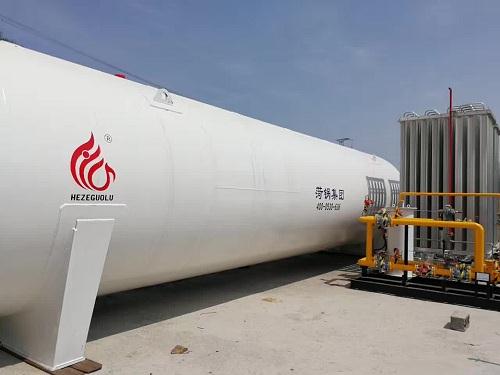
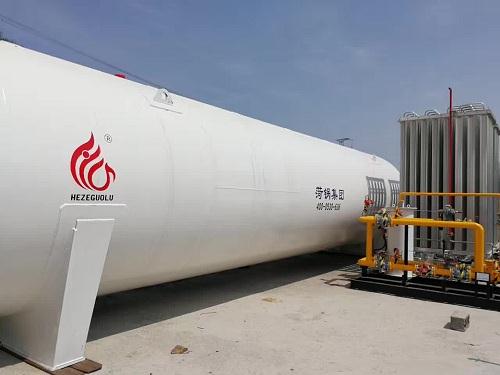
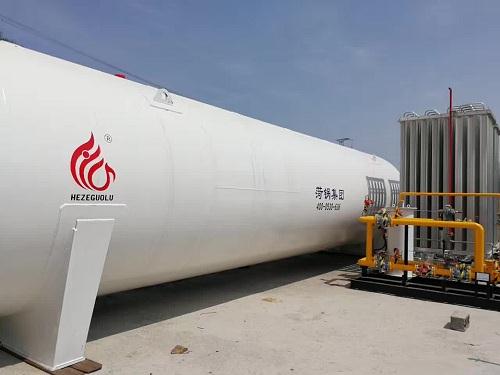
Brand Hekou Group Model CFW-60/0.8
Material: Stainless Steel, Diameter: 2916mm
Application Range: Down to -162°C, Volume: 60,000L
Heat Exchange Area - See drawing m², Ambient Temperature - See drawing °C
Wall Thickness: 8mm, Outer Dimensions: φ2916*14929mm
Origin: Shandong Heze

60-cubic-meter LNG Tank, Horizontal LNG Storage Tank, Professional Manufacturer of Liquefied Natural Gas Storage Tanks
LNG tanks are atmospheric pressure, low-temperature, large-capacity storage containers, typically featuring flat-bottomed, double-walled cylindrical design. The inner cylinder is usually made of 9% nickel alloy steel, but can also be made of all aluminum, stainless steel film, or pre-stressed concrete. The outer wall is made of carbon steel or pre-stressed concrete. The suspended insulating support platform at the top of the wall is aluminum, while the tank roof is constructed from carbon steel or concrete. The main insulating material inside the LNG tank includes expanded perlite, elastic glass fiber felt, and foam glass bricks.
LNG Tank Characteristics Requirements
Low-temperature resistance
The boiling point of liquefied natural gas at atmospheric pressure is -162°C. Therefore, LNG tanks require excellent low-temperature resistance and insulation properties.
(2) High safety requirements
Due to the storage of low-temperature liquids inside the tank, in the event of an accident, the refrigerated liquid would volatilize in large quantities, with the vaporization amount being approximately 625 times that of the refrigerated state, forming an explosive mixture in the atmosphere. Therefore, it is required that the tank be constructed with a double-walled structure and utilize the containment concept. In the event of a leak in the first layer of the tank, the second layer can completely contain the leaked liquid and the evaporated gas, ensuring storage safety.
(3) Special materials.
The inner cylinder must be capable of withstanding low temperatures and is made of austenitic stainless steel, while the outer casing is constructed from Q345R ordinary low-carbon alloy steel plate.
(4) Strict thermal insulation measures.
Due to the maximum temperature difference between inside and outside the drum of up to 200°C, the drum must have excellent insulation properties to maintain an internal temperature of -160°C. High-performance insulation material should be filled between the inner and outer drums. The insulation material at the drum bottom must also have sufficient pressure-bearing capacity. (5) Good seismic performance
General building seismic requirements are to crack but not collapse under specified seismic loads. To ensure the safety of the storage tank under accidental loads, the tank must have excellent seismic performance. Ensure that the tank does not suffer damage under the given seismic intensity. (6) Strict construction requirements
Tanks' weld seams must undergo 100% magnetic particle inspection (MT) and 100% vacuum leak detection (VBT). Strict selection of insulation materials is required, and the specified procedures must be followed during construction.
Huzhou Boiler Factory Co., Ltd. is a key enterprise designated by the China National Quality Supervision, Inspection and Quarantine Administration for the production of boiler pressure vessels, a vice-president unit of the China Industrial Boiler Industry Association, a member unit of the China Association of Heating, Ventilation and Drainage, and holds B-grade boiler manufacturing (certification number TS2110587-2011), Class III pressure vessel manufacturing (certification number TS2210916-2013) and design qualifications (certification number TS1237085-2011), and has passed the ISO9001 international quality management system certification.
Heze Boiler Factory Co., Ltd. Main Products:
Chemical Storage Tanks (liquefied gas tanks, LPG tanks, liquid ammonia tanks, propane tanks, propylene tanks, isobutane tanks, methyl chloride tanks, etc.); Non-standard Pressure Vessels (towers, heat exchangers, autoclaves, reaction vessels, stainless steel containers, etc.)
Cooling auxiliary equipment (evaporative coolers, ammonia storage tanks, drain drums, circulation drums, oil separators, separators, condensers, intermediate coolers, siphon tanks, economizers, etc.).
Boiler equipment (including steam boilers, hot water boilers, thermal oil boilers, fuel gas boilers, waste heat boilers, etc.)
Low-Temperature Storage Tanks (Liquid Oxygen Tanks, Liquid Oxygen Vessels, Liquid Nitrogen Tanks, Liquid Nitrogen Vessels, Liquid Argon Tanks, Carbon Dioxide Tanks, LNG Tanks, Liquefied Natural Gas Tanks)

60-cubic-meter LNG Tank, Horizontal LNG Storage Tank, Manufacturer's Professional Supply of 60-cubic-meter LNG Storage Tank
Product Description
Brand Hegu Group Model CFW-30/0.8
Material: Stainless Steel, Diameter: 2916mm
Application Range -162℃ Volume 30000L
Heat Exchange Area - See drawing m², Ambient Temperature - See drawing °C
Wall Thickness: 8/10mm, Dimensions: 2916*8289mm
Origin: Shandong Heze
30立方立式lng储罐 卧式LNG储罐 低温天然气储罐厂家
The low-temperature storage tank is a double-walled structure, with the inner shell storing low-temperature liquids and withstanding the pressure and low temperatures of the medium. The material of the inner shell is a low-temperature-resistant alloy steel (0Crl8Ni9). The outer shell serves as a protective layer for the inner shell, maintaining a certain distance to form an insulating space. It bears the gravitational loads of the inner shell and the medium as well as the vacuum negative pressure of the insulation layer. The outer shell does not come into contact with the low temperature and is made of container steel. The insulation layer is mostly filled with mica sand and high vacuum is drawn. The evaporation rate of the low-temperature storage tank is generally below 0.2%.
LNG tanks are categorized by capacity
(1) Small (5-50 m3): Commonly used for civil LNG vehicle refueling stations and civil gas liquefaction stations, etc. (2) Medium (50-100 m3): Typically used for industrial gas liquefaction stations. (3) Large (100-1000 m3): Suitable for small-scale LNG production facilities.
(4) Large (10,000-40,000 m³): Used for base load and peak-shaving liquefaction units. (5) Extra-Large (40,000-200,000 m³): Used for LNG receiving terminals.
LNG storage tanks are categorized by shape
Spherical: Generally used for medium to small capacity storage tanks. (2) Cylindrical: Used in storage tanks of various capacities. LNG Storage Tanks by Placement Category (1) Above Ground: Located on the ground. (2) Underground: Located beneath the ground.
Determination of Design Pressure and Calculated Pressure
Currently, the majority of 100m3 vertical LNG storage tanks have a maximum working pressure of 0.8MPa. According to the regulations of GB150 "Steel Pressure Vessels," when the maximum working pressure of the storage tank is 0.8MPa, the design pressure can be taken as 0.84MPa. The filling factor of the storage tank is 0.95, and the net pressure of the liquid column in the inner tank after filling with LNG is 0.062MPa. The absolute pressure between the inner and outer tanks is 5Pa, resulting in a calculated pressure of 1.01MPa for the inner tank.
The primary function of the outer container is to fix the inner container and the insulating material in a suspended or supported manner, forming a high-vacuum insulating layer with the inner container. The loads acting on the outer container are mainly the gravitational loads of the inner container and the medium, as well as the vacuum negative pressure of the insulating layer. Therefore, the outer container is an external pressure vessel, designed for a pressure of -0.1 MPa.
Material selection for LNG tanks
During normal operation, the working temperature of the LNG tank is -162.3°C. Prior to its first use, the tank must be pre-cooled with liquid nitrogen at -196°C, hence the design temperature of the tank is -196°C. The inner tank must withstand both the working pressure of the medium and the low temperature of LNG, requiring the material to possess excellent comprehensive mechanical properties at low temperatures, particularly good low-temperature toughness. Therefore, the inner tank material is selected as SS30408. Based on the calculated pressure of the inner tank and the selected material, the calculated thickness and design thickness are 11.1mm and 12.0mm, respectively. As a normal temperature external pressure vessel, the outer tank material is chosen as low-alloy steel 16MnR, with a design thickness of 10.0mm.
LNG Tank Takeover Design
Tapped openings on the inner tank include: inlet liquid ports, outlet liquid ports, discharge ports, vapor phase ports, level measurement ports, upper level gauge ports, lower level gauge ports, and 8 process manholes. All tapping materials on the inner tank are made of OCrl8Ni9.
For ease of regular vacuum measurement and evacuation, a vacuum evacuation port is provided on the bottom sealing cover of the outer casing (the port is sealed after evacuation). To prevent vacuum failure and the leakage of the inner tank medium into the outer tank, a burst-proof device is set on the sealing cover of the outer casing.
30立方立式lng储罐 卧式LNG储罐 低温天然气储罐厂家


液化天然气储罐哪家质量好-专业生产液化天然气储罐燃气蒸汽锅炉-专业制造液化天然气储罐哪家好-现货液化天然气储罐生产厂家
