


LNG Natural Gas Storage Tank, Liquid Low-Temperature Container
Low-temperature liquefied natural gas storage tank equipment is widely used in various industries of the national economy, including industry, agriculture, national defense, and scientific research. The application of natural gas storage equipment is increasingly extensive, primarily due to its advantages over traditional steel cylinders, such as convenient transportation, energy savings, safety, reliability, purity assurance, and versatility. China's low-temperature storage tanks are developing towards high quality, diverse varieties, and large capacities.
Low-temperature liquid storage tanks are high-vacuum insulated stainless steel pressure vessels, designed for storing, transporting, and using liquefied natural gas, liquid oxygen, liquid nitrogen, liquid argon, or carbon dioxide. These low-temperature containers are manufactured in accordance with GB18442 standards, used for reliable and cost-effective transportation and storage of low-temperature liquids, and for on-site storage and supply of low-temperature liquid gases across a wide range of applications.

Manufactured fixed pressure vessels comply with the following regulations and standards:
TSG 21-2016 "Regulation for the Safety Supervision of Fixed Pressure Vessels"
2. ASME Section I, Parts 1-4 - 2011 "Boilers and Pressure Vessels"
3. NB/T47014-2011 "Welding Procedure Qualification for Pressure Equipment"
4. NB/T47015-2011 "Code for Welding Procedure for Pressure Vessels"
5. GB/T25198-2010 "Pressure Vessel End"
6. NB/T47013-2015 "Non-Destructive Testing of Pressure Equipment"
7. NB/T 47016-2011 "Mechanical Property Testing of Welding Specimens for Pressure Equipment Products"
8. JB/T4711-2003 "Coating and Packaging for Pressure Vessels"
9. GB/T 18442-2011 "Fixed-Type Vacuum Insulation Low-Temperature Pressure Vessel"

A low-temperature storage tank is a pressure vessel used for storing various low-temperature liquids, such as natural gas tanks, LNG tanks, liquid oxygen tanks, liquid argon storage cells, and low-temperature liquid nitrogen tanks. Therefore, its safe operation rules should take into account factors such as the gas risk characteristics, low-temperature maintenance effects, surrounding environmental conditions, and characteristics of the pressure vessel. So, what are the detailed operation rules for low-temperature storage tanks? Let's explore them together below.
1. Types of facilities and fire separation
Low-temperature storage tanks are of category B and have a minimum fire resistance grade of two. The fire separation between low-temperature storage tanks should be no less than half the diameter of the larger tank among the adjacent two tanks. There is no limit on the fire separation between oxygen storage tanks with a volume of 50 m3 or less and their operational buildings. The spacing between nitrogen and argon storage tanks should meet construction and maintenance requirements and should not be less than 2 meters.
2. Lightning and static electricity protection
The area of the low-temperature storage tank must have lightning and static electricity grounding devices, and it is required to invite a qualified unit for regular resistance checks of the grounding annually. The equipment, pipelines, and flange and threaded connections on the low-temperature storage tank should be bridged with metal wires, with the bridging resistance being less than 0.03Ω.
Establish rigorous systems for the issuance, retrieval, and on-site handling of low-temperature steel materials, which are crucial quality assurance methods for the production of low-temperature pressure vessels. Particularly on the production site, as low-temperature steel can easily be mixed with regular steel, without strict management, it poses significant safety risks. Low-temperature steel and welding rods should be handled by designated personnel in separate storage. After technical briefing, construction staff and handlers should be familiar with the identification of low-temperature steel and welding rods to prevent confusion with other types of steel. Record the inventory for materials in and out of the storage, and promptly transfer labels for remaining materials. High surface quality is required for low-temperature steel, and during storage and transportation, the surface should be protected, and color-coded identification should be used. Cutting and shaping should be done under the supervision of material handlers and promptly labeled. Steel plates and semi-finished products should be sorted and stacked by batch number and standard. Prefabricated and processed materials should be stored using supporting brackets, and it is strictly forbidden to place low-temperature steel materials, especially welding materials, directly on the ground. The distance between the brackets and the ground or walls should be no less than 300mm. The welding rods should be dried for 2 hours at the specified temperature before use and then placed in a constant-temperature drying cabinet (100~150℃) after drying.
In the pressure vessels currently used in petrochemical enterprises, low-temperature pressure vessels account for a significant proportion. Due to their lower operating temperatures, the brittleness of the container materials increases correspondingly. Under the effect of tensile stress on the pressure-bearing elements, brittle fractures may suddenly occur at stress levels below the material's yield strength or below the allowable stress. Such fractures are characterized by either no or only minimal plastic deformation before and after the event, without overall yielding, making them difficult to detect during routine production and posing a greater safety threat to petrochemical production. Therefore, for low-temperature pressure vessels, there is a need for an increased level of requirements in all stages from design, material selection, manufacturing to inspection, compared to non-low-temperature pressure vessels.

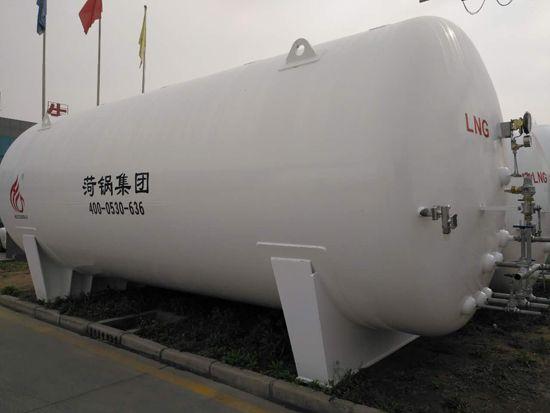
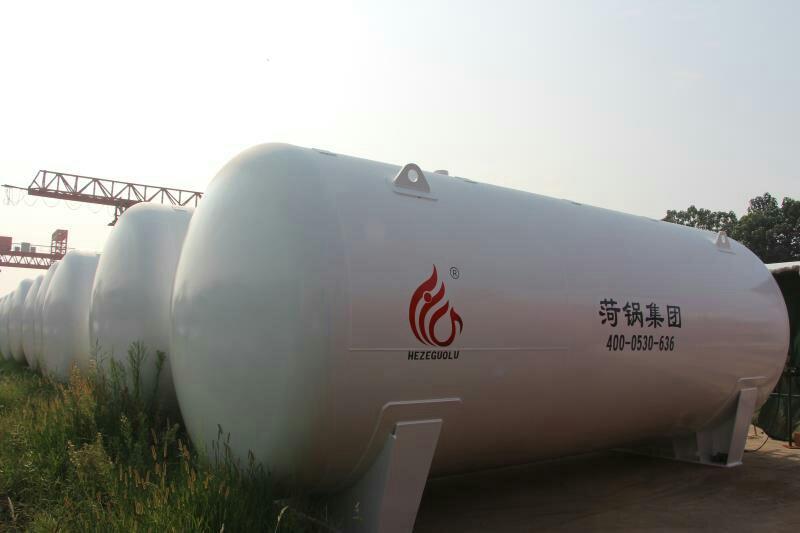
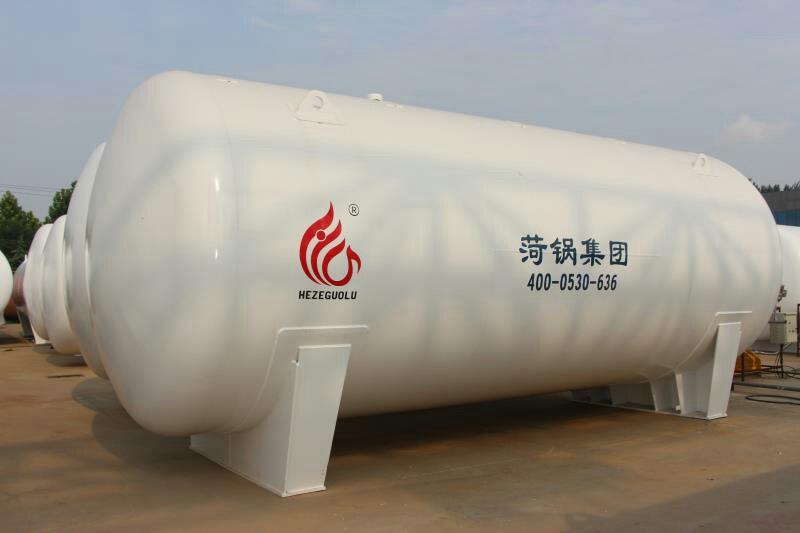
LNG Natural Gas Storage Tank, Low Temperature Liquid Container
Product Description
Brand Hegu Group Model CFW-60/0.8
Material: Stainless Steel, Diameter: 2916mm
Application Range -162℃ Volume 60000L
Heat Exchange Area - See drawing m², Ambient Temperature - See drawing °C
Wall Thickness: 8mm, Outer Dimensions: φ2916*14929mm
Origin: Shandong Heze

60-cubic-meter LNG Tank, Horizontal LNG Tank, Manufacturer's Professional Supply of 60-cubic-meter LNG Storage Tank
LNG storage tanks are atmospheric pressure, low-temperature, large capacity tanks, typically with a flat bottom and double-walled cylindrical design. The inner cylinder is usually made of 9% nickel alloy steel, but can also be made of all aluminum, stainless steel film, or pre-stressed concrete. The outer wall is made of carbon steel or pre-stressed concrete. The suspended insulating support platform at the top of the wall is aluminum, while the tank roof is constructed from carbon steel or concrete. The main insulating materials inside the LNG storage tank include expanded perlite, elastic glass fiber felt, and foam glass bricks.
LNG Tank Characteristics Requirements
Low-temperature resistance
The boiling point of liquefied natural gas at atmospheric pressure is -162°C. Therefore, LNG storage tanks must have excellent low-temperature resistance and insulation properties.
(2) High safety requirements
Due to the storage of low-temperature liquids inside the tank, in the event of an accident, the refrigerated liquid would evaporate in large quantities, with the vaporization amount being approximately 625 times that of the original refrigerated state, forming an explosive mixture in the atmosphere. Therefore, it is required that the tank be constructed with a double-walled structure and utilize the containment concept. In the event of a leak in the first tank shell, the second tank shell can completely contain the leaked liquid and evaporated gas, ensuring storage safety.
(3) Special Material.
The inner can must be able to withstand low temperatures, made of Austenitic stainless steel, while the outer casing is made from Q345R mild low-carbon alloy steel plate.
(4) Insulation measures are strictly implemented.
Due to the maximum temperature difference between inside and outside of the drum reaching up to 200°C, the drum must have excellent insulation properties to maintain an internal temperature of -160°C. High-performance insulation material should be filled between the inner and outer drums. The insulation material at the drum bottom must also possess sufficient pressure-bearing capacity. (5) Good seismic performance
General building seismic requirements are to crack under specified seismic loads without collapsing. To ensure the safety of storage tanks under accidental loads, they must have excellent seismic performance. Ensure that the tank does not suffer damage under the given seismic intensity. (6) Strict construction requirements
Tanks' weld seams must undergo 100% magnetic particle inspection (MT) and 100% vacuum leak tightness test (VBT). Strict selection of insulation materials is required, and the specified procedures must be followed during construction.
Huzhou Boiler Factory Co., Ltd. is a key enterprise designated by the China National Certification and Accreditation Administration for the production of boiler pressure vessels, a vice-president unit of the China Industrial Boiler Association, a member of the China Association of Heating, Ventilation, and Air Conditioning, and a member of the China Association of Water Supply and Drainage. The company holds B-grade boiler manufacturing qualifications (No. TS2110587-2011), third-class pressure vessel manufacturing qualifications (No. TS2210916-2013), and design qualifications (No. TS1237085-2011), and has passed the ISO9001 international quality management system certification.
Heze Boiler Factory Co., Ltd. Main Products:
Chemical Storage Tanks (liquefied gas tanks, liquefied petroleum gas tanks, liquid ammonia tanks, propane tanks, propylene tanks, isobutane tanks, chloromethane tanks, etc.); Non-standard Pressure Vessels (towers, heat exchangers, autoclaves, reaction vessels, stainless steel containers, etc.).
Cooling Auxiliary Equipment (evaporative coolers, ammonia storage tanks, drain drums, circulating drums, oil separators, separators, condensers, intermediate coolers, siphon tanks, economizers, etc.)
Boiler equipment (including steam boilers, hot water boilers, thermal oil boilers, oil-gas boilers, waste heat boilers, etc.)
Low-temperature Storage Tanks (Liquid Oxygen Tanks, Liquid Oxygen Vessels, Liquid Nitrogen Tanks, Liquid Nitrogen Vessels, Liquid Argon Tanks, Carbon Dioxide Tanks, LNG Tanks, Liquefied Natural Gas Tanks)

60-cubic-meter LNG Tank, Horizontal LNG Storage Tank, Professional Manufacturer of Liquefied Natural Gas Storage Tanks

30 Cubic Meters LNG Tank Price] - Special Price LNG Tank Price - Professional Manufacturer of LNG Tanks - How Much for a High-Quality LNG Tank
