


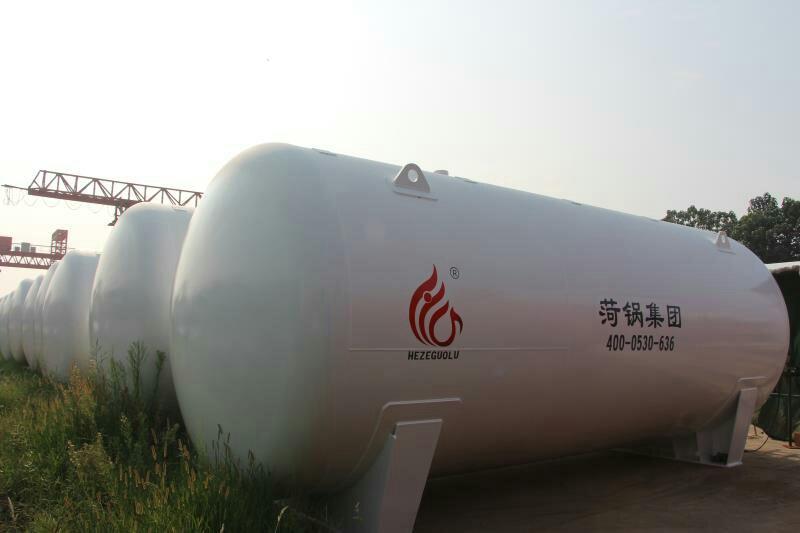

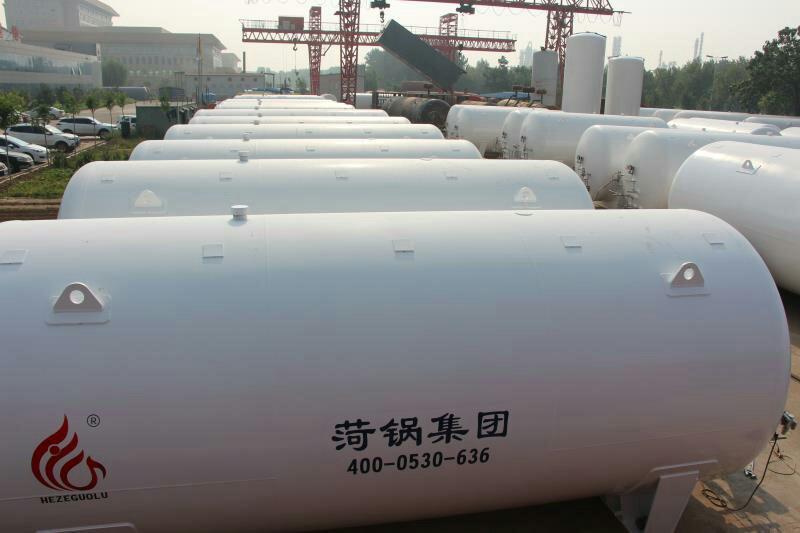
LNG natural gas storage tank, cryogenic liquid container
Low-temperature liquefied natural gas storage tank equipment is widely used in various industries of the national economy, including industry, agriculture, national defense, and scientific research. The application of natural gas storage tank equipment is increasingly widespread, primarily due to its advantages over traditional steel cylinders, such as ease of transportation, energy conservation, safety and reliability, purity assurance, and versatility. China's low-temperature storage tanks are developing towards high quality, diverse varieties, and large capacities.
Low-temperature liquid storage tanks are high-vacuum insulated stainless steel pressure vessels, designed for storing, transporting, and using liquefied natural gas, liquid oxygen, liquid nitrogen, liquid argon, or carbon dioxide. These low-temperature containers are manufactured according to the GB18442 standard and are used for reliable and cost-effective transportation and storage of low-temperature liquids, as well as for on-site storage and supply of low-temperature liquid gases across a wide range of applications.

Manufacturing of fixed pressure vessels complies with the following regulations and standards:
TSG 21-2016 "Technical Supervision Specification for Safety Supervision of Fixed Pressure Vessels"
2. GB150.1-150.4-2011 "Pressure Vessels"
3. NB/T47014-2011 "Welding Process Evaluation for Pressure Equipment"
4. NB/T47015-2011 "Code for Welding Procedure for Pressure Vessels"
5. GB/T25198-2010 "Pressure Vessel End Cap"
6. NB/T47013-2015 Non-Destructive Testing of Pressure Equipment
7. NB/T47016-2011 "Mechanical Property Testing of Welded Specimens for Pressure Equipment Products"
8. JB/T4711-2003 "Coating and Packaging for Pressure Vessels"
9. GB/T18442-2011 "Fixed Type Vacuum Insulation Cryogenic Pressure Vessel"

A low-temperature storage tank is a pressure vessel used for storing various low-temperature liquids, such as natural gas tanks, LNG tanks, liquid oxygen tanks, liquid argon storage containers, and low-temperature liquid nitrogen tanks. Therefore, its safe operation rules should consider factors such as the gas risk characteristics, low-temperature maintenance effects, surrounding environmental conditions, and pressure vessel characteristics. So, what are the detailed operation rules for low-temperature storage tanks? Let's explore them together below.
1. Types of facilities and fire separation intervals
Low-temperature storage tanks are of Class B, with the minimum fire resistance grade of二级. The fire separation between low-temperature storage tanks should not be less than half the diameter of the larger tank among the two adjacent tanks. There are no fire separation requirements for oxygen storage tanks with a volume of 50m3 or less and their application buildings. The separation of nitrogen and argon storage tanks should meet construction and maintenance requirements and should not be less than 2m.
2. Lightning and Static Electricity Protection
The low-temperature storage tank area must have lightning and static electricity grounding devices. It is required to invite a qualified unit for regular grounding resistance checks annually. The equipment, pipes, and flange connections on the low-temperature storage tank, as well as threaded connections, should be bridged with metal wires, with the bridging resistance being less than 0.03Ω.
Establish stringent procedures for the distribution, collection, and on-site handling of low-temperature steel materials, which is a critical quality assurance method for the manufacturing of low-temperature pressure vessels. Particularly in the production site, as low-temperature steel can easily be mixed with regular steel, improper handling can leave significant safety hazards. Low-temperature steel and welding rods should be handled by designated personnel in separate storage areas. After technical briefings, construction workers and relevant staff must be familiar with the identification of low-temperature steel and welding rods to prevent mixing with other types of steel. Records must be kept for the incoming and outgoing materials, and any remaining materials should be promptly re-labeled. The surface quality of low-temperature steel is of high importance, and during storage and transportation, the surface should be protected and color-coded labels should be used for identification. Cutting and material processing should be supervised by material handling personnel and immediately re-labeled. Surface markings are not allowed on low-temperature steel for identification purposes. Plate materials and semi-finished products should be stored according to batch numbers and standards. Pre-formed materials should be stored using cradles or supports, and it is strictly prohibited to place low-temperature steel materials, especially welding materials, directly on the ground. The distance from the supports to the ground and walls should not be less than 300mm. The welding rod storage area should comply with relevant welding material handling regulations, with the temperature not below 10℃ and relative humidity not exceeding 60%, and proper records should be maintained. Welding rods should be dried for 2 hours at the specified temperature before use and then stored in a constant-temperature drying box (100-150℃).
In the pressure vessels used in petrochemical enterprises today, low-temperature pressure vessels account for a significant proportion. Due to their lower operating temperatures, these vessels exhibit increased brittleness in the material. Under the effect of tensile stress, the stressed components may suddenly undergo brittle fractures at stress levels below the material's yield strength or below the allowable stress. Such fractures are characterized by minimal or no plastic deformation before and after, with no overall yielding, making them difficult to detect in routine production and posing a greater safety threat to petrochemical production. Therefore, for low-temperature pressure vessels, requirements for design, material selection, manufacturing, and inspection must be progressively more stringent compared to non-low-temperature pressure vessels.

LNG Natural Gas Storage Tank, Cryogenic Low-Temperature Container
Product Description
Brand Hoekou Group Model CFW-30/0.8
Material: Stainless Steel, Diameter: 2916mm
Application Range: -162℃; Volume: 30,000L
Heat Exchange Area See drawing sq.m Ambient Temperature See drawing °C
Wall Thickness: 8/10mm, External Dimensions: 2916*8289mm
Origin: Shandong Heze
Horizontal LNG Storage Tank 30 Cubic LNG Storage Tank 60 Cubic LNG Storage Tank 100 Cubic Natural Gas Storage Tank

The low-temperature LNG storage tank is a double-layered structure, with the inner vessel storing low-temperature natural gas liquid, withstanding the pressure and low temperatures of the medium. The material of the inner vessel is SS30408. The outer shell serves as the protective layer for the inner vessel, maintaining a certain gap to form an insulating space. It bears the gravitational loads of the inner vessel and the medium, as well as the vacuum negative pressure of the insulating layer. The outer shell does not come into contact with the low temperature and is made of container steel. The insulating layer is mostly filled with mica sand, and a high vacuum is drawn. The evaporation rate of the low-temperature LNG storage tank is generally less than 0.2%.

Low-Temperature LNG Storage Tank Structural Design
1.1 Liquid Filling System
The filling process is divided into upper filling and lower filling, with a quick connector CN-1 and a four-way connector connecting to the upper filling valve V3 and the lower filling valve V2, respectively. Pipes and transition connectors lead to the inner cylinder body.
Tubes are selected in φ28×2 and φ45×3.5 sizes.
1.2 Drainage System
The V6 valve can directly drain fluid, connected from the bottom of the cylinder; the pipes are selected in φ45×3.5. The V6 is chosen with 32gDA25C, with specifications of DN40PN4.0.
1.3 Vacuum Measurement System
VR vacuum silicon tube, used to measure the vacuum degree of the tank's insulation layer, connected to the evacuation pipe of the insulation layer. The insulation layer should be re-evacuated when the vacuum degree of the vacuum layer exceeds 3 Pa, to ensure the vacuum degree of the insulation layer and enhance the insulation effect.
1.4 Vacuum Insulation System
VV vacuum valve, select CF-40 with DN 40, for vacuum extraction; when the vacuum level reaches the required standard, close the VV to maintain the interlayer vacuum level.
1.5 Level Measurement System
Two pipelines are respectively extracted from the upper and lower parts of the cylinder. The top is the vapor phase, and the bottom is the liquid phase, connected together by the level gauge valve. L1 Level Gauge Valve PS×Z-1, the gas line connects to the pressure gauge valve and pressure gauge, with a liquid level range of 0 to 6 meters of water column.
1.6 Full Mouth Measurement
Install the pipeline based on the set liquid level. When the liquid level reaches the set value, the liquid flows downward into the fill valve MV. When filling, this valve opens until liquid starts to flow out, indicating the tank is full. Close the valve. Select a valve with model 32gDA10C, specification: DN20 PN4.0.
1.7 Self-pressurizing System
The pressure booster valve V1 is connected to the supercharger PBC-1, which uses CFB03-00. It vaporizes a portion of the liquid flowing down from the tank and introduces it into the inner tank, raising the tank's pressure and forcing the liquid out under pressure.
1.8 Gas Venting System
When the pressure at the top of the container increases, gas is released through the piping, passing through drain valve E1, then to a one-way valve CV. Since gas can only flow out, a one-way valve is used to prevent backflow. A flame arrester is then connected because gas, upon contacting air, may ignite a spark. The flame arrester is designed to prevent sparks from traveling with the gas into the inner tank, causing a fire and explosion.

Horizontal LNG Storage Tank 30 Cubic LNG Storage Tank 60 Cubic LNG Storage Tank 100 Cubic Natural Gas Storage Tank

LNG Storage Tank Supplier - In Stock LNG Storage Tank Prices - Professional LNG Storage Tank Company - Heze Boiler Factory Co., Ltd., Top Ten LNG Storage Tank Brands
