


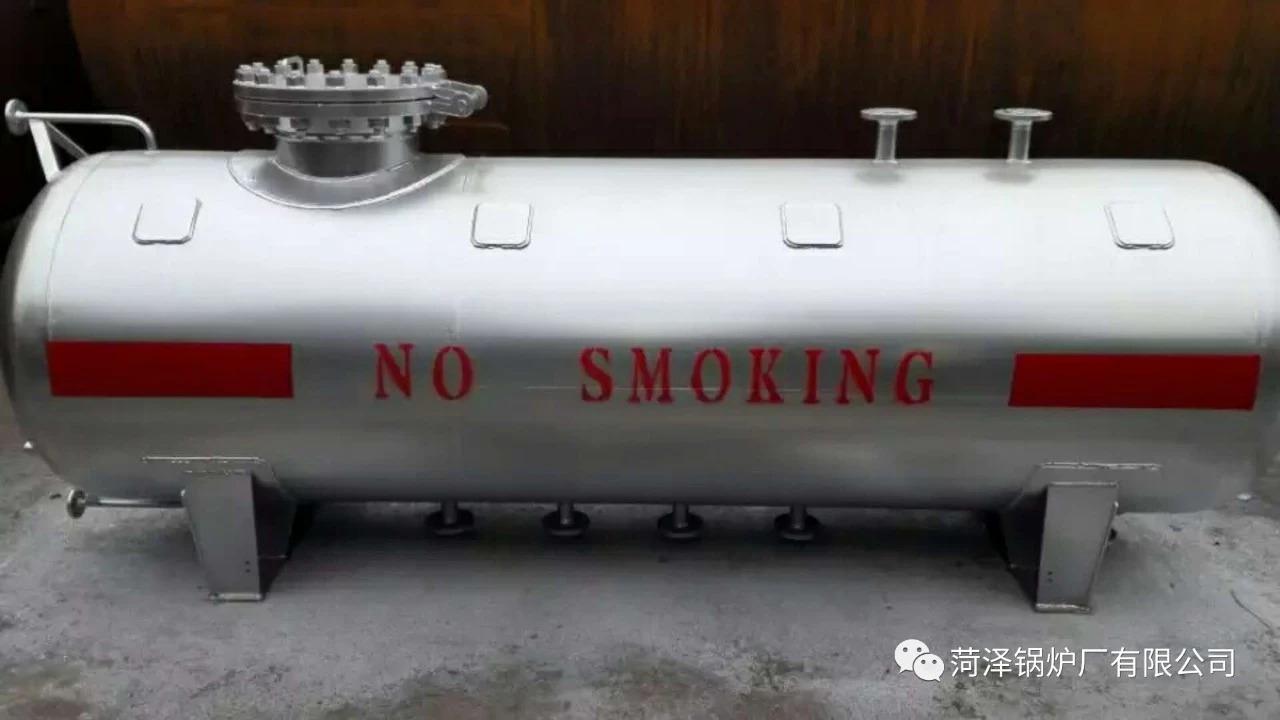
30, 60, 100 cubic meter LNG storage tanks - LNG gasification plant process flow
As shown in the figure, LNG is transported to the LNG satellite station via low-temperature truck-mounted containers. It is pressurized in the tank of the truck-mounted containers using horizontal specialized unloading boosters set at the unloading platform. The LNG is then delivered to the satellite station's low-temperature LNG storage tanks via pressure difference. Under operating conditions, the storage tank booster pressurizes the LNG inside the tank to 0.6 MPa. The pressurized low-temperature LNG enters an air-cooled vaporizer, where it exchanges heat with the air, converting into gaseous natural gas and increasing in temperature. The exit temperature is 10°C lower than the ambient temperature, with a pressure of 0.45-0.60 MPa. If the natural gas temperature at the outlet of the air-cooled vaporizer does not reach above 5°C, it is heated by a water bath heater. Finally, it is adjusted to a pressure of 0.35 MPa (via a regulator), metered, odorized, and fed into the city's transmission and distribution network for delivery to various customers.
1. Unloading Process
LNG is transported to the gasification station in consuming cities via highway tanker trucks or tank container vehicles from the LNG liquefaction plant. The tank trucks are pressurized using an air-temperature type vaporizer on the tanker or by an onboard booster vaporizer for tank container vehicles within the station, creating a pressure differential between the tanker and the LNG storage tank. This pressure differential is then used to discharge the LNG from the tanker into the storage tank at the gasification station. At the end of the unloading process, the gaseous natural gas from the tanker is recovered through the vapor phase pipeline on the unloading platform.
During unloading, to prevent an increase in pressure inside the LNG storage tank from affecting the unloading speed, an upward feeding method is used when the LNG temperature in the tank car is lower than that in the storage tank. The low-temperature LNG in the tank car enters the storage tank through the nozzle of the upward feeding pipe in a spray state, cooling some of the gas to a liquid and reducing the pressure inside the tank, allowing for smooth unloading. If the LNG temperature in the tank car is higher than that in the storage tank, a downward feeding method is employed. The high-temperature LNG enters the storage tank through the downward feeding port, mixing with the low-temperature LNG inside to cool down, thus preventing the high-temperature LNG from entering the tank through the upward feeding port and evaporating, which could increase the tank pressure and make unloading difficult. In practice, due to the relatively long distance from the LNG gas source to the cities consuming the gas, the LNG temperature in the tank car is usually higher than that in the storage tank at the gasification station upon arrival, necessitating the use of the downward feeding method. Therefore, except for the first time of filling the LNG, the downward feeding method is predominantly used during the normal unloading of tank cars.
To prevent significant temperature difference stress from damaging the pipeline or affecting unloading speed due to rapid cooling during unloading, the unloading pipeline should be pre-cooled with LNG from the storage tank prior to each unloading. Additionally, it should be avoided to rapidly open or close valves to prevent sudden changes in LNG flow rate, which can cause liquid impact damage to the pipeline.
2. Tank Boosting Technology
Driven by pressure, LNG flows from the storage tank to the adiabatic gasifier, where it is vaporized into gaseous natural gas for customer use. As LNG flows out of the tank, the internal pressure continuously decreases, slowing down the outflow rate until it stops. Therefore, in normal gas supply operations, it is necessary to continuously replenish gas into the tank to maintain the pressure within a certain range, ensuring the continuous vaporization process. The tank's pressurization is achieved using an automatic pressure boost valve and an auto-pressurizing adiabatic gasifier. When the tank's pressure falls below the set opening value of the automatic pressure boost valve, the valve opens, and the LNG within the tank is drawn into the auto-pressurizing adiabatic gasifier (the installation height of the auto-pressurizing adiabatic gasifier should be below the tank's lowest liquid level) due to the liquid level difference. In the auto-pressurizing adiabatic gasifier, the LNG vaporizes into gaseous natural gas through heat exchange with air, which then flows back into the tank, raising the internal pressure to the required working pressure.
3. LNG Gasification Technology
LNG undergoes heat exchange with the atmosphere in a vacuum-type gasifier, transitioning from liquid to gas. By the time it exits, it is 10℃ cooler than the ambient temperature. If it drops below 5℃, it is heated by a water-bath vaporizer. The hot water for the water-bath vaporizer comes from the water circulation of a hot water boiler.
4. Gas Safety Release Process
LNG is a liquid mixture primarily composed of methane, with a boiling point at -161.5℃ under normal pressure, and a storage temperature of -162.3℃ under normal pressure, with a density of approximately 430 kg/m3. When LNG is vaporized into natural gas, its critical buoyancy temperature is -107℃. Above -107℃,vaporized natural gas is lighter than air and will rise and float away from any leaks. Below -107℃,vaporized natural gas is heavier than air, and the低温vapor will accumulate at the bottom, forming an explosive mixture with air. To prevent the accumulation of low-temperature vaporized gas, which could form an explosive mixture when released by safety valves, a single air-cooled safety vent gas heater is set up. The vent gas is first heated through this heater to reduce its density below that of air before being discharged into the atmosphere.
For LNG liquefaction plants in the south without EAG heating equipment, to prevent cold burns to operators from the release of low-temperature LNG gas-liquid mixture after the safety valve trips, the single safety valve vent pipe and the storage tank vent pipe should be connected to the central vent main pipe for venting.
30, 60, 100 cubic meter LNG storage tank valve, piping, fittings
Valve selection and design
Process system valves must meet the pressure and flow requirements for transporting LNG, while also possessing low-temperature performance of withstanding -196℃. Common LNG valves include pressure-reducing regulating valves, pressure-reducing regulating valves, emergency shutdown valves, low-temperature cut-off valves, safety valves, check valves, etc. The valve material is 0Cr18Ni9.
2. Pipe, fittings, and flange selection and design
Pipes with medium temperatures ≤ -20°C are made of seamless stainless steel tubes for fluid transportation (GB/T 14976—2002) with material 0Cr18Ni9. Fittings are all made of seamless stamped fittings with material 0Cr18Ni9 (GB/T 12459). Flanges are of the long-neck type with male and female faces, steel pipe flanges (HG 20592), made of 0Cr18Ni9. The法兰seal gaskets are metal-wound type with material 0Cr18Ni9. Fasteners are specialized double-threaded bolts and nuts, made of 0Cr18Ni9.
Process pipelines with medium temperatures greater than -20°C. For nominal diameters ≤ 200 mm, use seamless steel tubes for fluid conveyance (GB/T 8163) made of 20# steel; for nominal diameters > 200 mm, use welded steel tubes (GB/T 3041—2001) made of Q235B steel. All pipe fittings are made of seamless forged fittings made of 20# steel (GB/T 12459). Flanges are of raised face, flanged, and welded steel pipe flanges (HG 20592) made of 20# steel. The flange sealing gasket is a flexible graphite composite pad (HG 20629).
LNG process pipelines are installed using焊接connections, with only necessary flange connections. Insulation is achieved in low-temperature process pipelines with polyurethane insulated pipe supports and composite polyethylene insulated pipe shells. Carbon steel process pipelines are treated for corrosion resistance.
Section 6: Fire Protection Design for LNG Gasification Stations
The fire protection design of the LNG gasification station is in accordance with the LPG section of CB 50028 "Urban Gas Design Code." A dike area is set around the LNG storage tanks to minimize the damage to surrounding facilities in case of an accident. Sprinkler systems are installed on the LNG storage tanks with a sprinkling intensity of 0.15 L/(s·m2). The water usage for sprinkling is calculated based on the total surface area of the storage tank on fire. Adjacent storage tanks within a diameter of 1.5 times that of the fire storage tank are calculated at 50% of their surface area. The water usage for fire hoses is selected according to GBJ 16 "Code for Fire Prevention Design of Building Construction" (2001 edition) and GB 50028 "Urban Gas Design Code" (2002 edition).


