


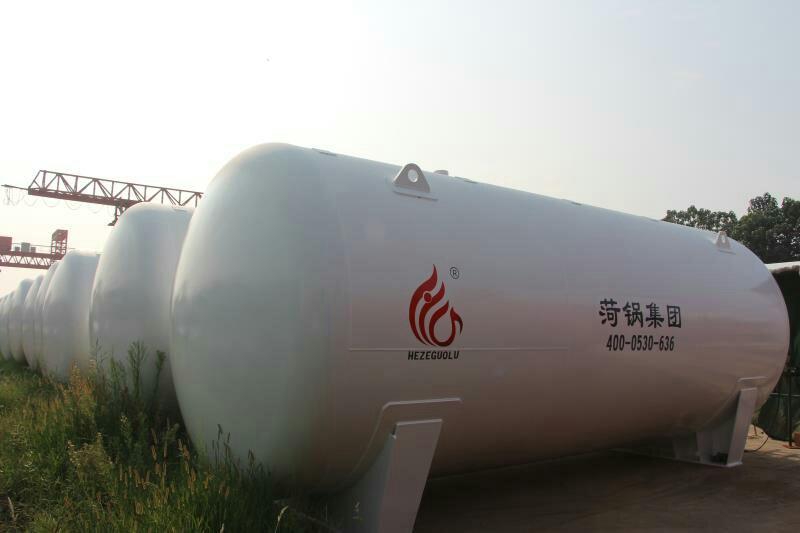
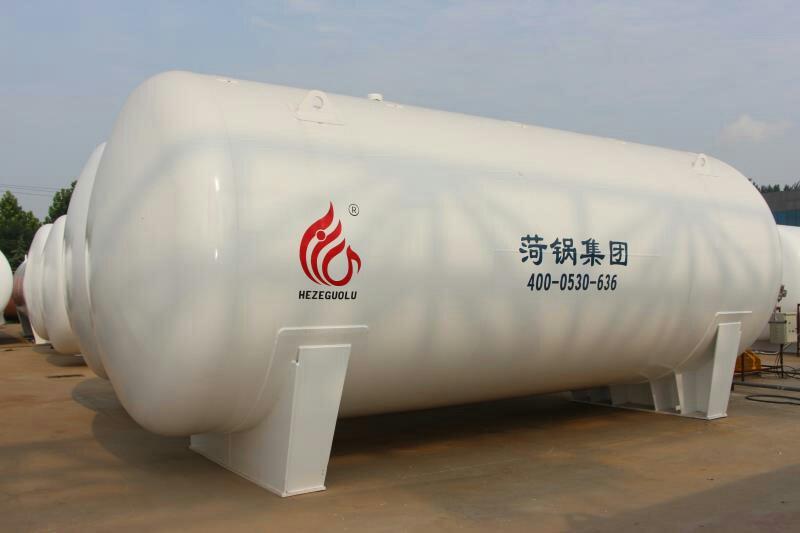
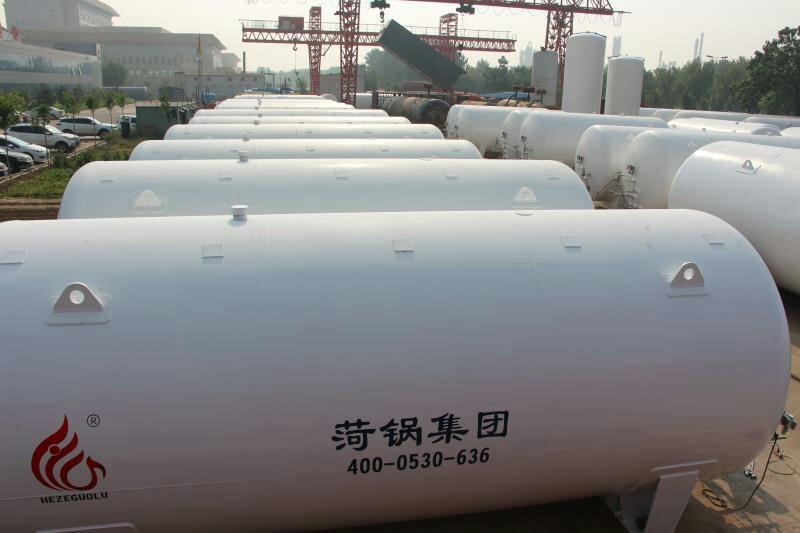
Safety Precautions for the Use of LNG Filling Station Storage Tanks:
1. Tanks with dual root valves, and the valves near the tank, should remain open.
2. During unloading, it is recommended that the tank's maximum filling capacity not exceed 90% of its effective volume (manufacturers specify between 85%-95% of the geometric volume), and the remaining capacity should not be less than 10%.
3. High pressure in an LNG tank does not necessarily indicate an issue with the tank itself. Consider factors such as the entire system's heat loss and liquid storage time. Generally, when the pressure exceeds 1.1 MPa, a discharge to relieve pressure is required. Long-term high-pressure operation can affect the lifespan of the tank's vacuum insulation.
4. If there is a significant and prolonged "sweating" or frosting on the storage tank, and the pressure is rapidly increasing continuously, consider the vacuum failure. Immediate action is required, including manual pressure relief and transferring the LNG liquid inside the tank.
5. It is recommended to perform vacuum testing on the storage tank annually. For hot tanks, a vacuum level less than 1Pa is considered合格. For cold tanks, a vacuum level less than 0.5Pa (0.00375 TOF) is deemed合格.
6. Tanks cannot be transported with liquid. When not in use for extended periods, the LNG liquid inside the tank should be drained.
7. Storage tanks are pressure vessels. According to the "Regulations for Safety Supervision of Pressure Vessel Technologies" implemented by the People's Republic of China, installation, maintenance, and modification of pressure vessels require that a qualified unit notify the local quality supervision department, obtain a permit before proceeding with installation, maintenance, or modification.
LNG Storage Tanks
LNG Tanks, Manufacturer of LNG Tanks, Producer of LNG Tanks
7 Liquefied Natural Gas Tanks
7.1 General Provisions
7.1.1 Selection of Liquefied Natural Gas (LNG) Storage Tanks should comply with the following specifications:
Assess the risk of tank types for liquefied natural gas storage, determining their impact on the surrounding environment, personnel, and property safety.
Choose the tank type shown in Appendix B of this specification for Liquefied Natural Gas storage tanks.
In areas with dense entry points or facilities, it is advisable to choose double-container tanks, full-container tanks, or film tanks.
4 Under the condition that the safety spacing requirements are met, a single containment tank can be selected.
7.1.2 The design of Liquefied Natural Gas (LNG) storage tanks shall comply with the following regulations:
During and after the OBE period, the storage system should continue to operate.
During and after the SSE, the storage capacity of the tanks remains unchanged and should be capable of being isolated and maintained.
The liquefied natural gas (LNG) storage tanks should undergo seismic calculations under OBE and SSE conditions, ensuring the tanks can safely shut down under SSE conditions. The prestressed concrete outer shell of the full-volume tanks should be subjected to ultimate bearing capacity calculations under ALE conditions.
7.1.3 The pipe openings of the liquefied natural gas storage tank should be located at the top of the tank.
7.1.4 The response spectra for OBE, SSE, and ALE should be determined in accordance with the following requirements:
The OBE should represent ground motion with a 10% exceedance probability within 50 years (return period of 475 years) and a damping ratio of 5%, and its response spectrum should not be less than the value corresponding to the seismic fortification earthquake for the region as specified by the current national standard for seismic design of buildings, GB 50011.
SSE should represent seismic ground motion with a 2% probability of exceedance within 50 years (return period of 2475 years) and a damping ratio of 5%, and its response spectrum should not be less than the value corresponding to the rare earthquake as specified in the current national standard for seismic design of buildings, GB 50011, for the region in question.
The acceleration value of the 3 ALE spectrum should be half of the SSE spectrum acceleration value.
4 In the absence of vertical earthquake response spectra, the vertical seismic influence coefficient should not be less than 65% of the maximum value of the corresponding horizontal seismic influence coefficient.
7.1.5 The auxiliary structures of the liquefied natural gas storage tank should be designed in accordance with OBE.
7.1.6 During seismic action, the damping ratios for each design component of the liquefied natural gas storage tank should be selected according to the specifications in Table 7.1.6.
Table 7.1.6: Onion Skin of Various Design Components
7.1.7 The permanent loads and variable loads of the liquefied natural gas storage tank shall comply with the specifications in Table 7.1.7.
Table 7.1.7: Permanent and Variable Loads on Liquefied Natural Gas Storage Tanks
Note: 1 a), b) Refer to Appendix B of this specification. "√" indicates consideration, while "—" indicates non-consideration.
"√* indicates that it only applies to the ambient steel tank lid for low-temperature steel exterior containers."
7.1.8 The seismic and accidental loads for liquefied natural gas storage tanks shall comply with the specifications in Table 7.1.8.
Table 7.1.8 Seismic and Accidental Loads on Liquefied Natural Gas Storage Tanks
Note: a), b) Refer to Appendix B of this specification. "√" indicates consideration, while "—" indicates non-consideration.
7.1.9 The liquefied natural gas receiving station site should undergo seismic and geological disaster assessment.


