One, the rise of LNG district gasification in China
If the 1980s to 1990s were the era of China's LPG community gasification, then the first 10 to 20 years of the 21st century will be the era of China's LNG community gasification. The origin of China's LPG community gasification is in Shenzhen, Guangdong, and the origin of China's LNG community gasification should be in Zibo, Shandong. The main gas source for Guangdong's LPG community gasification relies on overseas imports, while the current main gas source for Shandong's LNG community gasification comes from the LNG production plant in Puyang, Henan. In the future, there will be more routes for gas sources.
Yangzhai LNG Community Gasification Station, Zibo City, Shandong Province
This project is the first in China to design a gasification station for unloading, storage, and gasification of liquefied natural gas (LNG). The LNG is transported from the Zhongyuan Oilfield to the Zibo Gasification Station via low-temperature tankers.
The Zibo project commenced design in June 1999 and was completed in January 2000. Zibo Gas Company started construction in January 2000, completed the construction in October 2000, and began trial operations using LNG. It officially began supplying LNG gas on December 2, 2001. It is the first liquefied natural gas (LNG) gasification station in China and the largest in Asia. The natural gas is supplied exclusively to industrial users, with a designed capacity of 120,000 Nm3/d.
Qingdao Jiajialing LNG Residential Community Gasification Station
The Jijialing project commenced design in June 2000 and was completed in January 2001; the Qingdao Gas Company started construction in January 2001 and the facility was built and successfully tested in February 2002, becoming the first civil liquefied natural gas gasification station in China, with a design capacity of 20,000 Nm3/d.
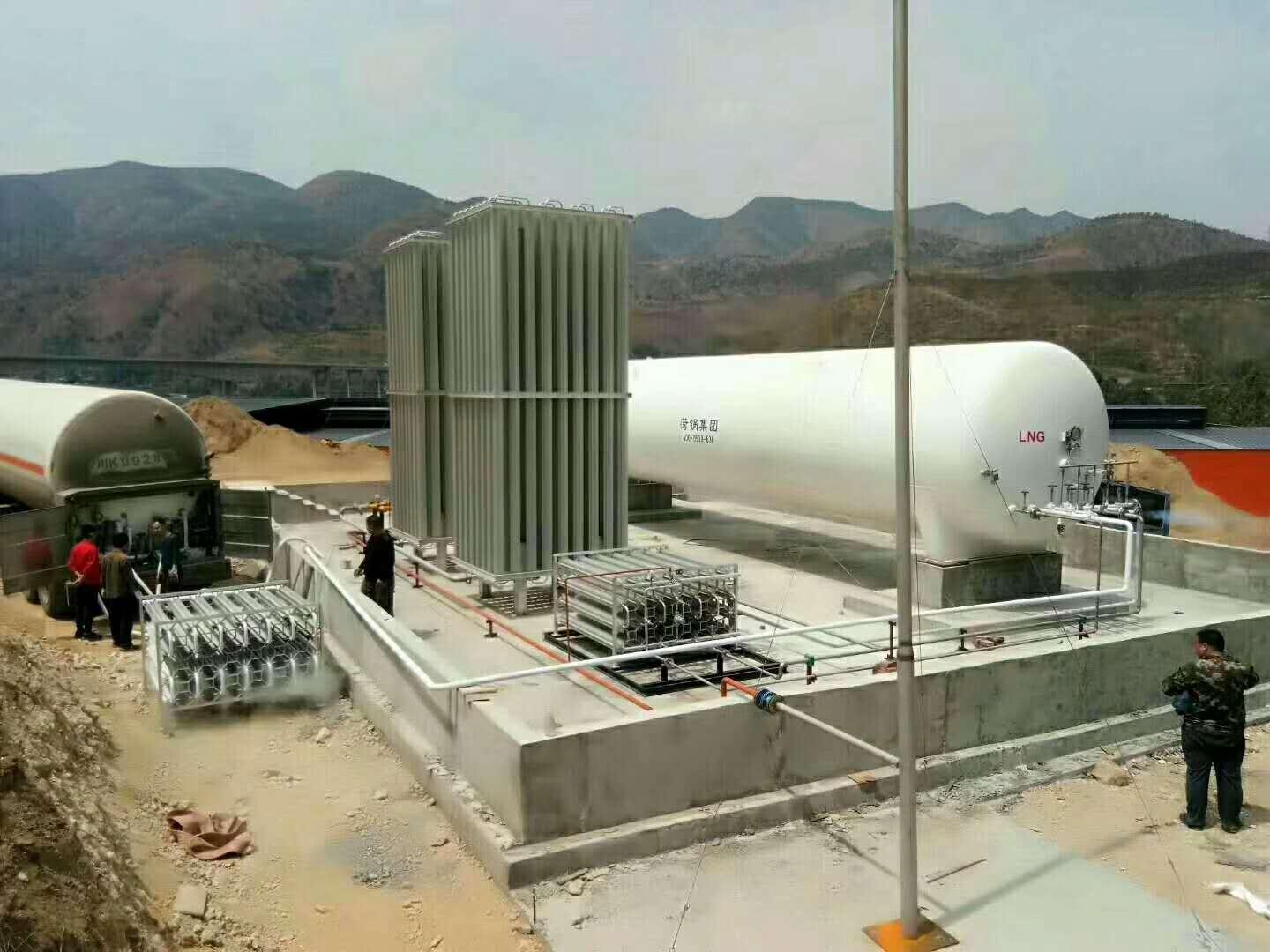
Guangdong Longchuan LNG Community Gasification Station Project
The Longchuan LNG gasification station boasts a short design and construction cycle, with the project from design to completion taking less than a year. The dedication ceremony was held on May 23rd of this year. Its design capacity is 10,000 Nm3/day.
Although Longchuan Station's LNG currently comes from Puyang, Henan, the operator's sights are set on Shenzhen. Once the Shenzhen LNG receiving station is completed, Longchuan will be the beneficiary.
The Longchuan LNG Gasification Plant project is a management general contracting project managed by Qingdao Chemical Engineering Design Institute.
In China, currently under construction and soon to be operational LNG liquefaction stations include Shangqiu in Henan, Jiangyan and Shuyang in Jiangsu, Fangzi in Shandong, Suzhou in Zhejiang, Miyun in Beijing, and Bengbu in Anhui. Planned and being designed are cities such as Yuyao in Zhejiang, Jiujiang in Jiangxi, Weifang, Pingdu, Qingzhou in Shandong, and Xiamen in Fujian. It is said that after completing the construction of the LNG liquefaction station in Longchuan, Guangdong, Shanghai Datong Energy Co., Ltd. plans to invest in and build LNG community liquefaction stations in cities like Yangjiang, Huide, and Shanwei in Guangdong.
The recent wave of LNG community gasification in Shandong, China, has far outpaced the earlier LPG community gasification in Guangdong, and is even faster than Japan's progress in the 1970s. Whether it's the scale, speed, organizational form of construction, or the degree of public concern, it surpasses the Guangdong LPG community gasification in every aspect.
Global natural gas conversion projects are inevitable.
With the advancement of the times, the development of the social economy, and the demand for environmental protection, the drawbacks of coal-to-gas conversion are increasingly being exposed comprehensively. Advanced countries have successively phased out coal-to-gas conversion in the 1950s, 1960s, 1970s, 1980s, and 1990s. Oil-to-gas conversion also has many insurmountable shortcomings. LPG will become a transitional energy source as the depletion of oil becomes apparent. The global shift to natural gas, replacing all other energy sources, will become an inevitable revolution in the development of gas energy.
Partial Natural Gas Conversion Schedule for Some Countries
Country
During natural gas conversion (year)
Gas Source
United States
1945-1958
Pipeline natural gas predominant
Former Soviet Union
1948-1960
Pipeline natural gas predominant
United Kingdom
1964-1977
Initially using LNG, later primarily utilizing pipeline natural gas.
France
1962-1982
LNG combined with pipeline natural gas
Germany
1960-1970
Pipeline natural gas, with a small amount of LNG
Australia
1976-1986
Pipeline Natural Gas
Japan
1969-1998
All LNG supply
天然气的利用途径可采取管道输送和液化后用船运输、公路槽车和铁路槽车运输多种途径来实现。长输管道输送受到铺设管道需要穿过崇山峻岭、农田村庄以及征用村镇土地赔偿费用等限制,超过一定长距离,从经济角度来考虑是很不合算的。而将天然气液化后用大船(13.5万立方米)通过海上运输,送至城市边沿建设的LNG接收基地是非常经济合算的事。LNG在美国、欧洲、日本早就得到广泛的应用,而日本是世界上使用LNG最成功的国家,年用量达到了5000万吨,占世界LNG贸易量8000万吨的62.5%。亚洲的日本、韩国和台湾地区LNG消费数量,占了世界总消费量的四分之三还多。
The launch of the 3 million tons LNG project in Guangdong, China, the construction of the 2 million tons LNG project in Fujian, and the commencement of the Indian LNG project, along with the completion of the Dongding LNG receiving base in Taiwan, will lead to a significant increase in Asia's LNG consumption.