The Rise of LNG Community Gasification in China
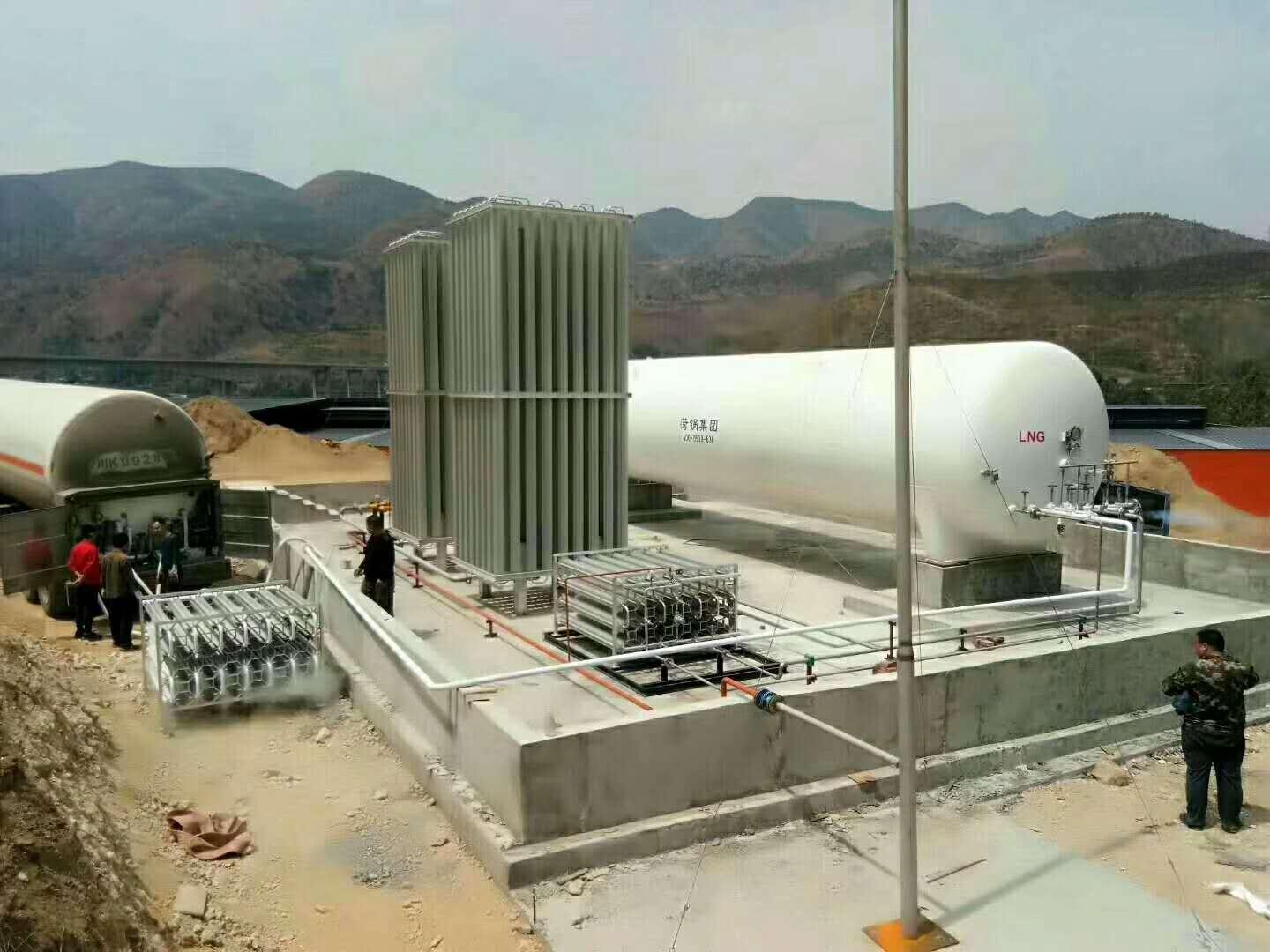
If the 1980s to 1990s were the era of LPG residential gasification in China, then the first 10 to 20 years of the 21st century will be the era of LNG residential gasification in China. The origin of China's LPG residential gasification is in Shenzhen, Guangdong, and the origin of China's LNG residential gasification should be in Zibo, Shandong. The gas source for Guangdong's LPG residential gasification mainly relies on overseas imports, while the gas source for Shandong's LNG residential gasification currently depends on the LNG production plant in Puyang, Henan, with more gas sources expected in the future.
Yangzhai LNG Community Gasification Station, Zibo City, Shandong Province
This project is the first in China to design a gasification station for unloading, storage, and gasification of liquefied natural gas. The liquefied natural gas is transported from the Zhongyuan Oilfield to the Zibo Gasification Station in低温 tank trucks.
The Zibo project commenced design in June 1999 and was completed in January 2000. The Zibo Gas Company started construction in January 2000, completed the construction in October 2000, and began trial operations using LNG. It was officially put into service for LNG supply on December 2, 2001. It is the first liquefied natural gas (LNG) gasification station in China and the largest in Asia. The natural gas is supplied exclusively to industrial users, with a designed capacity of 120,000 Nm3/day.
Qingdao Jiajialing LNG Community Gasification Station
The Jinqianling project commenced design in June 2000 and was completed in January 2001; Qingdao Gas Company started construction in January 2001, and the facility was completed and successfully trial-operated in February 2002, becoming the first civil liquefied natural gas gasification station in China, with a design capacity of 20,000 Nm3/d.
Guangdong Longchuan LNG Community Gasification Plant Project
The Longchuan LNG liquefaction plant has a short design and construction period, taking less than a year from design to completion. The opening ceremony was held on May 23rd this year. The design capacity is 10,000 Nm3/d.
Although Longchuan's LNG currently comes from Puyang, Henan, the operator's focus is on Shenzhen. Once the Shenzhen LNG receiving station is completed, Longchuan will benefit.
The Longchuan LNG Gasification Plant project is a management general contracting project managed by Qingdao Chemical Engineering Design Institute.
In China, currently under construction and set to be operational are LNG liquefaction stations in Shangqiu, Henan; Jiangyan and Chuxian, Jiangsu; Fangzi, Shandong; Suzhou, Zhejiang; Miyun, Beijing; and Bengbu, Anhui. Planned and in the design phase are cities such as Yuyao, Zhejiang; Jiujiang, Jiangxi; Weifang, Shandong; Pingdu and Qingzhou; and Xiamen, Fujian. It is said that after completing the construction of the LNG liquefaction station in Longchuan, Guangdong, Shanghai Datan Energy Co., Ltd. plans to invest in building LNG community liquefaction stations in cities like Yangjiang, Huide, and Shanwei in Guangdong.
The recent surge in LNG community gasification in Shandong, China, has far outpaced the LPG community gasification that occurred in Guangdong, China, and even surpasses the development pace of Japan in the 1970s. Whether it's the scale of construction, speed, organizational form, or the level of public concern and influence, it is unparalleled by the Guangdong LPG community gasification.

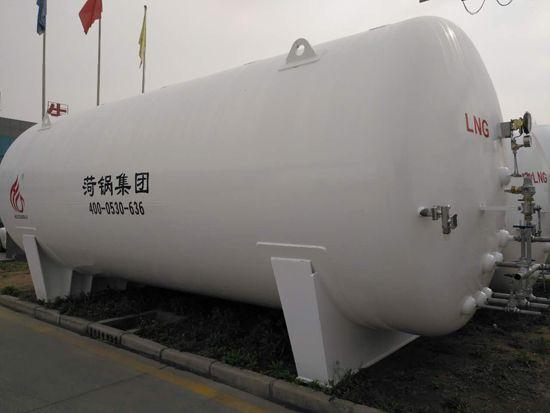
Natural gas is widely recognized as a clean, environmentally friendly, and safe high-quality energy source. Once liquefied, its volume is reduced by approximately 600 times, which greatly benefits storage. Storage of liquefied natural gas (LNG) is done in atmospheric pressure, low-temperature tanks. Let's discuss the unique features of these LNG storage tanks.
What are the special requirements for LNG low-temperature storage tanks?
1.Low-temperature resistant
At atmospheric pressure, the boiling point of liquefied natural gas (LNG) is -160°C. LNG is stored at low temperatures and atmospheric pressure, cooling the gas below its boiling point. This allows the operating pressure of the storage tank to be slightly above atmospheric, compared to high-pressure, ambient-temperature storage. It significantly reduces the tank wall thickness and enhances safety performance.
Therefore, LNG requires storage tanks with excellent low-temperature resistance and superior insulation properties.
2.High safety requirements
Due to the storage of low-temperature liquids inside the tank, in the event of an accident, the refrigerated liquid would vaporize in large quantities, with the amount of vaporization being about 300 times greater than its refrigerated state, forming an explosive gas cloud in the atmosphere.
Therefore, standards such as API, BS, etc., require double-walled tank structures and the application of sealing concepts. In the event of a leak in the first layer of the tank, the second layer can completely seal off the leaked liquid and evaporated gases, ensuring storage safety.
3.Special Material
The inner罐 wall requires low-temperature resistance, commonly made of 9Ni steel or aluminum alloys, while the outer罐 wall is constructed with pre-stressed reinforced concrete.
4.Thermal insulation measures are stringent
The temperature difference between the inside and outside of the drum can reach up to 200°C. To maintain a temperature of -160°C inside the drum, the drum must have excellent insulation properties, filled with high-performance insulation material between the inner and outer drums. The insulation material at the drum bottom must also have sufficient pressure-bearing capacity.
5.Good seismic performance
General building seismic requirements are to crack but not collapse under specified seismic loads. To ensure the safety of storage tanks under unexpected loads, they must possess excellent seismic performance. For LNG storage tanks, it is required that they neither collapse nor crack under specified seismic loads.
Therefore, the selected construction site typically avoids seismic fault zones, and抗震试验 must be conducted on the storage tanks before construction to analyze the structural performance under dynamic conditions, ensuring the tank does not suffer damage under the given seismic intensity.
6.Stringent construction requirements
Tanks must undergo 100% magnetic particle testing (MT) and 100% vacuum leak testing (VBT) for welds. Select insulating materials strictly and follow the prescribed procedures during construction. To prevent concrete cracking, post-tensioned prestressed construction is used uniformly, with strict control over the verticality of the tank walls.