


 I. Equipment manufacturing complies with the following regulations and standards:
1、TSG 21-2016"Regulations for Safety Supervision of Fixed Pressure Vessels"
2、GB150.1~150.4-2011"Pressure Vessel"
3、NB/T47014-2011"Pressure Equipment Welding Procedure Qualification"
4、NB/T47015-2011"Pressure Vessel Welding Procedure Specification"
5、GB/T25198-2010"Pressure Vessel Head"
6、NB/T47013-2015"Non-Destructive Testing of Pressure Equipment"
7、NB/T47016-2011"Mechanical Property Testing of Welded Specimens for Pressure Equipment Products."
8、JB/T4711-2003"Coating and Packaging for Pressure Vessels"
9、GB/T18442-2011"Fixed Vacuum Insulation Deep-Chilled Pressure Vessel"
II. Description of Equipment Features, Performance, and Structural Parameters
1Equipment Features
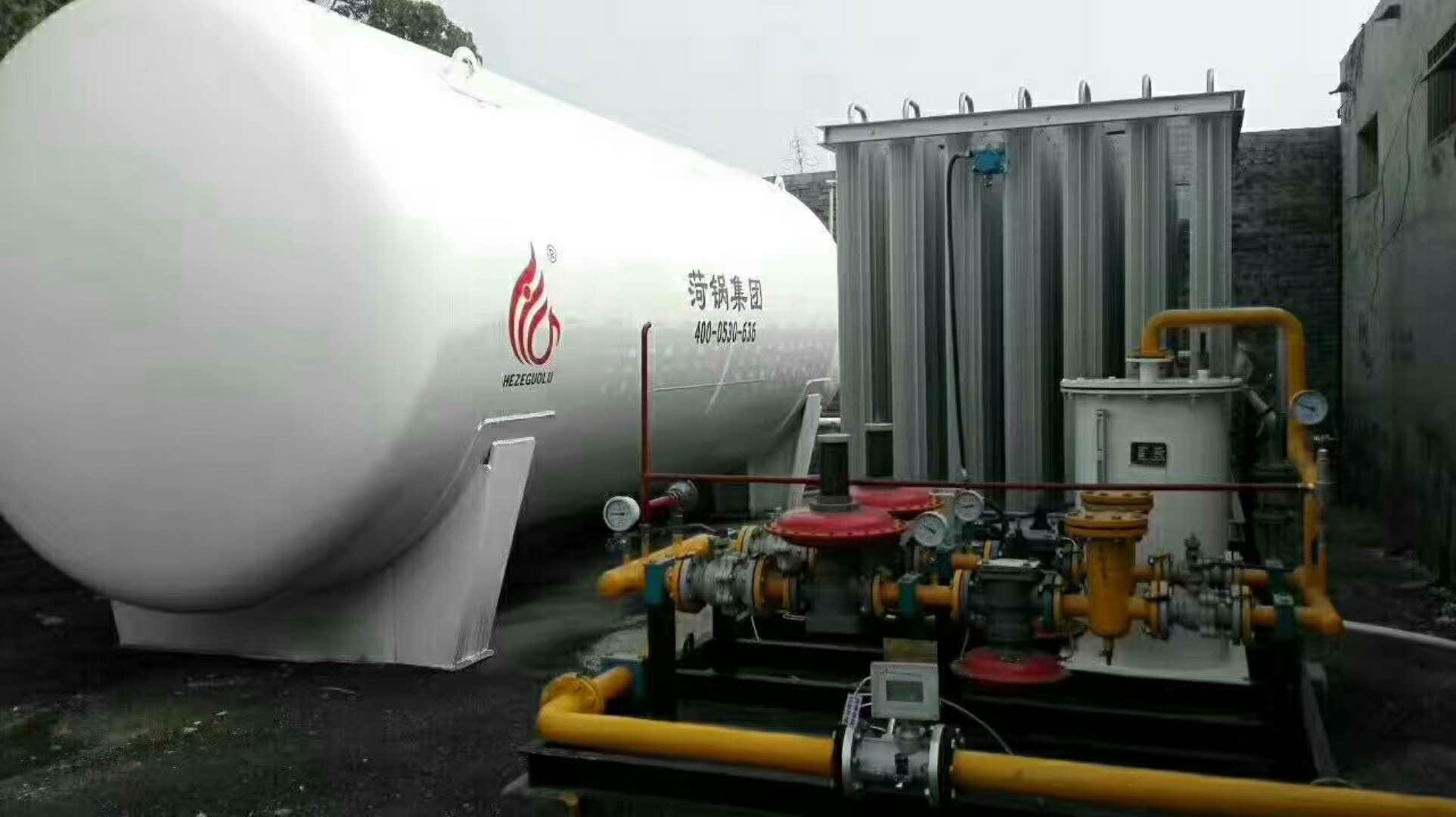
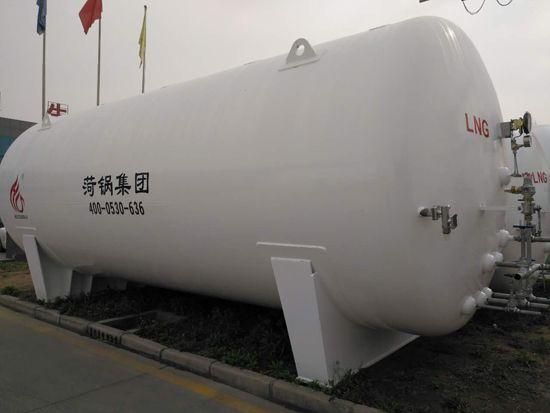
Liquefied Natural Gas (LNG) storage tanks are horizontal, double-walled cylindrical vacuum powder-insulated structures, with the inner cylinder containingLNGMaterial:S30408The head is made of a standard elliptical head, with the outer cylinder facing the atmosphere, and the material isQ345RLow-alloy steel, features an eight-point support structure between the inner and outer cylinders. Insulation thickness250mmThe inner and outer tube sandwich is filled with insulation material Pearl sand insulating material and evacuated, with the pressure between the inner and outer layers being absolute pressure ≤5PaThe factory vacuum level exceeds national standards, ensuring the evaporation rate specifications; the storage tank is equipped with a complete set of operating valves and gauges. These valves and gauges enable on-site observation of liquid in/out and pressure/level.
2Performance and structural parameters
Liquefied Natural Gas (LNG) storage tanks consist of the tank body, instruments, pipelines, valves, etc. These tanks are equipped with two types of liquid intake methods—upper and lower—and can be chosen for use based on actual conditions.
The inner tank of the Liquefied Natural Gas (LNG) storage tank is equipped with a safety system device featuring dual safety valves. Under normal operating conditions, one set is in operation while the other is on standby. If the safety valve in operation trips, the manual pressure relief valve is immediately opened to depressurize below the tank's maximum working pressure. Simultaneously, the safety device is swiftly switched to the standby system via the manual handle, effectively ensuring the tank's safety. This safety system device consists of safety valves, explosion-proof devices, vent valves, and three-way ball valves, not only reducing pipeline welding but also featuring excellent fire and static electricity prevention structures. Additionally, the safety relief openings on the outer shell are fully guaranteed to ensure the entire equipment's safety and reliability. The low-temperature pipelines are集中引出 for ease of operation and control, and the outlet is designed with a Duralumin structure to meet low-temperature requirements and reduce stress on the pipeline due to thermal expansion and contraction, ensuring the tank's safety. The vacuum pump valve employs a triple-sealed design.OThe form ring seal effectively ensures the reliability of the sandwich seal, and is made of full stainless steel, featuring a compact size. The liquefied natural gas storage tank is designed with a suspended structure at the top for easy transportation, lifting, and installation. The unique manhole design ensures the cleanliness inside the container when it is sealed. Vacuum isolation valves and combined vacuum regulators are used on the liquefied natural gas storage tank, facilitating the measurement and maintenance of the vacuum degree in the tank's sandwich, extending the tank's service life and improving its quality. The storage tank is equipped with a level gauge and a pressure gauge for local display of the liquid level and pressure. The sandwich insulating material is high-quality domestic pearl sand, with the following performance parameters of the pearl sand:
Serial Number | Indicator Name | Unit | Benchmark |
1 | Loose Bulk Density | Kg/m3 | 50-60 |
2 | Particle size | mm | 0.1-0.2 Not less than80% |
3 | Thermal Conductivity (at atmospheric pressure),Temperature310-77k) | W/m.k.s | <0.026 |
4 | Moisture content(Weight) | % | <0.1 |
5 | Unexpanded Rate | % | ≤1 |
6 | Temperature | ℃ | -200℃~600℃ |
7 | PHPlease provide the Chinese content you would like translated. | 6.5~7.5 |
Section 3: Inspection, Testing, and Acceptance
1Inspection of the inner cylinder material is required before it can be put into use.
2All welds are to be inspected.GB150.1~150.4-2011Inspection of standards and drawings is conducted; upon passing the inspection.A、BWeld-like seam100Percent gamma ray testingA、B、C、DWeld-like seam100% Permeability testing with a test report issued
3After the cylinder assembly is completedGB150.1~150.4-2011Inspection is conducted on geometric dimensions, pipe end orientation, and shape deviation according to standards and drawings.
4After inspection, conduct a pneumatic test and issue a pressure test report. Upon passing the pneumatic test, evacuate the vacuum. Once the vacuum level meets the requirements, perform a helium leak test.
5After interlayer leak testing passes, fill with pearlescent sand and then vacuum pump, achieving the vacuum degree ofGB/T18442-2011Standard vacuum degree after final sealing.
Section 4: Technical Documents
1After the contract is signed, the seller shall provide the following technical documents to the buyer:
⑴ Product Quality Certificate for the Equipment1Set (provided with equipment)
Including: Material Certificate for Main Pressure Components, Bill of Materials, Structural Dimensions Inspection Report, Inspection Plan, Product Compliance Certificate, Pressure Vessel Product Data Sheet, Welding Records, Non-Destructive Testing Report, Pressure Test Report, Supervision and Inspection Certificate for Special Equipment Manufacturing (Local Inspection Authority), Product Label Copy
As-Built Drawings Various1Each (supplied with the equipment)
Section 3: Strength Calculation Sheets1Piece (supplied with the equipment)
④ User Manual1Piece (supplied with the equipment)
Equipment process diagram and basic reference diagram each1Piece (Contract)7Available today (subject to change)
⑹ Certificate of Conformity for accessories, instrument calibration report 1Pack (provided with the equipment)
5. Quality Assurance, After-Sales Service, Technical Support
1The equipment performance meets the user's requirements and ensures normal operation within the process range.
2Valves and instruments on storage tanks come with a one-year warranty. Free service and repair are provided within the warranty period, along with free replacement of damaged parts. The equipment warranty period begins upon delivery.12Month(s).
3During the warranty period, if our manufactured equipment encounters issues on-site: if the issue is due to manufacturing defects, our company will respond to the customer's formal notification within normal working hours.2Hourly Response24Within hours, a professional technician will arrive on-site to address the issue. Service personnel will not leave the scene until the fault is resolved. Replacement parts are free of charge within the warranty period; beyond that, only cost-related fees are charged.
4During the equipment's operation, in the event of a malfunction, the seller shall first address the issue and then determine liability, with the criterion being the normal operation of the equipment.
Lifetime technical consultation provided by the supplier, always ready to answer users' questions.

Heze Boiler FactoryLimited Company
Equipment Name: Natural Gas Storage Tank --- Liquefied Natural Gas Storage Tank --- Natural Gas Storage Tank (Function Description)
Contact Information: AvailableManager
Manufacturer:Heze Boiler FactoryLimited Company
This article briefly outlines the basic requirements and safety points for the use of low-temperature liquid storage tanks, by analyzing their hazardous characteristics and combining various gas supply modes.
An LNG storage tank is a jacketed vacuum powder-insulated pressure vessel specifically designed for storing and supplying low-temperature liquefied gases (such as liquid nitrogen, liquid oxygen, liquid argon, liquid carbon dioxide, etc.). It has been widely used in industrial production and daily life.
1. Analysis of Low-Temperature Liquid Hazardous Characteristics
Low-temperature liquids possess hazardous characteristics, including low boiling points, high expansiveness, strong asphyxiating properties, and strong oxidizing properties.
1.1 Boiling points of low-temperature liquids at 101.3 KPa: Liquid nitrogen at -196°C, liquid oxygen at -183°C, and liquid argon at -186°C. Contact with the human body can cause severe frostbite to the skin and eyes. In cases of minor leaks or internal leakage in valves, they absorb heat from the surrounding environment, causing rapid condensation and frost formation at the leak point, which may lead to freezing in severe cases.
Low-temperature Storage Tank
1.2 Low-temperature liquids absorb energy from the surrounding environment due to high heat or large leaks, causing their volume to expand as they rapidly vaporize. At 0°C and a pressure of 101.3 KPa, the volume of gas resulting from the vaporization of 1L of low-temperature liquid is: nitrogen 674L, oxygen 800L, argon 780L. Inside sealed containers or pipelines, the increase in internal pressure due to the vaporization of low-temperature liquids can easily lead to overpressure explosions.
1.3 In the environment surrounding low-temperature storage tanks, after low-temperature liquid leaks and vaporizes, it is prone to form a rich gas area. High concentrations of nitrogen, argon, and carbon dioxide can easily cause asphyxiation injuries. Additionally, high oxygen concentrations can lead to oxygen enrichment injuries.
1.4 Oxygen is a powerful oxidizer with extremely strong oxidizing properties. Liquid oxygen, when in close proximity to combustible materials, is highly flammable upon contact with an open flame; contact with combustible materials can easily cause explosions due to vibrations or impacts; a mixture with combustible materials poses a potential explosive hazard. Liquid oxygen can adhere to clothing and fabrics, and upon contact with an ignition source, it can cause a flash fire, posing a risk to personal safety.
2. Low-temperature Storage Tank Gas Supply Mode and Basic Requirements
Based on different application scenarios and user requirements, the gas supply mode of low-temperature storage tanks mainly varies.
Available services: high-pressure cylinder refilling, low-temperature insulated cylinder filling, centralized gas supply through pipelines, and low-temperature liquid spray supply.


专业制造LNG储罐多少钱-专业定做LNG储罐规格-现货LNG储罐哪家质量好-专业承接LNG储罐多少钱
