


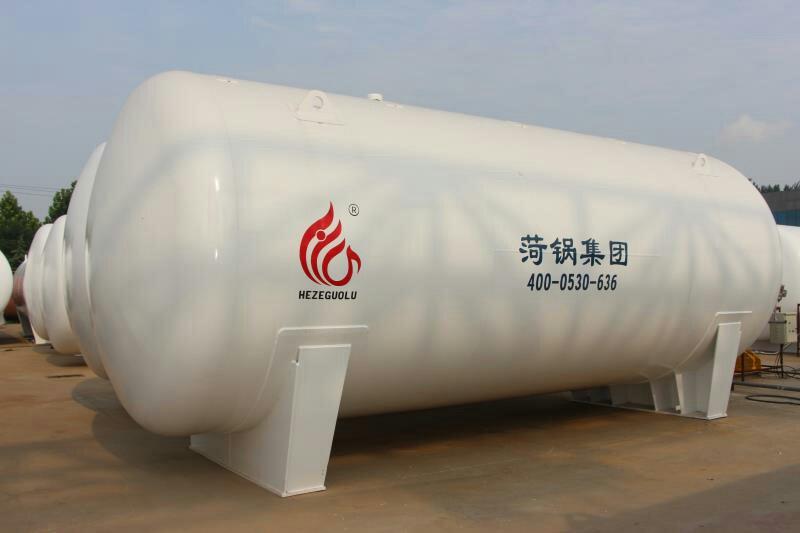

液化天然气储罐厂家:
Manufacturer of Liquefied Natural Gas Storage TanksHeze Boiler Factory Co., Ltd.
Section 1: LNG Storage Tank Safe Operating Procedures
1.1.1 Storage Tank Operation Process Specifications
1)Highest AllowableWork Pressure: 0.86MPa
2)DesignTemperature: -196°C
1.1.2 Tank Liquid Filling Procedure
1.1.2.1 Preparation
1) Operator Requirements: Operators must hold valid certifications after completing safety education and operational technique training. During operations, they are required to wear necessary personal protective equipment and work uniforms.
2) Pressure Testing Requirements
3) All equipment should undergo pressure tests in accordance with design specifications prior to operation.
4) The test pressure gas should be dry nitrogen, with oxygen content not exceeding 3%, water vapor pressure not exceeding -25°C, and free of oil contamination.
5) Purge Replacement Requirements: Purge replacement is a safety measure to ensure the safe filling of liquids into equipment. It should first be purged with nitrogen containing no more than 3% oxygen, while ensuring no oil contamination and a dew point of no more than -25°C. Then, LNG should be used to replace the liquid to reach the required purity before allowing the liquid to be filled.
6) Pre-cooling: After pressure testing is passed, the equipment must be pre-cooled using liquid nitrogen to ensure reliable low-temperature operation. The tank must be purged and pre-cooled with nitrogen before its first use. The high purge pressure should be equivalent to 50% of the high working pressure, or lower than this pressure.
1.1.2.2 Initial Liquid Filling Operation of the Tank
1) Open both the upper and lower liquid inlet valves simultaneously for filling. At the same time, open the valve for the liquid to overflow, releasing the gas in the storage tank until LNG gas is discharged; immediately close the overflow valve.
2) Close the lower liquid inlet valve when the tank is filled to over 50% of its capacity.
3) Upon reaching 85% of the tank's capacity, close the liquid inlet valve, and stop filling for 5 minutes to allow the liquid level to settle. Then, reopen the liquid inlet valve and continue filling until liquid starts to overflow from the full overflow valve. Immediately close the full overflow valve, stop filling, and close the liquid inlet valve.
4) Upon starting the fluid filling process, loosen the joints at both ends of the level gauge. Fully open the liquid phase display valve and the gas phase display valve to check if any moisture is present in the exhaust gas flow. If moisture is detected, continue to exhaust until no moisture is present. Then, tighten the joints at both ends of the level gauge and close the balance valve to put the level gauge into normal operating condition.
1.1.2.3 Tank Refueling Procedure
1) After the initial formal filling, when refilling the tank, the gas phase pressure inside the tank should be reduced as much as possible.
2) Fill simultaneously from top and bottom. When the liquid level gauge shows approximately 50% full, close the lower inlet valve. When filled to 85% of the tank's capacity, close the upper inlet valve and stop filling for 5 minutes to settle the liquid level inside. Then, reopen the upper inlet valve to continue filling until liquid starts to flow out of the overflow valve. Close the overflow valve and simultaneously close the upper inlet valve to stop filling.
3) Monitor the pressure gauge and level gauge during filling. (If the pressure rises above the filling transfer pressure or nears the safety valve pressure, it is necessary to open the gas discharge valve to release an appropriate amount of gas phase from the storage tank.)
4) Fill out the operation record form
2. Tank Pressure Boosting Operation Procedure
1) The boost system is the tank pressure regulating system. When the tank pressure falls below the set value, we open the boost regulating valve to increase the pressure in the tank.
2) During operation, open the boosting liquid-phase valve to allow LNG to enter the boosting gasifier directly. After vaporization, it passes through BOG and into the storage tank. At this point, closely monitor the pressure and close the boosting liquid-phase valve once the storage tank pressure reaches the desired level.
3) Important Notes:
a) During operation, the LNG tank must maintain a liquid level of ≥15%.
b) During operation of the boost system, personnel are strictly prohibited from leaving the site.
c) When the supercharging system is in operation, the pressure-reducing system should be in the off state.
3. Tank Discharge Operation Procedure
Preparation:
1) Check that the tank's pressure gauge, level gauge, thermometer, flammable gas detector, and safety valve are all functioning normally.
2) Inspect that the pipeline valves, pressure gauges, and safety valves are operating normally.
3) Prepare all explosion-proof tools and wear personal protective equipment.
Section 2: Catalytic Converter Safe Operation Procedures
1) When operating, first close the inlet and outlet valves in the system, then slowly open the inlet valve. When frost appears on the pipe, slowly open the exhaust valve until the desired vaporization amount is reached, and then stabilize the valve opening.
If frost is found on the exhaust pipe, indicating an abnormally low exhaust temperature, it suggests an excessive liquid intake. It is imperative to immediately reduce the intake valve to prevent overflow, and to promptly clear frost from the pipe, increase ventilation equipment, or take other appropriate measures.
3) The vaporizer must be oil-free. When operating, wear oil-free thermal gloves. If the vaporizer is contaminated with oil, clean the heat exchanger. Use 60-80°C hot water for cleaning, and if necessary, blow with nitrogen heated to 80-100°C until oil-free and dry.
4) In severe cases, use carbon tetrachloride for cleaning. Be vigilant during cleaning and wear a gas mask if the odor is strong. After washing with the chemical, rinse with oil-free and debris-free clean water until no chemical components are present in the water. Then, dry with nitrogen heated to 80-100°C until completely dry.
5) Conduct leakage checks on the vaporizer and all pipeline systems every six months and maintain records.
60-cubic-meter LNG storage tank approval procedures, 60-cubic-meter LNG storage tank, complete accident status analysis and prediction for the monitored area based on monitoring data, operate controls for process safety and handle emergencies, implement disaster relief plans. The level gauge should be capable of repair or replacement under storage tank operation, density variations must be considered during selection, and a densimeter may need to be added if necessary, monitor the stratification of liquefied gas inside the tank to prevent "upset" occurrences. 60-cubic-meter LNG storage tank approval procedures, 60-cubic-meter LNG storage tank.

60-cubic-meter Liquefied Natural Gas (LNG) Storage Tanks Approval Procedures, 60-cubic-meter LNG Storage Tanks, LNG Storage ① Determination of Storage Tank Volume: The total tank volume is generally determined based on the average daily gas consumption during the 3 to 7 peak months, taking into account the number of long-term gas suppliers, maintenance schedules, transportation cycles, and fluctuations in customer gas usage. Industrial gas consumption should be determined according to the nature of the gas-consuming equipment and specific production requirements.

60-cubic-meter Liquefied Natural Gas (LNG) tank, how many tons is a 60-cubic-meter LNG tank, 2) How many tons for a 60-cubic-meter LNG tank with slanted holes, approval procedures for a 60-cubic-meter liquefied natural gas tank, when storing low-temperature liquids, the filling rate must not exceed 0.95, and overfilling is strictly prohibited.
 Application procedures for 60-cubic-meter liquefied natural gas (LNG) storage tanks, 60-cubic-meter LNG storage tanks, and cryogenic liquid storage tanks, which are jacketed vacuum powder-insulated pressure vessels specifically designed for storing and supplying low-temperature liquefied gases (such as liquid nitrogen, liquid oxygen, liquid argon, liquid carbon dioxide, LNG, etc.), may experience low-temperature frost injury incidents.

Pressure increase requires immediate closure of the lower inlet valve for a 20-cubic LNG tank; the vacuum degree is good for a 20-cubic LNG tank. Insulating materials should not cause corrosion to pipelines and equipment.
60 cubic meter LNG storage tank with what size of vaporizer, procedures for approval of a 60 cubic meter liquefied natural gas storage tank, the nationwide promotion and application of LNG, and how to effectively manage the safety and technical aspects of LNG have become a new challenge. (3) Cautionary Notes: a) When the LNG storage tank is in operation, the liquid level must be ≥15%.


Authentic LNG Tanks - Where to Find LNG Tank Promotions - Genuine LNG Tank Wholesale - Professional LNG Tank Wholesale Prices
