


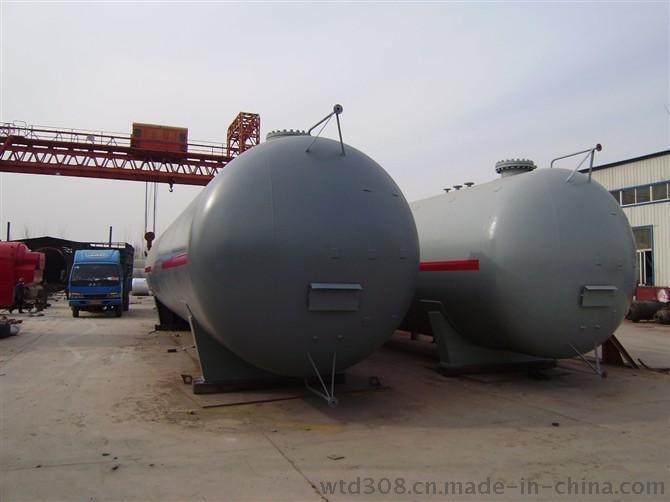
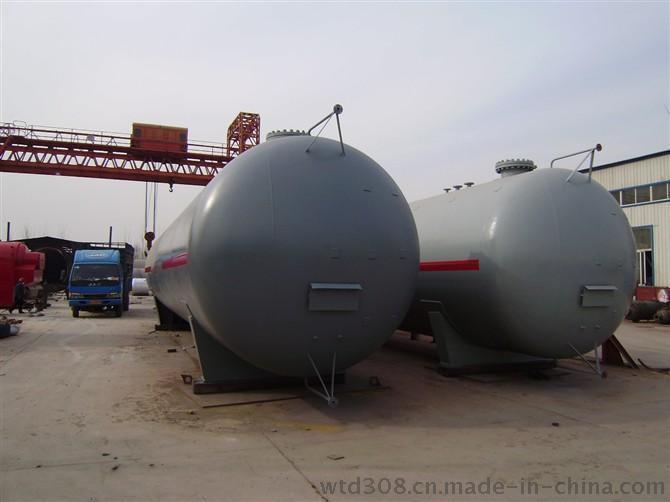

Manufacturing10Cubic Liquefied Gas Storage Tank20Cubic Liquefied Gas Storage Tank30Cubic LPG Storage Tank50Cubic Liquefied Gas Storage Tank60Cubic LPG Storage Tank80Cubic Liquefied Gas Storage Tank100Cubic LPG Storage Tank150Cubic Liquefied Gas Storage Tank200Cubic Liquefied Gas Storage Tank10Cubic liquid ammonia storage tank20Cubic liquid ammonia storage tank40Cubic liquid ammonia storage tank50Cubic liquid ammonia storage tank80Cubic liquid ammonia storage tank100Cubic liquid ammonia storage tank150Cubic Liquid Ammonia Storage Tank200Cubic liquid ammonia storage tank
Heze Boiler Factory Co., Ltd. is a producer of liquefied gas storage tanks in China.5--200A fullannealing furnace for cubic liquefied gas tanks, steel column sandblasting for rust removal, advanced manufacturing management systems, procurement of high-quality raw materials, and welding techniques by skilled welders forge a liquefied gas tank production base.
Liquefied Petroleum Gas (LPG) storage tanks are pressure vessels used for storing LPG. They are special equipment that can only be produced by enterprises approved by the National Quality Supervision and Inspection总局. Such production requires a Class 3 pressure vessel design and manufacturing qualification issued by the state. Shandong Heze Boiler Factory Co., Ltd. is a national-approved design and manufacturing enterprise for Class 1, 2, and 3 pressure vessels. It is capable of producing pressure vessels, including LPG storage tanks under 200 cubic meters, making it one of the few nationwide that can produce such equipment.200Cubic Corporation.
Liquefied Petroleum Gas Storage Tanks - Selected according to national standardsQ345RSteel plates, generally sourced from Jinan Iron and Steel Works or Anyang Iron and Steel Works, both being major state-owned steel enterprises in China. The quality of the steel plates is guaranteed, and our technical staff will re-inspect them upon arrival to ensure their compliance. Qualified steel plates undergo multiple processes including rolling, splicing, welding, non-destructive testing, annealing, hydrostatic and pneumatic testing, sandblasting for rust removal, and painting, all using state-of-the-art production techniques to guarantee the quality of our storage tanks. Liquefied gas storage tanks are primarily used in liquefied gas stations. The production process of the storage tanks involves several steps, with the key ones being: selecting raw materials from reputable large-scale steel mills, where our company sources materials from state-owned steel enterprises in Jinan and Anyang; next, the tanks must undergo overall annealing after welding to relieve the stress in the steel plates, ensuring the tank becomes a unified whole and preventing cracks from forming in the welds; further, we employ sandblasting for rust removal, using steel sand with a particle size of one to two millimeters to abrade the tank's surface. This method effectively removes rust, and the paint applied will also last longer.***Our company selects products from large paint manufacturers, applying two coats of anti-rust primer followed by two coats of topcoat. Four coats of paint ensure the tank will not peel for five to ten years, and with good maintenance, it can last up to twenty years without the need for repainting.
Huzhou Boiler Factory Co., Ltd. operates a development center, an installation company, and three production bases. It has established close cooperative relationships with numerous key universities and research institutions in China. New product development is ongoing and highly favored by a wide customer base. We offer industrial and residential coal-fired boilers, oil-fired boilers, gas-fired boilers, biomass boilers, heat transfer oil boilers, waste heat recovery boilers, refrigeration auxiliary equipment, and pressure vessels of categories I, II, and III (including liquefied gas storage tanks, liquid ammonia storage tanks, methyl chloride storage tanks, propane storage tanks, underground tanks, tower vessels), low-temperature containers (liquid oxygen storage tanks, liquid nitrogen storage tanks, liquid argon tanks), heat exchanger units, and ground-source heat pump units, among others. For many years, the company has actively implemented an innovation strategy centered around technological, market, and management innovation, accelerating corporate reform and restructuring. It has gradually established a modern corporate system that adapts to the socialist market economy system.
Liquefied Petroleum Gas primarily originates from refinery gas and associated gas from oil fields.
I. Extracted from refinery natural gas
Refinery gas is a byproduct of the oil refining and processing, with its quantity depending on the production method and processing depth of the refinery, generally accounting for 4%-10% of the original weight. Currently, the recovery of liquefied petroleum gas from the catalytic cracking gas of refineries is the primary source for domestic LPG.
Section II: Derived from Associated Gas from Oil Fields
Associated gas from oil fields is a byproduct gas produced during the oil extraction process. It is itself a combustible gas that exists within the geological structures of the oil-bearing layers, containing 10%-40% of propane, butane, pentane, and higher carbon alkanes. During oil extraction, both oil and associated gas are emitted simultaneously. They are separated using gas-oil separation units installed above the oil wells. The associated gas contains approximately 5% of propane and butane components, which can be extracted using absorption methods to yield high-purity liquefied petroleum gas with very low sulfur content. The liquefied petroleum gas supplied by countries such as Europe, the United States, and Japan often falls into this category.
III. Extracted from Natural Gas
Pure natural gas extracted from underground is divided into dry gas and wet gas. Wet gas contains less than 90% methane, with more than 10% of ethane, propane, butane, and other alkanes. After the gas is compressed and fractionated, it is absorbed using diesel spray, then condensed into a liquid state at a pressure of 1.6 MPa in a fractionation tower, forming liquefied petroleum gas.
Safety Procedure for Inverting Drums
1. Prior to production or maintenance procedures, first inspect the pressure, liquid level, and temperature of the inverting and pouring tanks, record them upon confirmation, then proceed with decanting.
2. Determine the liquid discharge volume from the tank and the incoming liquid volume to the receiving tank, and calculate whether the receiving tank's capacity meets the process and safety requirements. Confirm the tank transfer process.
3. The operation procedure is: open the liquid phase valves for in and out of the tank — adjust the vapor phase valves — start the circulating compressor.
4. During decanting, pay attention to checking the storage tank pressure and liquid level changes, and reverify calculations at any time; the incoming liquid tank must not exceed the maximum allowable liquid level.
5. After decanting is complete, shut off the compressor, close the liquid phase valve, and re-adjust the compressor valve.
6. Thoroughly complete the operational records.


液化气储罐出售-专业定制液化气储罐批发价-知名液化气储罐生产厂家-专业液化气储罐生产厂家
