


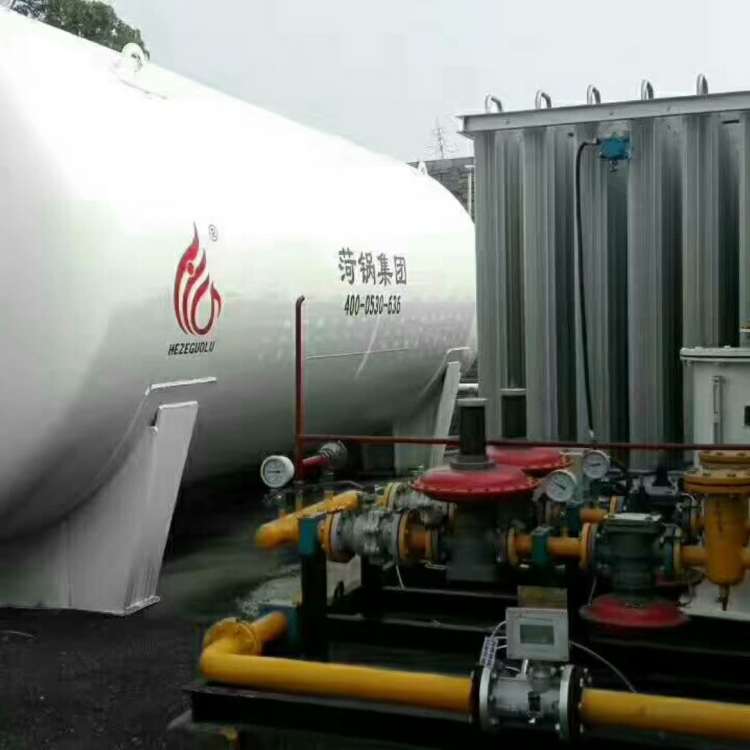
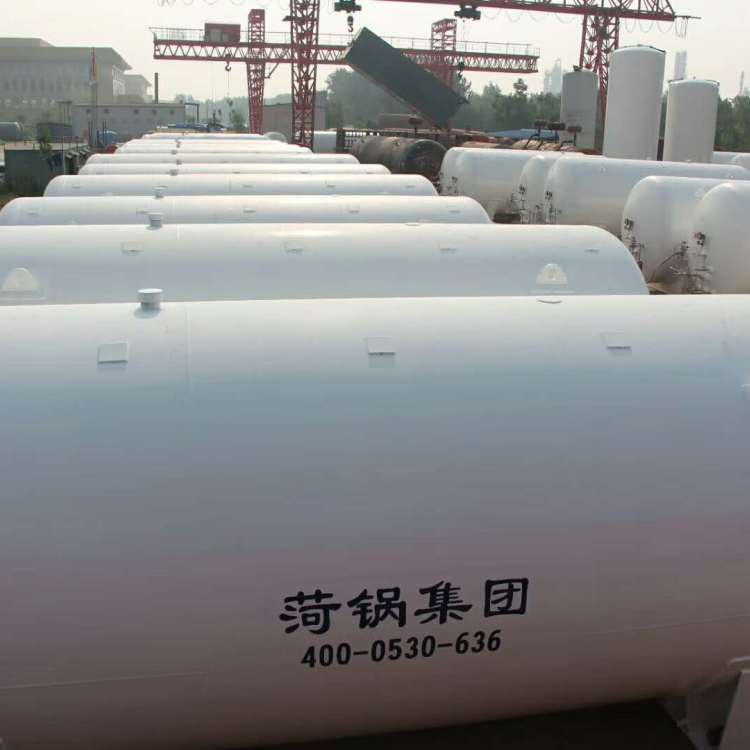
Production Knowledge of LNG Stored in LNG Tanks
We've already introduced a lot of knowledge about LNG tanks, and I believe everyone has a certain level of understanding. Now, let's delve into the production process of the LNG gas stored in these tanks. LNG gas is highly flammable and explosive, and it's widely used in both industrial production and our daily lives. In fact, we can't live without LNG gas.
The relevant personnel have provided us with explanations regarding this issue. The production process of LNG is a purely physical change, with a short process flow that is convenient for safety management. The main technological approach involves the use of deep refrigeration technology, cooling it to (-162℃). Under normal pressure, LNG fuel remains in a liquid state, while other heavy components become solid floatables and are removed. Some gases (such as N2) remain in a gaseous state and are collected and emitted. Thus, LNG fuel is a pure alkane, and it is pumped into an insulated LNG storage tank at low temperatures for storage.
Our company specializes in providing various storage tanks and devices for special gases. Welcome all customers in need to inquire and purchase. Production knowledge of LNG stored in LNG tanks.
The lng tank industry rides the wave of lng-powered ship demand
Due to increasingly stringent international requirements for ship emissions, China has fully developed the supporting capabilities for LNG fuel storage tanks, which are crucial for LNG-powered vessels. However, as the modification and construction of China's LNG-powered ships are still in the early stages, there is insufficient emphasis on the storage safety of LNG fuel, leading to potential safety hazards in some of our LNG storage tanks.
What issues might arise with low-temperature storage tanks and how to solve them
Tanks are a crucial device for containing gases, playing a prominent role in the industry. Tanks are highly stringent products, and even so, it's difficult to guarantee they won't encounter issues. This is true not just for low-temperature tanks, but also for other types like LNG and liquid oxygen tanks, which can all develop problems over time. The key is to identify and address these issues promptly. Let's take a look at what problems low-temperature tanks might encounter and how to resolve them.
1. The evaporation in the low-temperature storage tank increases, and the vacuum level decreases. This may be due to the degassing of pearly sand. Pearly sand requires specific particle size and temperature during filling. If the particle size and temperature of the pearly sand are not suitable, after operating for a period, the pearly sand will release steam, leading to a decrease in vacuum level and an increase in evaporation.
2. The outer shell of the low-temperature storage tank "sweats" at the top. This may be due to the accumulation of pearly sand at the bottom. After a period of use, the pearly sand settles, creating space at the top of the container, which significantly reduces the insulation effect, causing the container to leak cold. In this case, if there is a large amount of evaporation, the top of the jacketed outer shell can be opened up to replenish pearly sand.
3. There is significant sweating and frosting on the outside of the storage tank. This may be due to a leak in the pipeline within the tank's sandwich layer, insufficient filling of pearly sand, or other reasons causing damage to the vacuum degree of the sandwich. It requires inspection and correction, leak detection, or replenishing the pearly sand, and then re-evacuating the vacuum.
4. Abnormal pressure increase in the storage tank inner cylinder, triggering the safety valve. This may be due to one of the following three reasons: a. The vacuum degree of the storage tank sandwich is damaged; b. The inner cylinder pressure booster valve is malfunctioning, requiring repair or replacement of the booster valve; c. Leakage at the bottom of the interface is located at the welded joint between the stainless steel and carbon steel outer shell, or at the connection between copper pipes and the stainless steel inner cylinder, i.e., the dissimilar welding joint, primarily due to electrochemical corrosion at the dissimilar welding joint.
What issues might arise with low-temperature storage tanks and how to resolve them
The pressure in lng tanks and BOG have a significant impact on tank safety, which is also one of the issues to be noted during tank construction. Longer storage times, increased pressure inside the pipes, and a higher BOG level can reduce safety; higher environmental temperatures also greatly affect pressure and BOG, with increased temperatures leading to lower safety; better insulation makes the tank safer; increasing the nitrogen content inside the tank can also reduce BOG and enhance safety.
-/gjehec/-
