


High evaporation rate in biomass pellet boiler fuel may lead to the following issues:
Incomplete combustion: Fuels with high volatility release a large amount of steam during combustion, which lowers the combustion temperature and affects the completeness of combustion. Incomplete combustion leads to energy loss and increased emissions, reducing the boiler's thermal efficiency and environmental performance.
Poor combustion stability: Fuels with high evaporation rates tend to cause instability in the combustion process, potentially leading to issues such as flameout and uneven combustion. This can result in unstable operation of the boiler and affect the stability of hot water supply.
To address issues caused by high-evaporation fuel, the following measures can be taken:
Combustion System Optimization: Optimize the combustion system of biomass pellet boilers, encompassing aspects such as combustion chamber design, air supply, and mixing. Enhance combustion completeness and stability through measures like increasing combustion temperature and oxygen supply.
Combustion Control: Utilizes a combustion control system that monitors and adjusts parameters such as temperature and oxygen content in real-time during the combustion process. Adjusts the supply of combustion air based on actual conditions to maintain stability and completeness of combustion.
Fuel Pre-treatment: Pre-treat biomass pellet fuel with high volatile matter content, such as drying and crushing. By reducing the moisture content and particle size of the fuel, the volatile matter content is minimized, enhancing the efficiency and stability of combustion.
Burn parameter adjustment: Adjust the boiler's burn parameters, such as combustion temperature and time, based on actual conditions. Through reasonable parameter adjustment, make the combustion process better adapt to the characteristics of high-evaporation fuel.
In summary, by optimizing the combustion system, adjusting control mechanisms, pre-treating the fuel, and fine-tuning combustion parameters, issues related to high evaporation rates of biomass pellet boiler fuel can be reduced, thereby improving the boiler's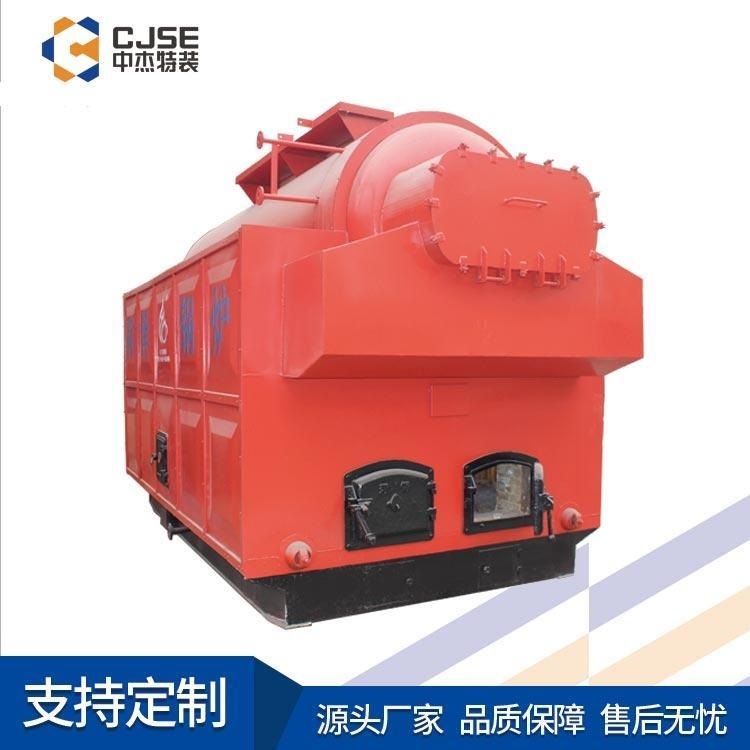
The DZH steam boiler is a manually operated solid fuel boiler with the following technical features:
Fueling Method: The DZH steam boiler utilizes manual fueling, meaning the operator manually feeds fuel and adjusts the combustion process. This method is relatively simple and flexible, suitable for small to medium-sized applications.
Multiple Fuel Adaptability: The DZH steam boiler boasts strong fuel adaptability, capable of burning solid fuels such as wood chips and straw. This feature allows the DZH steam boiler to be widely used in various regions and under different fuel resource conditions.
Furnace Structure: The DZH steam boiler features a double-chamber furnace structure, with a partition between the combustion chambers. This design enhances both the temperature and combustion efficiency of the chambers, thereby improving thermal efficiency.
Flue Gas Channels: The DZH steam boiler features a spiral flue tube design for its flue gas channels, which increases the contact area between flue gas and water, enhancing heat exchange efficiency. Additionally, a flue gas reversal chamber is incorporated within the flue gas channels, allowing the flue gas to circulate multiple times within the furnace, extending its residence time and improving combustion efficiency.
Safety Protection: The DZH steam boiler is equipped with various safety devices, including pressure controllers, water level controllers, and overheat protectors, ensuring safe operation of the boiler.
Compact Structure: The DZH steam boiler features a compact structure with minimal floor space, making it ideal for installation in limited areas.
Overall, the DZH steam boiler features strong fuel adaptability, flexible operation, and high thermal efficiency, making it suitable for small and medium-sized solid fuel steam demand applications.
Biomass boiler furnace soot blowing refers to the process of cleaning the combustion area within the furnace by using a soot blowing device. The purpose of soot blowing is to remove ash and slag within the furnace, maintain the unobstructed flow of the combustion area, and enhance the combustion efficiency and operational stability of the boiler.
The ash blowing operation in the furnace is generally divided into two types: mechanical ash blowing and pulse ash blowing.
Mechanical Ash Blowing: Mechanical ash blowing is a process that uses mechanical devices, such as rotary ash blowers and chain ash blowers, to clean the combustion area inside the furnace. The mechanical ash blower rotates or moves periodically to remove ash and slag from the combustion area.
Pulse Blasting: Pulse blasting involves using high-pressure gas or compressed air to喷射气流 into the combustion area of the furnace through nozzles, creating shock and vibration to remove ash and slag. This method boasts effective ash removal and rapid cleaning speed.
The impact of the furnace ash blowing operation on biomass boilers is mainly reflected in the following aspects:
Clean combustion area: The furnace ash blowing can burn the slag and accumulated ash in the combustion area, keeping the combustion area unobstructed, which is conducive to the full combustion of fuel and improves combustion efficiency.
Reduce smoke gas resistance: Firing bed ash blowing can burn the ash and slag in the combustion area, reducing the resistance in the smoke gas passage, conducive to smooth exhaust of smoke gas, and improving the heat exchange efficiency of the boiler.
The SZL biomass boiler is a water-tube boiler with a double drum and chain grate, designed for burning biomass fuel. Below is a structural introduction to the SZL biomass boiler:
Boiler Drum: The SZL biomass boiler features two parallel water pipes in the drum, the upper drum and the lower drum. The upper drum is used for the combustion chamber, while the lower drum is for heat transfer of steam and flue gas.
Briquette: The SZL biomass boiler utilizes a chain grate, where fuel enters the combustion chamber through the grate, thereby initiating the combustion process. The design of the chain grate ensures even and complete combustion of the fuel.
Combustion Chamber: The combustion chamber is located inside the upper cylinder, where fuel is burned to release heat energy. The structure and design of the combustion chamber ensure complete combustion of the fuel and efficient conversion of heat energy.
Flue Duct: The smoke produced by combustion enters the lower cylinder through the flue duct, where it exchanges heat with the water inside the pipes, transferring thermal energy to the water and producing steam.
Water pipes: A large number of water pipes are arranged inside the lower drum of the SZL biomass boiler. Flue gas passes through these pipes, where it exchanges heat with the water, transferring thermal energy to the water and generating steam.
Upper Equipment: The upper equipment of the SZL biomass boiler includes steam separators, level gauges, safety valves, etc., which are used for controlling and protecting the safe operation of the boiler.
Equipment: The SZL biomass boiler also includes equipment such as the water supply system, sewage system, and fuel supply system, which are used to provide the boiler with water, treat wastewater, and supply fuel, etc.
The SZL biomass boiler features a compact structure and high thermal efficiency, suitable for the combustion of biomass fuel. Its design with two drum boilers and a chain grate ensures complete fuel combustion and heat conversion, while also offering excellent safety and reliability.
Shandong Zhongjie Special Equipment, welcome clients for factory discussions and collaboration.
