


Planar grinding machines are widely used for single-sided polishing and lapping of various materials such as LED sapphire substrates, optical glass wafers, quartz wafers, silicon wafers, sheets, molds, light guide plates, and optical fiber connectors.
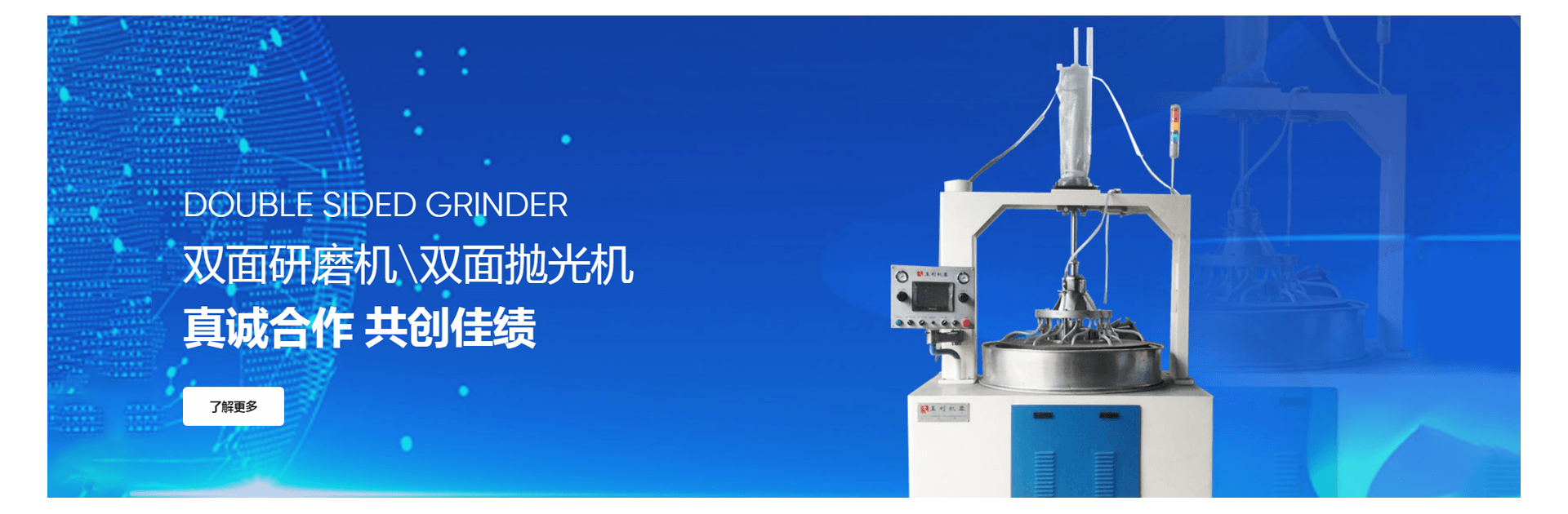
The flat grinding machine is a precision grinding and polishing equipment, where the material to be ground or polished is placed on a flat grinding disc. The grinding disc rotates counterclockwise, and the correction wheel drives the workpiece to rotate automatically. Gravity or other pressure methods are applied to the workpiece, and the workpiece and the grinding disc perform relative movement and friction to achieve the grinding and polishing purpose. The abrasive particles that produce the grinding effect come from two sources: one is continuously added externally (commonly referred to as free abrasive); the other is to fix the abrasive particles in the grinding disc (commonly referred to as bonded abrasive).
Grinding machines are abrasive machines that use tools coated or embedded with abrasive materials to grind the surface of workpieces. They are primarily used for grinding high-precision flat surfaces, internal and external cylindrical surfaces, conical surfaces, spherical surfaces, threaded surfaces, and other shaped surfaces on workpieces.
Flat grinding machines are widely used for single-sided polishing and lapping of various materials, including LED sapphire substrates, optical glass wafers, quartz wafers, silicon wafers, plates, molds, light guide plates, and optical connectors.
The main types of grinding machines include disk-type, shaft-type, and various specialized grinding machines. The control system of the grinding machine is centered around a PLC, with a text display serving as the human-machine interface. The human-machine interface can communicate with users regarding equipment maintenance, operation, and fault information; the operating interface is intuitive and easy to use, with program control and simple operation. Safety considerations ensure that unintended operations in abnormal states are ineffective. Real-time monitoring is in place, with fault and error alarms, and maintenance is convenient. Grinding is a precision finishing process that utilizes abrasive particles coated or embedded in a grinding tool, which, through relative motion between the grinding tool and the workpiece under certain pressure, refines the surface to be machined (such as cutting). Grinding can be used to process various metals and non-metallic materials, and can produce surface shapes including planes, internal and external cylindrical surfaces, conical surfaces, convex and concave spherical surfaces, threads, gear surfaces, and other complex shapes.
The machines can be categorized by the number of grinding disks: single-sided and double-sided grinding machines. And by the size of the grinding disks: 380 grinding machine, 460 grinding machine, 610 grinding machine, 910 grinding machine, and so on.
