
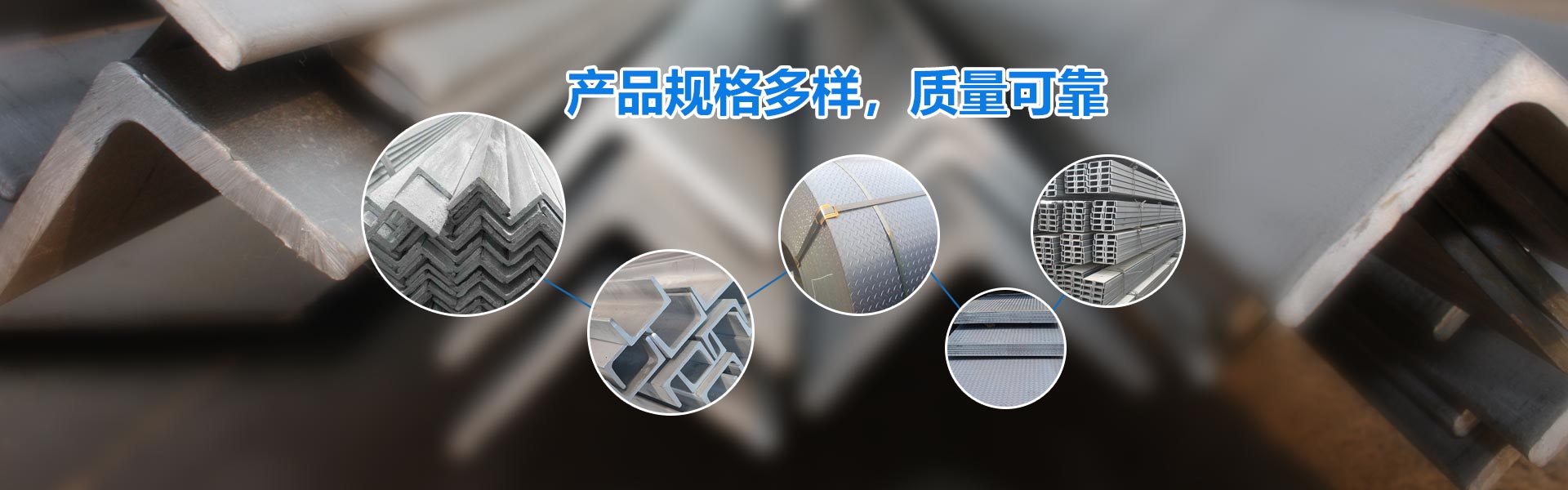

H-beams are one of the four major types of steel products (sheet, tube, section, and wire). According to their cross-sectional shapes, sections are categorized into simple section sections and complex section sections (special-shaped steel). The former includes square steel, round steel, flat steel, angle steel, hexagonal steel, etc.; the latter includes I-beams, channel steel, window frame steel, and bent sections, etc.
Square steel: steel with a square cross-section, available in two types: hot-rolled and cold-rolled. Hot-rolled square steel has side lengths ranging from 5 to 250mm, while cold-drawn square steel has side lengths from 3 to 100mm.
Round Steel: Round-sectioned steel bars, categorized into hot-rolled, forged, and cold-drawn types. Hot-rolled round steel ranges from 5 to 250mm in diameter, with 5-9mm commonly used as the raw material for drawn steel wires, known as wire rod; due to its coil supply, it is also referred to as hot-rolled coil. Forged round steel has a thicker diameter and is used for shaft blanks. Cold-drawn round steel has a diameter of 3-100mm, with high dimensional accuracy.
Flat Steel: Steel with a width of 12-300mm, thickness of 4-60mm, and a rectangular cross-section with slightly rounded edges. Flat steel can be finished steel or used as billets for welded pipe production and as thin plate billets for rolling.
Angle Iron: There are two types of angle iron: equal-leg angle iron and unequal-leg angle iron. The specifications of angle iron are indicated by the dimensions of the side length and thickness. The commonly produced specifications range from 2 to 20 numbers, representing the centimeters of the side length. For instance, a 5-number equal-leg angle iron refers to an angle iron with a side length of 125px (50mm). The same number of angle iron often has 2 to 7 different thicknesses.
I-Beams, also known as steel beams, are long strips of steel with a cross-section in the shape of an "I." They are categorized into three types: regular I-Beams, light I-Beams, and H-shaped steel. I-Beams are widely used in various architectural structures, bridges, vehicles, supports, and machinery.
Channel steel is a long, strip-shaped steel with a notch-shaped cross-section. It falls under construction and machinery-grade carbon structural steel, being a steel section with a complex shape characterized by a notch profile. Channel steel is primarily used in building structures, curtain wall projects, machinery and vehicle manufacturing, and more.
Window frame steel, obtained by taking a square-sectioned billet steel, is hot-rolled into an H-shaped section on a rolling mill. At the exit of the subsequent rolling mill, there is a clamping and cutting slot device, which cuts longitudinal grooves on both sides of the H-shaped section from the core. After cooling, the H-shaped section is longitudinally cut into two T-shaped sections.
Bent steel is formed by bending sheet steel or strip steel, and it comes in two types: hot-bent and cold-bent steel. There are over 2,000 varieties and specifications of bent steel. By using bending techniques, complex cross-section steel, thin-walled steel, and hollow steel can be produced, which cannot be made through hot rolling methods. Replacing conventional hot-rolled steel with bent steel can reduce structural weight, minimize manufacturing labor, and save a significant amount of metal. Bent steel is widely used in the manufacturing sectors of automobiles, vehicles, shipbuilding, agricultural tools, furniture, aviation, bicycles, and more.
