


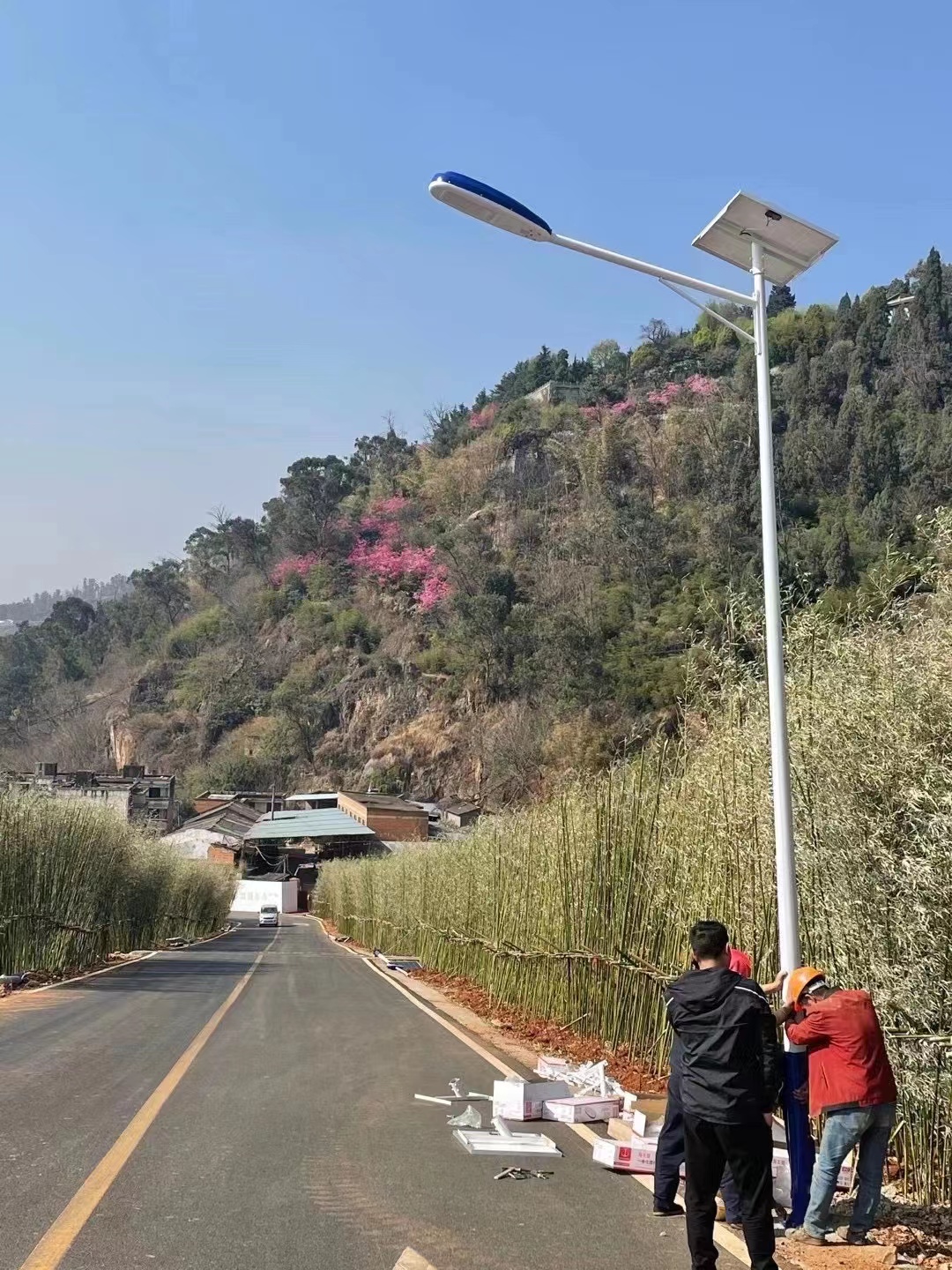
Solar street lights are a type of lighting that converts solar energy into electrical energy for illumination. They integrate cutting-edge technologies of solar power generation and LED lighting, truly achieving "zero carbon and zero emissions." The solar street light system is easy to install, requires no cable laying, and can be quickly and simply mounted in places with abundant sunlight. Solar street lights represent a new direction in road lighting in the new era and are widely used in the construction of rural roads, urban and rural roads, campus roads, factory roads, and more. Choosing the right solar street lights involves the following elements:
Installation and arrangement of solar street lights:
Solar streetlights should be selected based on the road width and proposed lighting requirements, determining the installation and layout of the fixtures. Traditional lighting methods include three types: single-sided lighting, double-sided symmetrical lighting, and double-sided alternating lighting.
2. Solar Roadway Lighting Source Selection:
Due to the ongoing deterioration of the global environment and the continuous warming of the climate, widespread solar-powered street lighting is being promoted as an LED lighting solution under policy initiatives.
3. Lighting Selection:
The selection of lighting primarily considers reflectance, luminance, and maintenance factor. Road lighting quality is typically measured by three indicators: road brightness, uniformity, and glare.
Brightness Level
Roadway average luminance requirements vary according to road grade. Generally, highways and main roads require luminance greater than 2 cd/m², while secondary roads, auxiliary roads, or community roads have relatively lower requirements.
2) Average Luminance
Average luminous intensity refers to the average of all luminous intensities on the road, a unit of lighting intensity, usually represented by LM.
Glare
Roadway lighting should minimize uncomfortable glare to a certain extent, typically represented by the G-value. Generally, g=7 IV.
4. Controller Selection:
Controllers are typically made of stainless steel, offering both aesthetics and durability. The rechargeable and discharge controllers are designed with lighting control, time control, and overcharge/overdischarge protection, enabling secondary energy-saving control and half-power lighting within the specified time frame.
5. Solar Panel Capacity:
For solar street lights, the entire system configuration formula is: p = light source power x light source working hours / peak sunlight hours; where p is the power of the battery module, measured in watts (W); light source working hours are in hours, and peak sunlight hours are also in hours.
Battery Capacity:
Determine the battery type and storage days based on the local rainfall.
7. Light Pole Design:
Solar street lights feature a conical pole design, which is aesthetically pleasing and durable, with simple processing techniques and high mechanical strength, making it easy to shape into various forms. Common pole cross-sections include circular, hexagonal, and octagonal shapes. The taper ratio is typically 1:90 or 1:100. The wall thickness usually ranges from 2.3 to 5mm, depending on the pole's stress.
8. Tilted Design
To maximize solar radiation within a year, we should choose an appropriate angle based on local sunlight conditions and extend the exposure time to its limit.
9. Wind Resistance: The wind-resistant design is primarily divided into two parts: the wind resistance of the battery module bracket and the wind resistance of the pole.
