

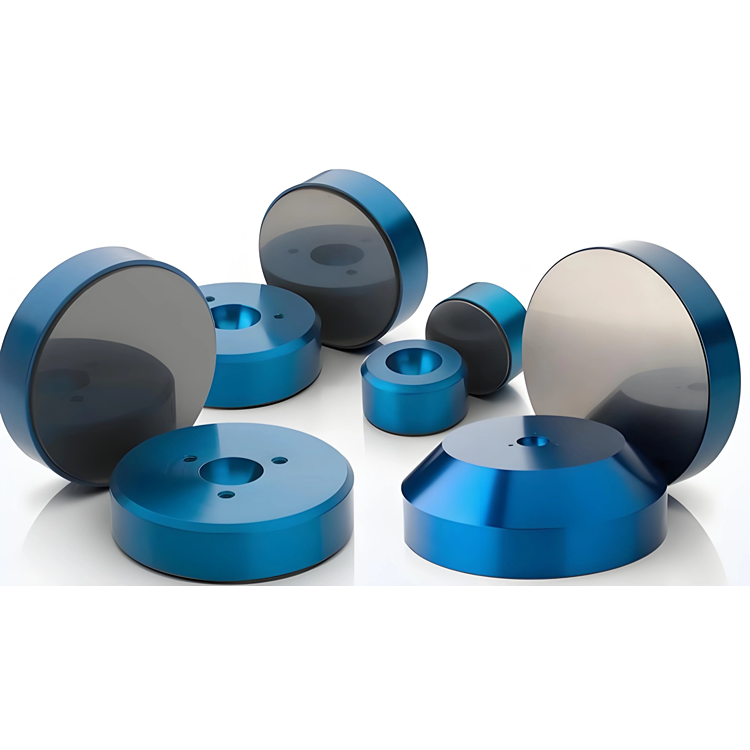

Aeration floating bearing is a type of bearing that utilizes...High-pressure gases (such as air, nitrogen, etc.) form a gas filmTo achieve bearing technology with non-contact support, featuringZero friction, zero wear, ultra-high precisionWith features, widely applied in precision manufacturing, semiconductor equipment, aerospace, and other fields.
1. The core principle of aerodynamic bearing
Aeration bearing achieves complete separation between the rotor and stator by injecting high-pressure gas into the bearing clearance (typically 5~50μm), forming a stable gas film.
Non-contact levitationEliminate mechanical friction, theoretical lifespan is infinite (no wear).
Nano-scale precisionThe air film uniformity can reach sub-micron levels, suitable for ultra-precision motion control.
Zero pollutionNo lubrication required, high cleanliness, suitable for dust-free environments (such as lithography machines).
2. Main types of air bearing
(1) Classified by the method of aerofilm formation
| Type | Principle | Features | Applied |
|---|---|---|---|
| Static Pressure Floating Bearing | Continuous pressure supply from external source, stable aerogel membrane | High load-bearing capacity, large stiffness, but requires complex air routes | Machine Tool Spindle, Precision Measurement |
| Dynamic Pressure Floating Bearing | Relying on the rotor's high-speed rotation to generate its own air pressure | No external gas source required; however, contact is present during the start/stop phase. | High-speed turbine, flywheel energy storage |
(2) By structural classification
Radial Floating BearingRadial load supporting the rotating shaft (e.g., the spindle).
Pusher Force Floating BearingBearing axial loads (such as vertical shaft supports).
Composite Floating BearingRadial and axial integrated design (e.g., lithography machine stage).
3. Core Performance Parameters
| Parameters | Description | Typical Value |
|---|---|---|
| Air Film Thickness | Rotor and Stator Clearance | 5~50 μm |
| Stiffness | Resistance to deformation | 50~500 N/μm |
| Load-bearing capacity | Single bearing maximum load | Dozens to thousands of Newtons (N) |
| Gas Pressure | Gas Source Pressure Requirement | 0.3~0.8 MPa |
| Motion Precision | Rotary/Linear Motion Error | ≤0.1 μm (high-end applications) |
4. Advantages and Disadvantages of Floating Bearings
✅ Advantages
Zero Friction & Wear-FreeTheoretical lifespan is virtually unlimited, with extremely low maintenance costs.
Ultra-high precisionNo mechanical vibration, motion repeatability down to the nanometer level (e.g., in lithography machines).
High speedSpeeds above 100,000 RPM (e.g., dental drills, centrifuges).
Clean and pollution-freeNo lubrication required; suitable for semiconductor and medical equipment.
❌ Limitations
High costPrecision machining required (pores/air grooves with μm level tolerance) and stable gas source.
Low load capacityCompared to hydraulic or ball bearings, the load-bearing capacity per unit area is lower.
Dependent on gas sourceLoss of gas supply or unstable pressure can cause the gas film to collapse, necessitating a backup system.
