
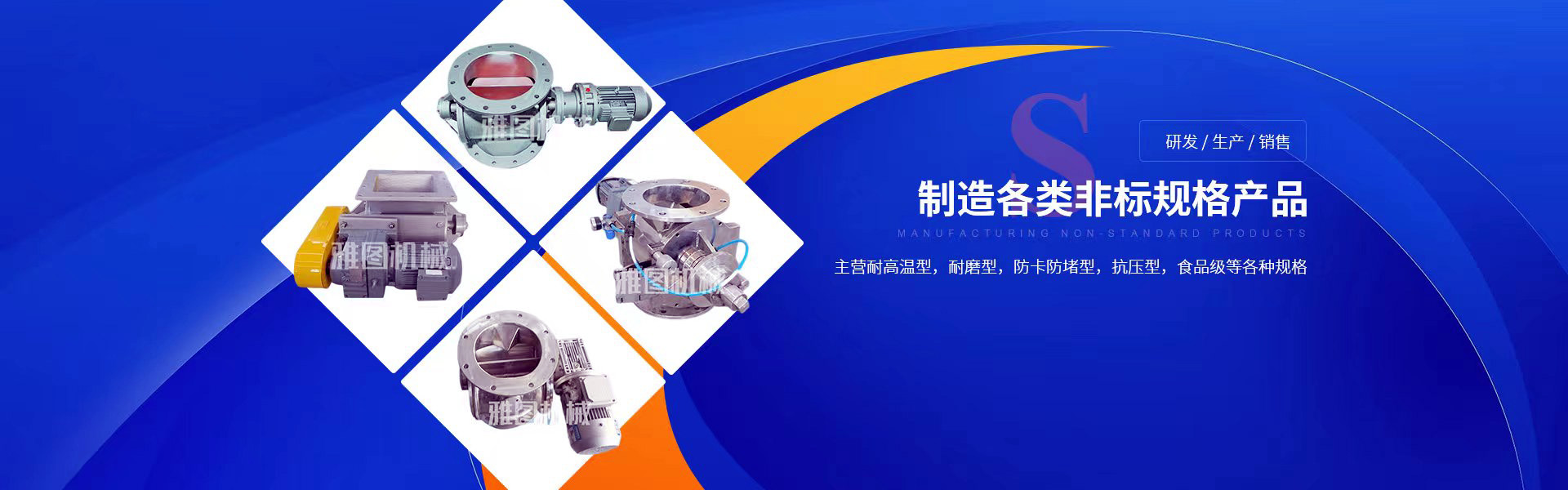
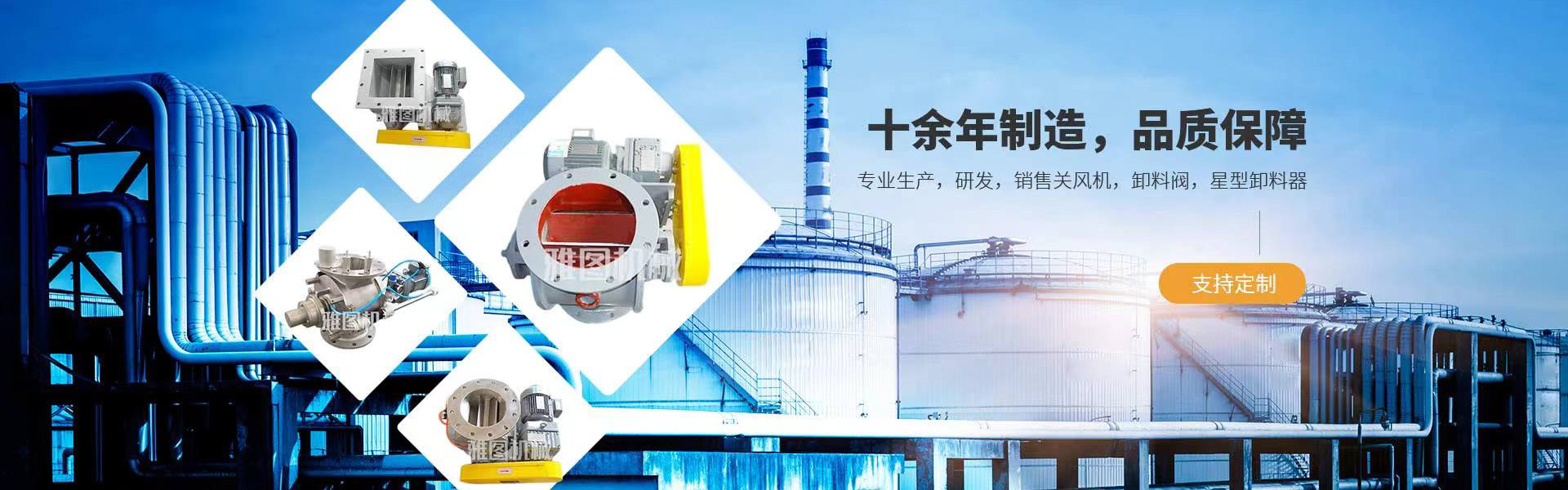



Rotary Valve Applications:
The rotary valve, also known as a star feeding machine or impeller feeding machine, incorporates the advantages of discharging and serves as a uniformly continuous batching, conveying, and unloading equipment in mechanical and automatic control systems. The entire rotary valve boasts features such as a small size, light weight, strong production capacity, and convenient maintenance and operation. The rotary valve finds wide application in the pneumatic conveying projects and bulk material handling systems of various industries and fields such as powder engineering, grain processing, ports and docks, petrochemical, chemical fiber, chemical industry, power, food, building materials, and mining, thanks to its characteristics of simplicity, environmental protection, and long-distance automatic control.
Section II: Working Principle and Brief Description of the Rotating Valve
Rotary valves, also known as impeller feeders, star feeders, airlock valves, gas locks, rotary feeders, and star valves, are composed of a rotor with several blades, a housing, seals, and an electric motor, reducer, etc. As the rotor rotates within the cylindrical housing, materials that fall from the upper hopper due to gravity fill the spaces between the blades and are discharged at the bottom as the rotor turns, thereby achieving a uniform and continuous material conveying process.
The rotary valve is a key equipment in pneumatic conveying systems. It can supply material evenly and continuously to the conveying pipeline for both positive and negative pressure conveying systems. The rotary valve is particularly suitable for positive and negative pressure pneumatic conveying systems, pulse dust removal equipment, and precise feeding applications. It features a compact structure, attractive design, good airtightness, stable operation, uniform material discharge, lightweight, and energy-saving. It serves to supply material and lock the air flow, effectively preventing reverse airflow due to the low-speed rotation of the impeller and the small gap between the impeller and the shell cavity, thus ensuring stable pressure within the system and normal discharge of materials.
According to the characteristics, usage, and application conditions of different materials, there are various structural types of rotary valves. The selection of the valve depends on the properties of the material being conveyed, such as particle size, adhesiveness, temperature, humidity, etc.
Section III: Performance Parameters of the Rotating Valve
Main Specifications: DN100~600 (4"~24")
Main Materials: SS304, SS316L, WCB
Main Models: Pneumatic Conveying Type, Gravity Discharging Type, Variable Discharging Type
Work Pressure: Atmospheric/ Low/ Medium/ High Pressure
ATM<0.1mpa0.15~0.35mpahp>0.35Mpa
Operating Temperature: -20℃ ~ 200℃ / ≤450℃ ~ ≤720℃
Flange Standard: ANSI B16.5150LB, GB, HG, SH as designed by the client
Electrical Explosion Proof Grade: User-defined
Applicable Media: Solid Materials (Powders, Granular Materials, Powder-Granule Mixtures, Sheets, etc.)
Four: Rotating Valve Performance Features:
Under the power of the motor, the drive reducer drives the impeller on the spindle to rotate, conveying the material evenly from the upper storage bin to the discharge port via the impeller slots.
2. Suitable for a variety of loose, non-adhesive dry materials.
3. Depending on the characteristics of the material being conveyed, explosion-proof motors, variable-frequency speed control motors, or electromagnetic speed control motors can be matched.
