


What are the classifications of nylon rods, tubes, and plates?
Nylon bar materials are categorized into extruded and cast types based on their production processes.
Currently, the commonly used extruded nylon rods on the market.
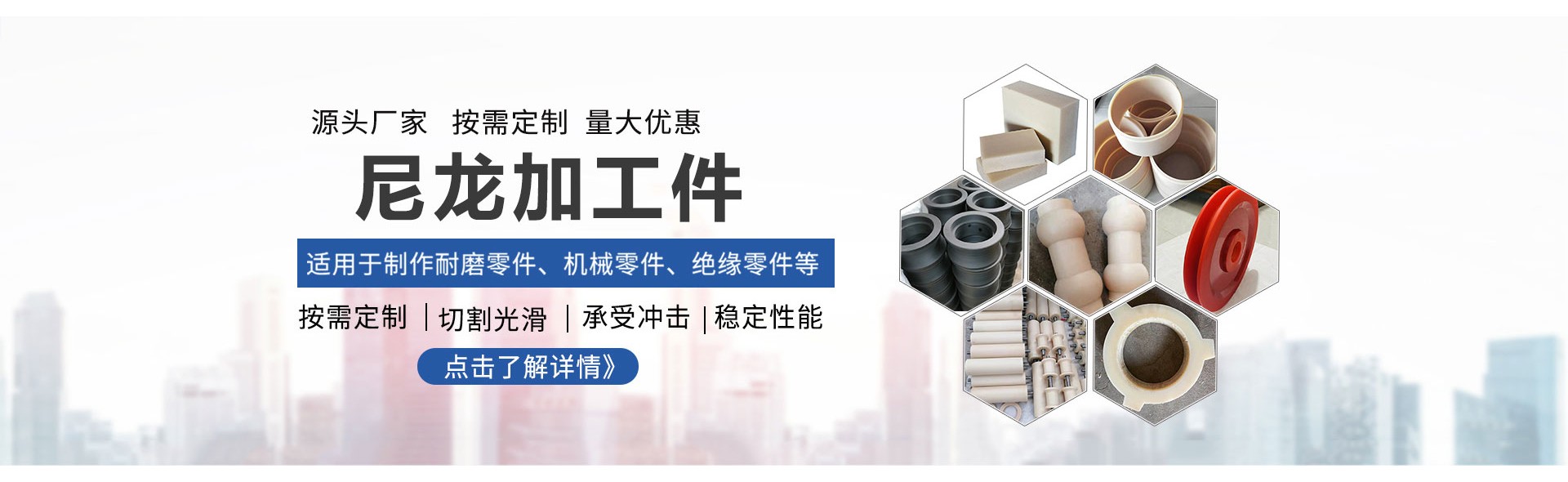
Nylon 6 (White): This material boasts superior comprehensive properties, including mechanical strength, stiffness, toughness, vibration damping, and wear resistance. With its excellent electrical insulation and chemical resistance, Nylon 6 is a "general-purpose" material, commonly used in the manufacturing of mechanical structural parts and maintenance components.
Nylon 66 (Cream): Compared to Nylon 6, it offers improved mechanical strength, stiffness, heat and wear resistance, and creep resistance. However, its impact strength and mechanical shock absorption properties are reduced, making it suitable for automatic lathe machining.
Nylon 4.6 (Red Brown): Compared to standard nylon, Nylon 4.6 boasts superior retention of rigidity, excellent resistance to creep, and enhanced resistance to heat aging over a broader temperature range. Therefore, it is used in "higher temperature areas" (80-150°C) where standard nylon 6, nylon 66, POM, and PET fail to meet requirements for stiffness, creep resistance, heat aging resistance, fatigue strength, and wear resistance.
Nylon 66+GF30 (Black): Compared to pure Nylon 66, this nylon is reinforced with 30% glass fiber, which improves its heat resistance, strength, rigidity, creep resistance, dimensional stability, and wear resistance. It allows for higher operating temperatures.
Nylon 66+MOS2 (Grey-Black): This nylon additive includes Molybdenum Disulfide, which enhances its rigidity, hardness, and dimensional stability compared to standard Nylon 66, albeit at the expense of lower impact resistance. The crystal formation effect of the MOS2 improves the crystalline structure, leading to improved load-bearing and wear-resistant properties of the material.
Cast Nylon Rod, also known as MC Nylon: English Name MoNomer Casting Nylon, also known as monomer casting nylon in Chinese, is a versatile material that replaces steel in various applications. It boasts unique properties such as light weight, high strength, self-lubricating, wear-resistant, corrosion-resistant, and insulating capabilities. As a widely-used engineering plastic, it is present in nearly all industrial fields.
Pouring
MC Nylon (Ivory White): Unmodified cast nylon 6 has properties very similar to nylon 66, offering excellent overall performance, high strength, rigidity, and hardness, resistance to creep and wear, heat aging resistance, and good machinability.
MC901 (Blue): This modified nylon 6 features a striking blue hue, boasts higher toughness and flexibility than standard cast nylon, and exhibits fatigue resistance, making it an ideal material for gears, racks, and transmission gears.
PA6+ Oil (Green): This molding nylon 6 is a true self-lubricating nylon, specifically developed for parts that require no lubrication, high loads, and low operating speeds, thereby broadening the scope of nylon applications. It features a lower coefficient of friction (reduced by 50%) and improved wear resistance (up to 10 times better) compared to regular nylon.
PA6+ MoS2 (gray-black): Enriched with MoS2 powder, it enhances the load-bearing capacity and wear resistance of unmodified nylon without affecting its impact and fatigue resistance, widely used in the production of gears, bearings, sprockets, and bushes.
PA6+ Solid Lubricant (Gray): Formulated with patented molding nylon 6, this material contains solid lubricant, offering self-lubricating properties, excellent friction characteristics, and outstanding wear resistance and pressure-velocity capabilities (five times higher than standard molding nylon). Particularly suitable for high-speed operating, lubrication-impossible moving parts, and serves as a perfect complement to oil-lubricated nylon.
