
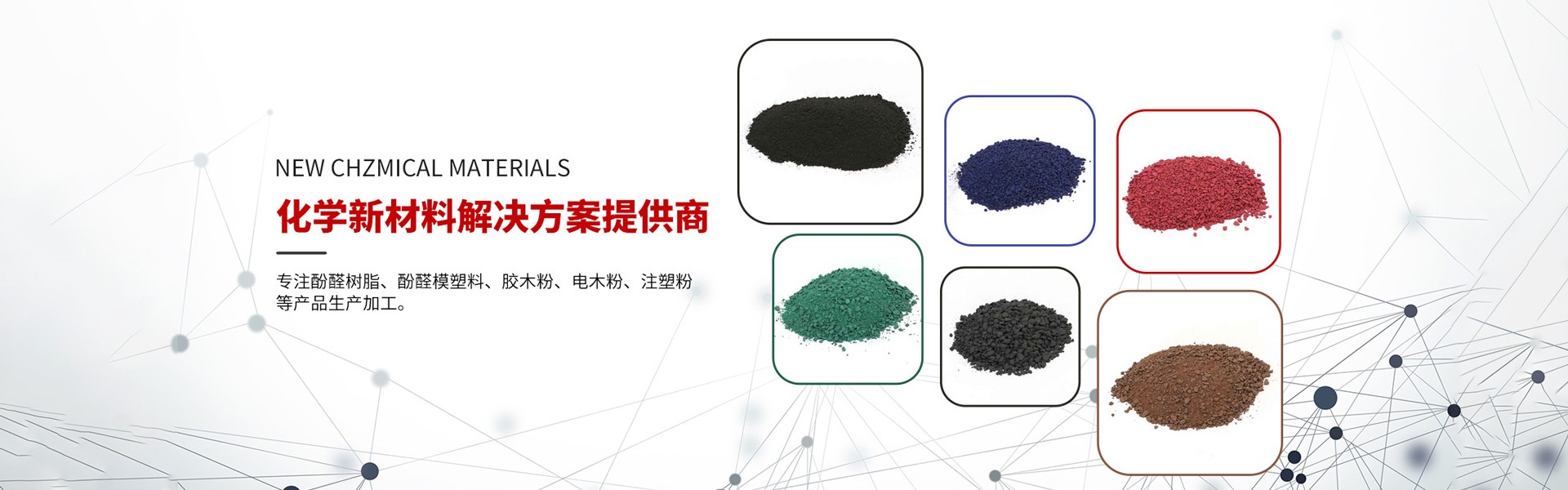
When formaldehyde (mole ratio) is less than 1, a thermoplastic product is obtained, known as thermosetting phenolic resin, or linear phenolic resin. It does not contain further condensation groups and can only be cured by adding a hardener and heating. For example, using hexamethylenetetramine as the hardener, the curing temperature is 150°C, mixed with fillers to form molding powder, commonly known as bakelite powder. When formaldehyde (mole ratio) is greater than 1, under alkaline catalysis, the A-stage resin is first obtained, which is a thermosetting phenolic resin, soluble in organic solvents. The A-stage resin contains hydroxymethyl groups that can be further condensed, thus it can cure without a hardener: heating the reaction produces the B-stage resin, also known as semi-soluble phenolic resin, which is neither soluble nor fusible but can swell and soften. Further reaction yields the C-stage resin, an insoluble and non-melting cross-linked structure, also known as non-soluble phenolic resin. The A-stage resin can also cure spontaneously upon long-term storage.
Thermosetting phenolic resins can be cured through two methods: room temperature curing and heat curing. Room temperature curing can be achieved using non-toxic room temperature curing agent NL, or benzene磺酰 chloride or petroleum sulfonic acid, but the latter two materials have higher toxicity and irritability.
Phenolic and aldehyde condensation products are commonly referred to as phenolic resins, generally referring to synthetic resins obtained through condensation reactions of **with formaldehyde. It is a type of thermosetting resin that was synthesized early on.
Phenolic resins, although they belong to an older category of thermosetting resins, are still widely used due to their readily available raw materials, ease of synthesis, and excellent mechanical strength and thermal resistance. Notably, they possess outstanding high-temperature resistance and ablation properties. Moreover, the resins can be extensively modified, making them suitable for manufacturing glass fiber reinforced plastics, carbon fiber reinforced plastics, and other composite materials. Phenolic resin composites play a crucial role in the aerospace industry, serving as structural materials with high-temperature resistance and ablation properties for spacecraft, rockets, missiles, and other applications.
The synthesis and curing process of phenolic resin strictly adheres to the rules of thermosetting polymerization. By controlling different synthesis conditions (such as the ratio of phenol to aldehyde, the type of catalyst used, etc.), two distinct types of phenolic resins can be obtained: one known as thermosetting phenolic resin, which contains active hydroxymethyl groups capable of further reaction. If the synthesis is not controlled, the thermosetting polymerization will continue until an irreversible, non-melting, non-soluble cured resin with a three-dimensional network structure is formed, hence also referred to as first-order resin. The other type is called thermoplastic phenolic resin, which is a linear resin that does not form a three-dimensional network structure during synthesis. A curing agent must be added during the further curing process, and this type of resin is also known as second-order resin. These two types of electrical wood powder differ significantly from both thermosetting and general thermoplastic materials in their excellent thermoplastic properties.
