


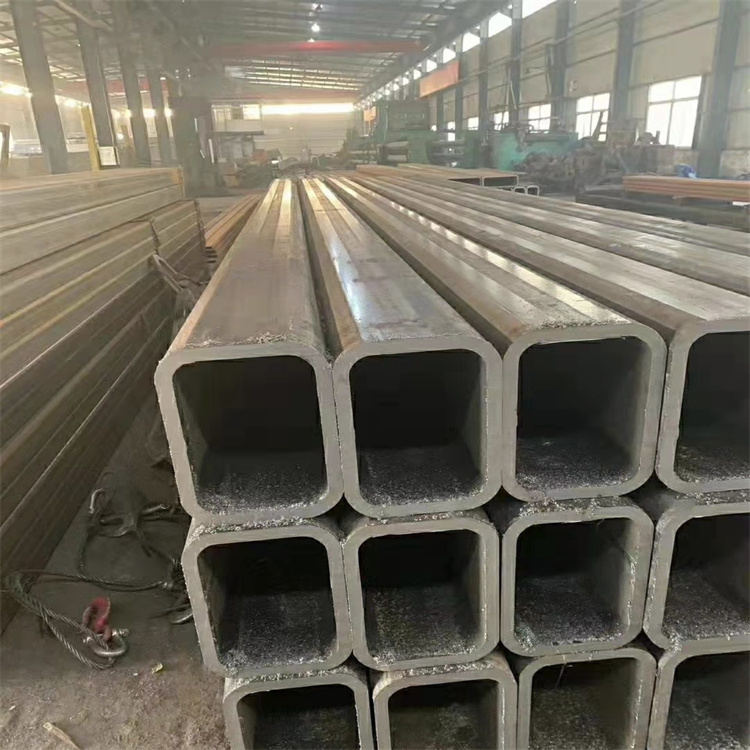


Four Methods to Measure the Length of Square Tubes
1. Improved Encoder Length Measurement. This method is an indirect measurement technique, determining the length of steel pipes by measuring the distance between the two ends of a square tube and their respective reference points. One length-measuring cart is set at each end of the square tube, with the initial position at zero and a spacing of L. The encoder length is then adjusted to the walking distance (L2, L3) to each end of the steel pipe, with L - L2 - L3 being the length of the pipe.
2. Encoder Length Measurement. Install an encoder at the hydraulic cylinder, using the cylinder to push the steel pipe along the roller track. On the opposite side, install a series of evenly spaced photoelectric switches. When the square pipe is pushed by the cylinder and touches the photoelectric switch at the pipe end, the travel of the cylinder is calculated from the recorded encoder readings. This allows for the determination of the square pipe's length.
3. Camera-based Length Measurement. Utilizes image processing for square tube length measurement, with the principle being the installation of a series of equidistant photoelectric switches on a section of the square tube conveyor roller, and adding a light source and camera on the other section. As the square tube passes through this area, the length of the steel tube can be determined by the position of an image captured by the camera through a photoelectric switch on the screen.
4. Length measurement with grating gauges. Two fixed-length grating gauges are set on the outer sides of both ends of the square tube. The grating gauges are brought close to the ends of the square tube using a rodless cylinder, and the length of the square tube is measured through the interference phenomenon of light.
