



In many production processes, due to the use of acids, bases, or salts, or their generation during the production process, the wastewater, after neutralization, contains high levels of salts, which negatively impacts biochemical treatment. Consequently, this wastewater often poses a significant challenge.
For some unconditioned activated sludge, the inhibitory effect on activated sludge begins to show when the sodium chloride content exceeds 4,000 mg/L.
Wastewater containing sodium chloride typically involves the following treatment methods: When the wastewater contains both organic matter and a chloride content less than 2%, it is generally treated by diluting with domestic sewage or cultivating special microorganisms. Due to the harmful effects of high salinity, achieving effective and stable operation of the system is quite challenging. Moreover, it requires operators to have extensive experience in order to promptly identify potential issues within the chemical system.
For wastewater containing only sodium chloride and no organic matter, or wastewater with organic matter and high salt concentrations (greater than 2%), the use of a sodium chloride wastewater treatment crystallization evaporator is a stable, effective, and economical method.
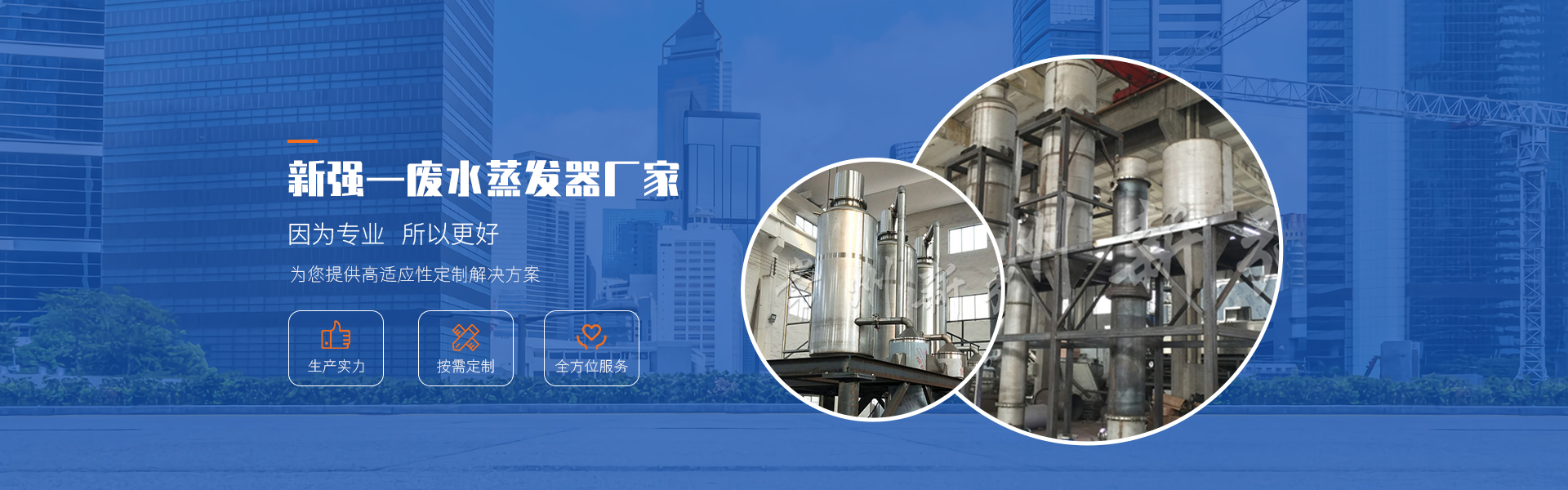
Sodium chloride typically has a solubility of around 26%, with minimal fluctuations due to temperature changes. In response to the characteristics of saline wastewater, we have developed tube-type falling film evaporators and crystallization evaporators. The tube-type falling film evaporator is primarily used for wastewater concentration, while the crystallization evaporator is designed for crystallizing saline wastewater. The complete wastewater evaporation system is highly suitable for treating saline wastewater. When the salt content in the wastewater is low, a multi-effect falling film evaporator is used to concentrate the wastewater almost to saturation, after which it enters the crystallization evaporator for further evaporation and crystallization. The concentrated solution with crystals at the bottom of the crystallization evaporator continuously enters the salt separator, where crystal salt and water are separated. The crystal salt is then transferred to the salt storage pond, and the separated brine is returned to the crystallization evaporator for evaporation and crystallization.
Product Features:
Wastewater can be evaporated to meet reuse or discharge standards in a single step!
Step 2: The wastewater concentration and salt crystallization processes are carried out separately in different types of evaporators. Salt is separated from the crystallizer in crystal form, delivering excellent desalination results!
3. Utilizing a multi-effect evaporation process, low-concentration or low-salt wastewater can be treated with a multi-effect tubular falling film evaporator, complemented by a crystallization evaporator; for high-concentration or high-salt wastewater, a multi-effect crystallization evaporator is suitable, with an appropriate configuration of tubular falling film evaporators. The equipment is highly efficient and energy-saving!
4. The newly developed flue gas waste heat desalination equipment utilizes flue gas waste heat for evaporation, eliminating the need for steam, and boasts low operating costs!
5. Customizable equipment in various materials to meet customer needs!
6. The system operates flexibly and is easy to use!
