


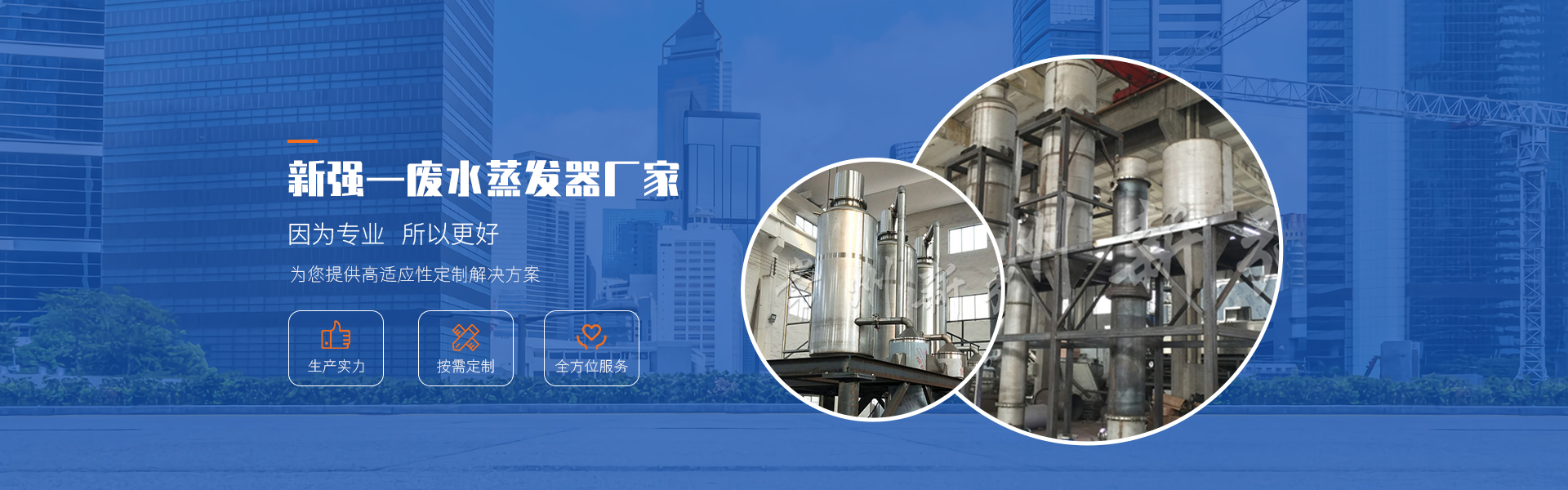

Principle of Operation for Multi-Effect Falling Film Evaporator
Film Evaporation involves introducing the feed liquid into the upper header of the falling film evaporator's heating chamber. It is then evenly distributed to each heat exchange tube by the liquid distribution and film-forming device. The liquid flows down the inner wall of the tubes in a uniform film. As it flows, it is heated and vaporized by the shell-side heating medium, with the steam produced entering the separator chamber of the evaporator along with the liquid phase. After thorough separation, the steam either condenses in the condenser (single-effect operation) or becomes the heating medium for the next-effect evaporator, thereby enabling multi-effect operation. The liquid phase is then discharged from the separator chamber.
Film Evaporation Process
The process flow has four forms: concurrent flow, countercurrent flow, mixed flow (cross flow), and horizontal flow.
In the upstream process, the flow of solution and steam is the same, both sequentially flowing from the first stage to the last stage. The raw liquid is pumped into the first stage and automatically flows into the next stage due to the pressure difference between stages, completing the liquid extraction from the last stage (usually operated under vacuum) by pumping it out. Since the pressure in the next stage is lower, the boiling point of the solution is also lower. When the solution flows from the previous stage to the next, a portion of the water vaporizes (flash vaporization), resulting in a higher amount of secondary steam. Due to the higher concentration and lower operating temperature in the later stages compared to the earlier stages, the heat transfer coefficient of the first stage is often much higher than that of the last stage. The upstream process is generally suitable for handling heat-sensitive materials under high concentration conditions.
Counterflow: Raw materials are sequentially fed from the last stage to the first stage by a pump, with the finished liquid discharged from the first stage. The material and steam flow in opposite directions. Generally suitable for treating solutions with varying viscosity with temperature and concentration, but not suitable for handling thermosensitive materials.
Mixed Flow: A combination of both upstream and downstream processes, it retains the benefits of both while avoiding their drawbacks. However, it is operationally complex and requires a high degree of self-control.
Flow: All processes have been dosed and completed with the liquid output, crystallization has occurred in all processes, which can be separated promptly, generally used for the evaporation of saturated solutions.
The Multi-Effect Falling Film Evaporator utilizes the falling film evaporation principle to heat and boil dilute solutions, vaporizing a portion of the water to achieve the purpose of concentrating the solution. The entire unit operates through a continuous production process.
The Multi-effect Falling Film Evaporator is widely used for concentrating aqueous solutions such as glucose, starch sugar, oligosaccharides, maltose, sorbitol, fresh milk, fruit juice, vitamin C, and maltodextrin. It can also be applied in the waste liquid treatment for industries such as monosodium glutamate, alcohol, and fish meal.
The equipment operates continuously under vacuum and low-temperature conditions, featuring high evaporation capacity, energy-saving, reduced consumption, low operation costs, and the ability to maintain the original color, aroma, taste, and composition of the processed material. It is widely used in many industries, including food processing, grain deep processing, beverage, light industry, environmental protection, and chemical engineering.
The TNJM03 evaporator series (also known as the three-effect falling film evaporator) can be designed with different process flows based on the characteristics of the treated material, and can also be equipped with an automated control system to meet various user requirements.
With a high concentration ratio (1/5-1/10), wide viscosity range (<400cp), excellent heat transfer performance, and large processing capacity, it is suitable for the evaporation of heat-sensitive, high-concentration, high-viscosity, and corrosive materials. It is applicable for corn syrup and invert sugar juice in the starch industry, fruit juice and monosodium glutamate solution in the food industry, milk in the dairy industry, sugar juice and molasses in the sugar industry, and filtrate of alcohol in the alcohol industry.
The company offers a range of multi-functional countercurrent, cocurrent, and film evaporator equipment, designed for concentrating and evaporating corn syrup, fermentation juice, fruit juice, beverage, milk, wine lees, industrial, fermentation, and high-concentration organic or chemical wastewater.
Equipped with energy-saving features, short heating time, and suitability for materials with high viscosity, it offers advantages such as evaporation, concentration, and high concentration ratios. Additionally, it can produce deionized water to meet the needs of industrial boiler water.
The system can be combined into dual, triple, quadruple, and quintuple-effect evaporator systems. It can also utilize waste steam from the top of tube or disk dryers, as well as other low-heat-value heat sources (such as condensate steam) as the heat source for the evaporator, thereby becoming a waste heat evaporator. This can reduce the consumption of steam and achieve energy-saving effects. When there is an adequate supply of waste heat steam, it is possible to completely do without primary steam.
