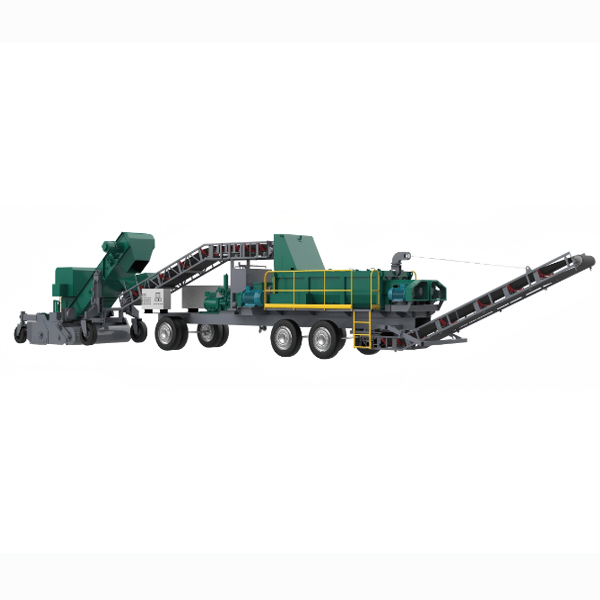
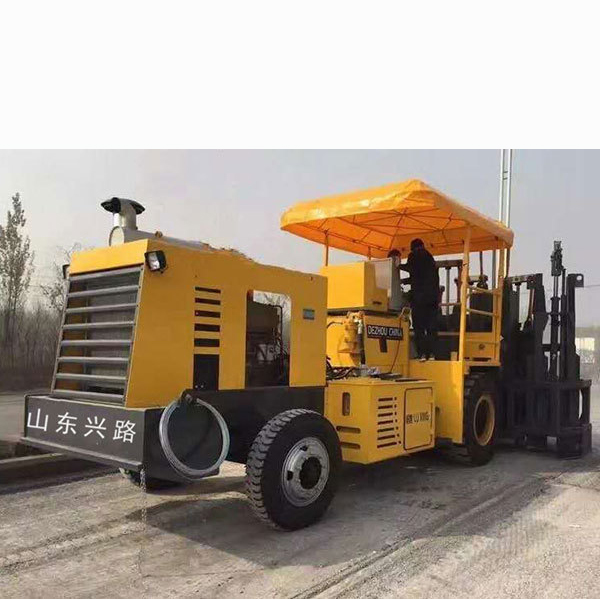
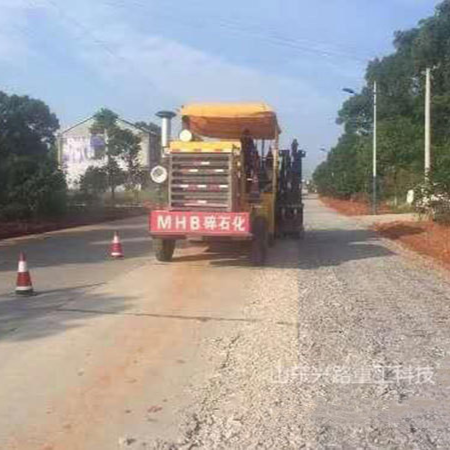
Resonant Crusher, Resonant Crushing Machine

I. Common Processing Methods
1. Typically, this involves removing the existing concrete structural layer and resurfacing the road.
This method removes the existing concrete layers, thereby completely resolving the issue of reflective cracks on the old cement slabs. The process is simple, mature, and requires minimal equipment. However, the construction timeline is lengthy, resulting in extended road closures, which can lead to traffic congestion on busy highways, thereby increasing social costs. Additionally, it requires a significant amount of space for disposing of old concrete slabs, which is不利于 environmental protection.
2. Reflective cracks are set on the original concrete road surface to delay structural deterioration, such as by adding glass fiber cloth, rubber asphalt layers, etc., followed by the application of the surface layer.
This method has a shorter construction period, produces little waste, and generates minimal noise and vibration. Its drawbacks include the necessity to treat damaged sections, such as grouting for hollowed-out sections, which is also a complex process. The main drawback is that it can only delay the formation of reflective cracks, not eliminate them completely, leading to a shorter lifespan. Additionally, the post-maintenance is more complicated and costly.
3. Utilizing the technology of破碎old concrete road surfaces for stabilization and resurfacing
This refers to a construction method during the renovation of old cement concrete road surfaces, where specialized cement panel crushing equipment is used to break and stabilize the old cement concrete surface before adding a new structural layer. As the cement panels are crushed into smaller fragments, this significantly reduces thermal expansion and contraction of the panels due to temperature changes; subsequently, the use of rollers to compact the surface eliminates differential settlements between panels, thereby reducing the likelihood of reflective cracking.
There are generally three types of crushing technology: impact compaction technology, cracking and stabilization technology, and rock crushing technology.
The first two methods, including the multi-impact hammer technology in the crushing technology, can help suppress the formation of reflective cracks; however, due to insufficiently thorough crushing of the cement slabs, these techniques cannot completely eliminate reflective cracks. Additionally, the high impact force during construction can affect surrounding houses, retaining walls, and more. The disturbance and damage to the old pavement structure layers are severe, which may lead to insufficient load-bearing capacity of the old road and necessitate reinforcement.
Introduction to Resonant Crushing Technology
The cement road resonance crushing technology was first developed and used in the United States in 1986. In 2004, the technology was introduced to China by the American company, Ames Corporation. Starting from 2005, the technology was gradually applied in regions such as Shanghai and Zhejiang.
This technology primarily utilizes resonance equipment to emit vibrations at a specific harmonic frequency that matches the concrete's frequency, causing the concrete slab to resonate and rapidly crack and break, thereby achieving the goal of breaking up old concrete slabs. This method significantly differs from other crushing technologies in terms of the mechanism, which relies solely on the impact force.
III. Advantages of Resonant Crushing Technology
When compared to other crushing and screening technologies, resonant crushing technology boasts several advantages:
1. The old pavement layers are minimally disturbed or damaged, thus maintaining the original road's load-bearing capacity. Due to its use of resonance principle, the energy is absorbed by the cement concrete, preventing broken stones from being pounded into the original subgrade, thereby preserving the load-bearing capacity of the subgrade. Field construction observations and comparative experiments indicate that the resonance construction produces less vibration than other crushing techniques.
2. The old board crushing is more thorough and structurally more rational. After crushing, the upper layer particle size is mostly below 4 centimeters, effectively preventing reflective cracks; the lower layer is mostly below 15 centimeters, representing a layer with good body but many cracks. The cracks are at a certain angle, forming an interlocking structure. Compared to the vertical cracking structure formed by other crushing methods, this structure has greater bearing capacity. In other words, it can ensure that the crushed layer still maintains a certain strength while also preventing reflective cracks. This structure is currently unattainable by other methods.
3. This method offers a shorter construction period, with a maximum crushing capacity of 4,000 to 5,000 square meters per day. The road can be paved immediately after crushing, reducing the traffic closure time by 3 to 5 times compared to the traditional method of removing the existing concrete layer and resurfacing.
4. Minimal waste is produced, benefiting environmental protection.
5. In terms of pricing, it is comparable to, and even slightly less expensive than, the cost of removing the existing concrete structural layer and resurfacing. Compared to other resonance technologies, it boasts a significantly longer lifespan due to its reasonable reflection crack control, far exceeding that of other resonance technologies.
Resonant Crushing Technology for the Design of Overlay Structural Layers
After the crushing and reconstruction of concrete road surfaces, we have applied a layered structural design. Based on the current research materials, due to the varying national conditions and road design methods across different countries, the methods used by each nation are not entirely uniform. To align as closely as possible with our existing standards, we have adopted the elastic layered system theory method from the "Highway Asphalt Pavement Design Specification" for this project.
The crushed stone structure differs from both the commonly used semi-rigid subgrade pavement structure and the flexible subgrade pavement, and is most similar to the "reversed structure" used internationally. To ensure compatibility with existing regulations, in accordance with domestic research findings, the calculation can be based on either the flexible subgrade or the composite subgrade.
Establish the modulus of the subgrade, base course, and crushed stone layer, preferably using measured values. The modulus of the crushed stone layer is generally between 500 to 1000 MPa, with a typical calculation range of 600 to 800 MPa.
The surface layer thickness generally needs to be greater than 12 centimeters, with the most common range being 12 to 25 centimeters. This project uses a thickness of 15 centimeters.
Resonant Crushing and Overlay Construction Techniques
Before the crushing and screening construction, we must first conduct an investigation and prepare.
Pre-treatment for poor geological sections is necessary. Additionally, to ensure the safety of bridge and culvert structures, a certain distance must be maintained at both ends, and the crushing process cannot be used. Based on our actual construction conditions, round pipe culverts buried 50 centimeters below the subgrade will generally have no impact.
Additionally, due to the expansion of the old concrete around the crushed stone, consideration should be given to longitudinal cutting of the old cement concrete pavement for surfaces with strong panel properties (such as reinforced concrete), wider surfaces, or limited crushed stone expansion space.
Aggregate破碎 requires high drainage system standards, including whether it can provide adequate load-bearing capacity, prevent, and eliminate reflective cracking, which greatly depends on the installation and rational design of the drainage system. After the old road surface is broken into aggregates, it acts as a subgrade drainage system. Our task is to drain water from the aggregate layer to the subgrade. Generally, this can be achieved by setting up blind ditches or collection pipes along the roadside. We need to remove asphalt patches from the old road as they can affect the performance of resonance machinery.
Before the formal crushing, trial vibration and excavation test pit inspections must be conducted. Through the excavation, the particle size distribution and uniformity are checked, and the construction parameters of the crushing equipment and the organizational measures for construction are determined.
3. After crushing, it needs to be compacted. During compaction, use road rollers with high frequency and low amplitude, and the tonnage does not need to be too large. Also, avoid excessive numbers of passes to prevent over-compaction.
4. The asphalt paving process is the same as other asphalt pavement processes, but attention should be given to the fact that paving should be done within 48 hours after the crushing layer has been compacted to minimize the impact of vehicle traffic and rain on the crushed layer. After the crushing layer has been compacted, it is generally not necessary to apply priming oil, nor is it necessary to set up stress-absorbing layers, stress-absorbing films, geotextiles, and other materials. Paving and compaction can be done directly. It is also recommended to refer to the experience of multi-ram crushing construction and to spray emulsified asphalt priming oil on the surface after the crushing layer has been compacted.
Reference:
Wu Qingfeng, Ling Jianming. Research and Application of Resonant Crushing Technology for Cement Concrete Pavement Overlay. Shanghai Municipal Engineering Administration Bureau Science and Technology Development Fund Project.
Wang Songgen et al. Guide to the Application of Stone Crushing Technology for Old Concrete Pavements. People's Communications Press, 2007.1
[3] Ministry of Transport of the People's Republic of China. Design Specifications for Highway Cement Concrete Pavements (JTG D40-2002). People's Traffic Publishing House.
[4] Ministry of Transport of the People's Republic of China. Highway Asphalt Pavement Design Specification (JTG D50-2006). People's Communications Press


b2b.china9.net © Zhongshang 114 Hebei Network Technology Co., Ltd.Address: Room 6009, Oriental New World Center, No.118 East Zhongshan Road, Qiaoxi District, Shijiazhuang City, Hebei ProvincePlatform Service Hotline: 4006299930