
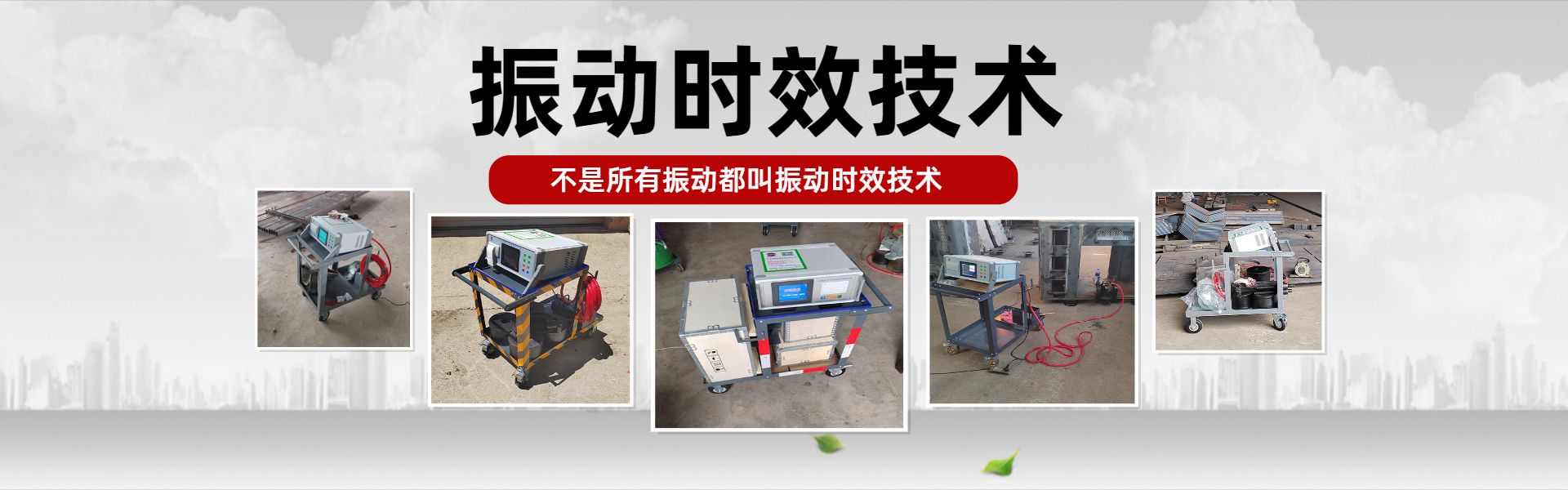


In production practice, it has been discovered that vibration aging not only eliminates the residual stress in workpieces but also significantly improves their strength indicators after the process. This has inspired us to subject workpieces to vibration treatment to enhance the material's strength.
Vibration enhancement involves subjecting workpieces to forced vibrations from external cyclic loads, with the exciting force originating from the eccentric part of the exciter. This is a forced vibration problem within a multi-degree-of-freedom, damped system. For ease of analysis, we simplify the system to a single-degree-of-freedom, damped system for examination. The mechanical model is illustrated in the figure below.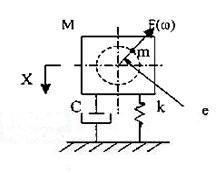
Vibration System Mechanical Model Diagram
The dynamical equation is: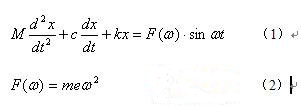
The magnitude of the vibration force increases with the increase in eccentricity e and rotational speed ω2. Therefore, in practical applications, by adjusting the eccentricity and rotational speed of the vibration exciter, alternating stress can be applied to metalwork, which, under the action of alternating stress, will produce dislocation movement.
As the applied dynamic stress increases from zero to its peak, metallic material dislocations are activated, continuously releasing new dislocations, and accumulating in front of obstacles. The continuously increasing stress field of the accumulated dislocation clusters tends to cause the dislocations in nearby grains to move. The accumulations in areas of the original stress field that were previously higher are first cleared, releasing their stress concentration.
During the process of decreasing the maximum stress to zero, the equilibrium state of dislocation pile-ups is disrupted. A large number of dislocations will intersect with other dislocations during the movement process, thereby significantly increasing the dislocation density. With the alternating applied dynamic stress, this process is continuously repeated. While the peak internal stress decreases, the dislocations are continually proliferating. The continuously increasing dislocation density is conducive to enhancing the fatigue strength of the material.
Fatigue damage occurs in three stages: crack initiation, crack propagation, and instantaneous fracture. The fatigue life of metallic materials is primarily composed of two parts: the crack initiation life and the crack propagation life.
Cracks typically initiate at locations with the highest stress and weakest strength. Post-vibration treatment reduces the high internal stress, achieving uniform distribution and minimizing the impact of stress concentration. Simultaneously, the increased dislocation density makes it more difficult for slip bands to slide, thereby extending the crack initiation life. The change in the dislocation configuration and the increased dislocation density also increase the resistance to slip movement, requiring more energy for crack propagation, thus extending the crack propagation life and enhancing the material's fatigue strength, reinforcing its performance.
News Center Co., Ltd.
