
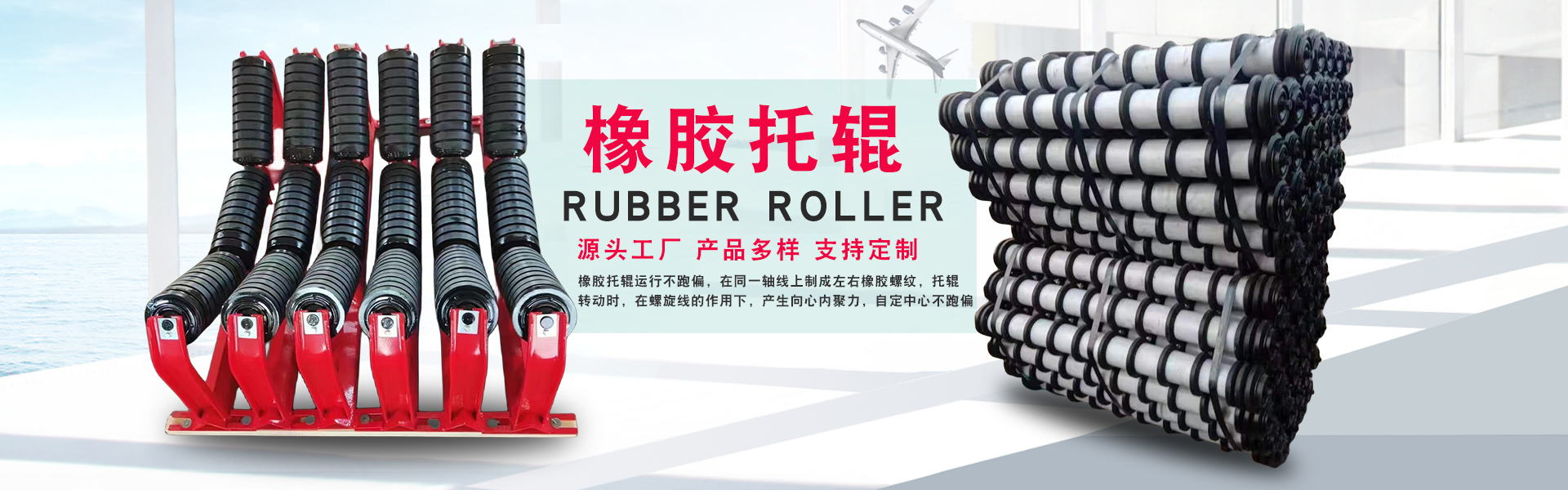

Rubber roller development spans over a century, with the invention of the rubber roller by Siemens AG of Germany in 1866. Four years later, Canadian Henry Martinson filed a patent for balancing technology, initiating the balancing correction industry. In 1907, Dr. Franz Lawaczek provided an improved balancing technology to Mr. Carl Schenck of Germany, who produced a double-sided rubber roller in 1915.
By the late 1940s, all balancing processes were carried out on purely mechanical balancing equipment. The balancing speed of the rotor was typically set to the resonant speed of the vibration system to achieve a large amplitude. Under this method, the measurement of rotor balance had significant errors and was also unsafe.
The rubber roller, along with the development of electronic technology and the widespread adoption of the rigid rotor balancing theory, saw most balancing equipment adopt electronic measurement technology after the 1950s. The flat separation circuit technology rubber roller effectively eliminated the mutual influence between the left and right sides of the balanced workpieces. The emergence of hard-mounted rubber rollers in the 1970s can be considered a leap in the development history of rubber rollers. They employed static balancing dimension settings, eliminating the inconvenience of frequent dynamic adjustments required by traditional soft-mounted rubber rollers, creating standardized rubber rollers. In the 1980s, the advent of piezoelectric sensor technology brought about another revolution in the development of rubber rollers. Rubber rollers utilizing this technology essentially replaced soft-mounted rubber rollers in most non-high-speed balancing applications.
With the application of microcomputer technology, rubber roller technology has entered a new era, significantly improving in performance, precision, and operability. The rubber roller has integrated various technologies such as optics, electricity, and machinery. It is now widely used in electric tools, mechanical manufacturing, fans, motors, papermaking, textiles, household appliances, metallurgy, and other fields.
MoreAbrasive-resistant rubberFor roller information, please follow the news of Cangzhou Xiangtong Machinery Manufacturing Co., Ltd.!
News Center Co., Ltd.
