

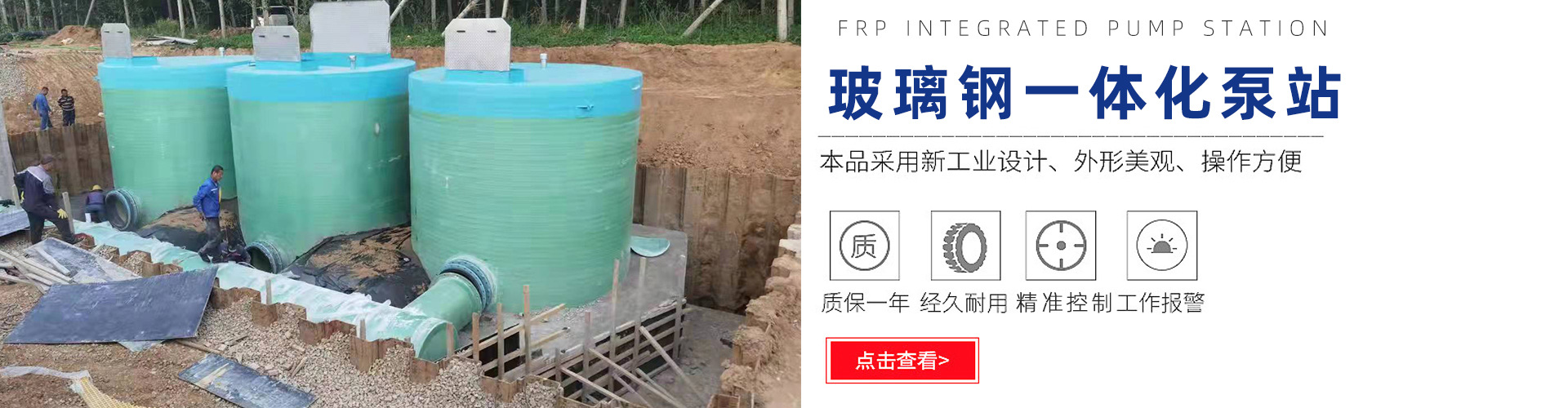


Have you ever experienced it? When heavy rain hits, the entire neighborhood and even the street turn into a sea. This situation is often caused by inadequate drainage or improper drainage facilities. The introduction of integrated pump stations can solve the rainwater and wastewater discharge issues at these locations. This equipment can alleviate the flooding caused by heavy rains and also greatly improve the problem of wastewater sedimentation. It plays a major role in water discharge and pumping.
One, the design of the overflow pool should minimize sharp bends to avoid water impact and backflow. The design of the pressure tank should prevent the mutual impact of water flows in the outlet pipes to reduce energy loss.
Secondly, it is preferable to use locally available construction materials. The design should ensure simplicity and ease of construction, as well as minimal investment in the project.
The overall layout should be reasonable, particularly for pump stations that combine irrigation and drainage, or those that integrate self-drainage, self-conveyance with water lifting, as well as pump stations combined with lock stations. The layout should strive for compactness, making full use of buildings for regulation.
In selecting pump types, it is crucial to ensure that the pump station's design head matches the pump's rated head, and meets the requirements for irrigation and drainage flow rates. Additionally, it is advisable to opt for technologically advanced pump types to guarantee high efficiency of the pump station and minimize operating costs. The chosen pump types should also be relatively mature, with a certain operating history, and it is best to avoid experimental pump types.
When selecting pump types, it is crucial to consider the purpose and operational nature of the integrated pump station. For irrigation and water replenishment pump stations that operate for extended hours each year, choose pumps with a wide range, high efficiency, and excellent cavitation performance. For pump stations primarily focused on drainage, opt for pump types with reliable operational performance and simple structures.
Six. The engineering layout should preferably use positive water inflow to ensure that each unit's water inflow conditions are good and the flow pattern is uniform. When lateral water inflow is unavoidable in the layout, the design should extend the distance between the lateral water inflow port and the pump as much as possible and adopt certain guidance measures.
The integrated pump station not only simplifies the work, but also boasts a high degree of integration and a compact size, making it extremely suitable for areas with limited space. Even if there's no room to place it, it can be buried underground and still used as usual.
