
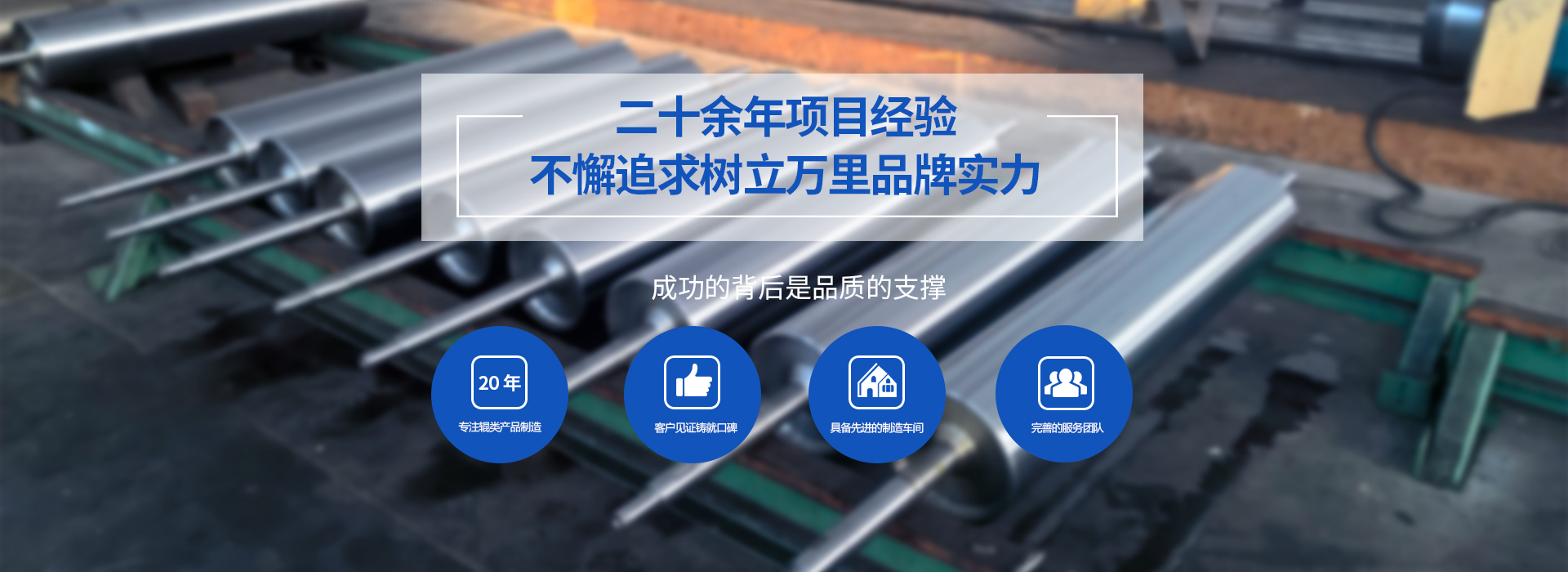







Thermal roller, also known as a cooling roller, plays a crucial role in reducing material deformation caused by excessive heat or shrinkage during the winding process of film rolls. By cooling the material prior to winding using the cooling roller, it minimizes material shrinkage and improves product yield. In practical applications, the cooling roller is typically installed after the reel dryer to lower the temperature of ultra-thin film rolls to an ideal winding temperature, preventing the occurrence of defective products.
One: Internal Structure of Heat-Conducting Roll/Cooling Roll
Currently, the internal structure of heat-conducting rollers is divided into double-layer single-flow and double-layer double-flow setups, with the internal heat-conducting medium being water or thermal oil. These different internal structures also result in distinct manufacturing processes, significantly impacting costs.
The double-layer single-flow heat-conducting roller's internal structure consists of an outer shell, an inner shell, and a spiral baffle plate on the inner shell. Water or heat-conducting oil is transported in from one side and circulated through the internal single-flow heat-conducting pipeline, exiting from the other side to carry away heat, thereby achieving the cooling effect.
2. Dual-layer Double-Flow Heat Conducting Roller Internal Structure: This model of heat conducting roller is composed of an outer shell, an inner shell, and spiral baffle plates on the inner shell. What sets it apart is the use of a dual-layer double-flow heat dissipation circulation method. Water or heat-conducting oil is transported from one side and circulated through the internal double-flow heat conducting pipeline. It boasts high heat dissipation efficiency, a more complex production process, and slightly higher costs.
II. Thermal Conduction Roller Technology Features
1. Treated with advanced heat treatment technology, the inner and outer tube walls are precision turned to ensure uniform wall thickness and minimal cooling temperature difference. Employing state-of-the-art heat-fusion welding, stress is relieved, quenched, finely ground, and hard chrome plated. Finally, it is subjected to ultra-fine grinding and precision polishing using American 3M abrasive materials. This results in high external precision, a superior contact surface with materials requiring heat dissipation, and high heat dissipation efficiency.
2. The cooling roller features a unique structural design and advanced heat exchange technology, which rapidly transfers the absorbed heat from the working area to both ends, thereby accelerating production speed. Additionally, it ensures uniformity in roller surface temperature, enhancing product quality and pass rate.
Section 3: The Role of Thermal Conduction and Cooling Roll
Thermal roller's excellent heat dissipation performance is widely used in food, pharmaceutical packaging industries, optical film, and solar cell industries, as well as on lithium battery film and coating equipment. Compared to traditional cooling rollers, this structurally complex cooling roller has higher technical content, leading to increased costs. However, the production efficiency improvements and product quality stability brought by the new cooling roller cannot be measured by the price difference between the two types of rollers.
As the cooling process increases the temperature difference between the hot material and the roller surface, it accelerates the heat exchange rate, thereby significantly enhancing production efficiency (usually by 50~200%) and reducing production costs.
2. The entire cooling roller surface temperature remains stable, ensuring that no condensation forms at the ends of the roller surface, thereby eliminating any impact on product quality caused by condensation.
Due to the advantage of the cooling roller structure not frosting, even with low temperatures of cooling water and thermal oil, there is no need for operators to monitor the cooling water temperature or the frosting on the roller surface, which reduces the workload and labor intensity of on-site operators.