


I. Overview
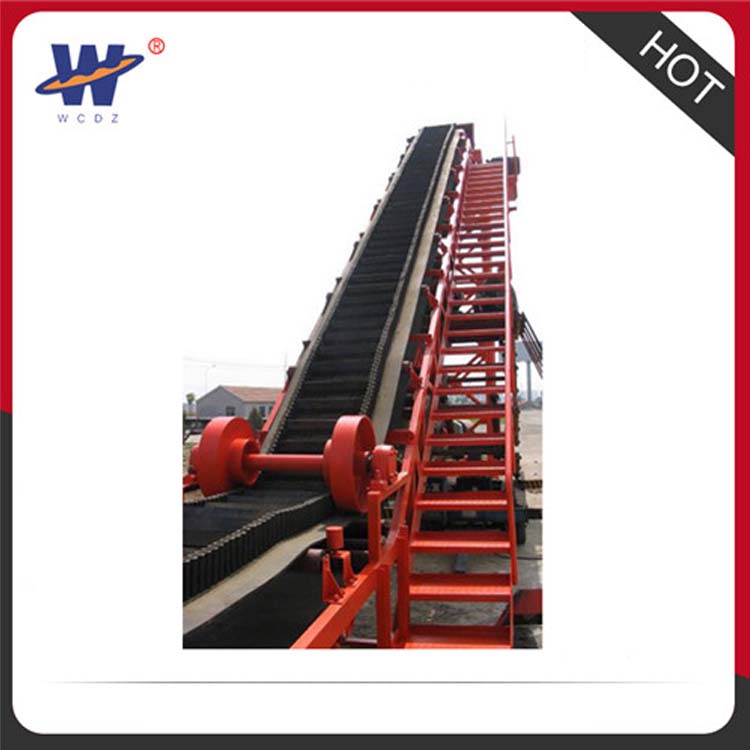
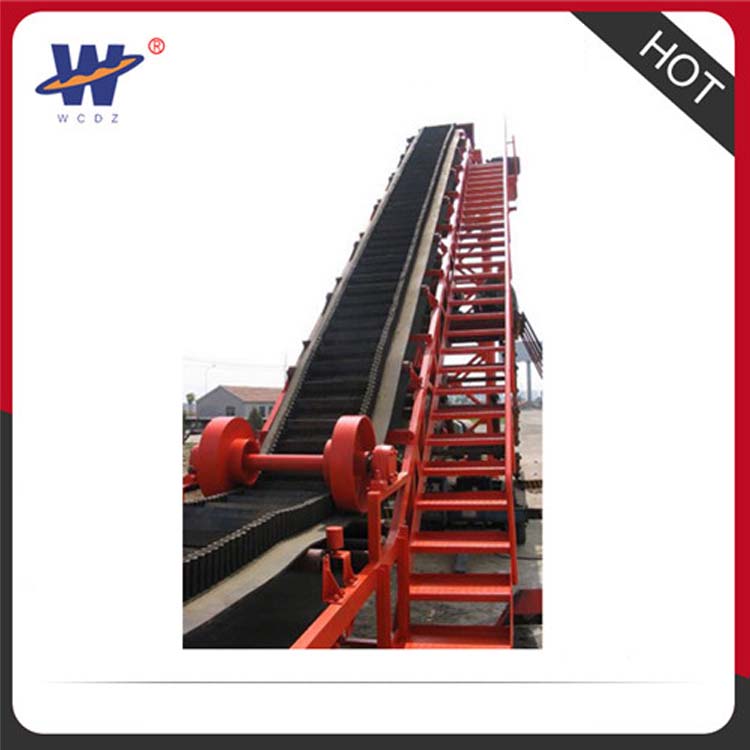
This series of products is mainly used for the continuous large-angle conveying of bulk materials. It features conveyer belts with wavy side edges and cross plates, capable of conveying at angles below -90° to 70°. Its characteristics include: the ability to complete horizontal discharge conveying in confined spaces with a single piece of equipment, high reliability, energy efficiency, and cost-effectiveness similar to belt conveyors for horizontal or slight incline conveying and bucket elevators for lifting materials. This series is widely used in coal, grain, building materials, chemicals, hydropower, and gold industries, conveying various bulk materials with a stacking density of 0.5-2.5 t/m³ within an environmental temperature range of -19°C to +40°C. It is also suitable for materials with special conveying requirements, such as those with high temperatures or containing acidic, alkaline, oily substances, organic solvents, and other components.
Special edge conveyor belts made of the specified material must be requested at the time of ordering.
Section 3: Outline Drawing

Four, Selection
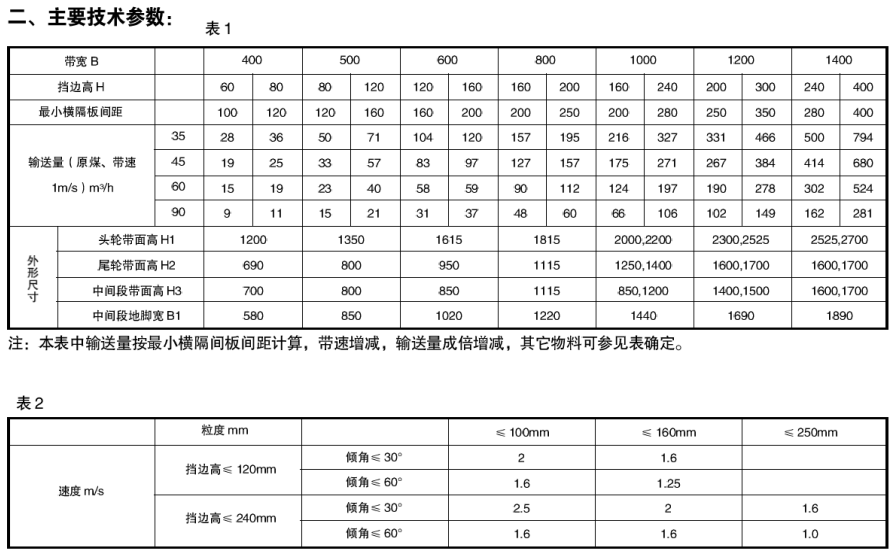
Based on the characteristics of the conveying material, the angle of inclination, and the size of the conveying volume, refer to Tables 1 and 2 to determine the conveyor belt width, side height, and belt speed. Among them:
(1) Edged conveyor belts are available in several types: normal temperature (-20~50°C), heat-resistant (below 10°C), high-temperature-resistant (below 18°C), and acid/alkali-resistant and oil-resistant.
(2) When conveying large pieces of material, the skirt should be selected to be higher: Alternatively, the belt width and skirt can be maintained, and the conveying volume can be increased by increasing the belt speed (1.25m / 1m / 2m / s).
(3) High conveying height of 70m, large particle size should be less than 30-40mm below the edge height
(4) Upper tray spacing is typically 1.2m, lower tray wheel spacing is usually 1.2m, with an angle greater than 60° at 2.4m, and anti-drift shield spacing at 3-6m. L3 standard is 2200, small 1500.
Section 5: Instructions for Use
1. This table is only for preliminary and simple selection. The final selection should be determined based on the calculated results.
2. The data in this table is calculated under the assumed conditions of tape line speed V=1m/s, separator spacing ts=0.25m, material density y=1t/m3, and lifting height H=10m. Appropriate conversion should be made if the conditions differ.
3. Selection Examples:
Known: The conveying material is coal, capacity V=0.8t/m³, particle size A<40mm, conveying B=45, conveying rate Q=85t/h, conveying height 15m. Calculate the required belt width, belt speed, and motor power. First, calculate the conveyor belt conveying rate should be 85t/h=0.5t/m³=106.25m³/h. Then, in the table's 45-degree angle column, find the conveying rate of B=800, H=160 is 96.6m³/h, which is the closest. Next, change the linear speed to 1.25m/s, the conveying rate of the belt becomes 96.6m³/h x 1.25 = 120.75m³/h, which meets the usage requirements. The corresponding required power is 4.59kW x 15m x 10m x 1.25 = 8.6kW.
4. The baffle design is selected based on the conveyor inclination size.
18°<3<40° T-Type, 40°<B<60° C-Type, 60°<p<90° TC-Type
