


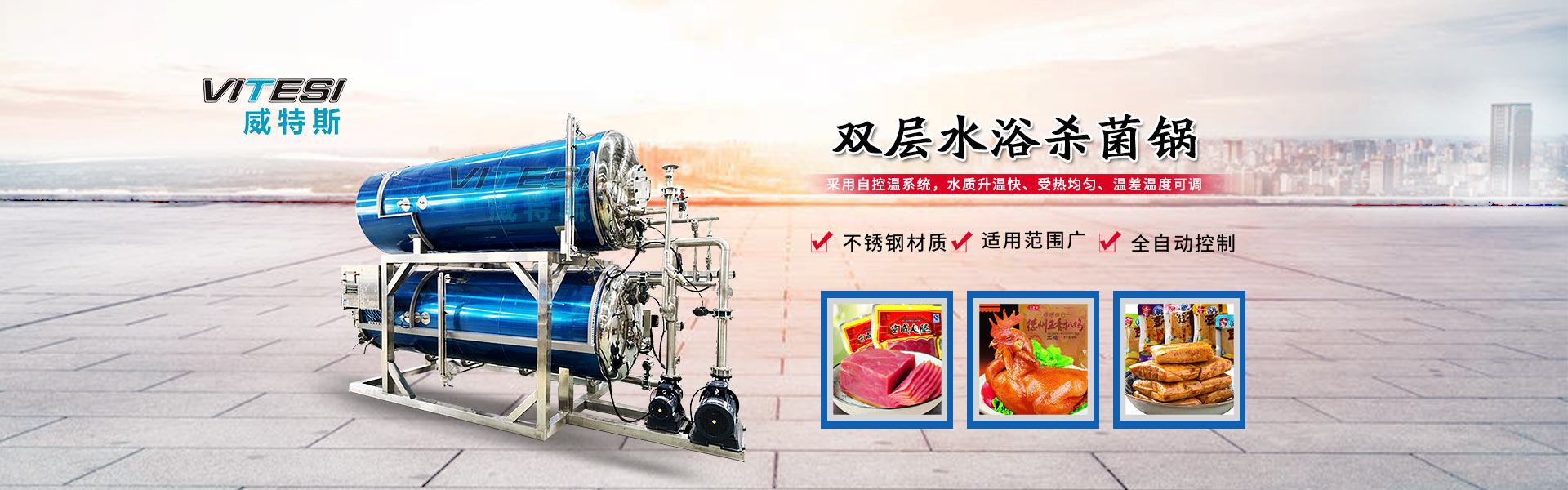


The sterilization kettle primarily utilizes steam generated at a certain pressure within the tank to heat the food requiring sterilization inside. Many types and models of equipment products have been developed. In terms of appearance, there are single-tank, double-tank, double-layer, vertical, and horizontal layouts; in terms of control level, there are manual, semi-manual, and fully programmed categories; and there are also classifications based on the sterilization methods.
Traditional sterilization pots mainly adopt two sterilization methods: fully submerging food in hot water or using steam generated by hot water directly for sterilization. These methods are relatively uneven and have strict requirements for the food being sterilized.
The sterilizing pot is equipped with safety valves, pressure gauges, thermometers, and other accessories to ensure safety, completeness, sensitivity, and reliability. Maintenance and regular calibration should be performed during use. The safety valve's trip pressure is equal to the design pressure and should remain sensitive and reliable, preventing arbitrary adjustments. The pressure gauge and thermometer both have a precision level of 1.5, and differences within the tolerance are normal. Lead-sealed pressure gauges must not be used; if the pressure gauge fails to indicate, the scale is unclear, the dial is cracked, the gauge does not return to zero after depressurization, or the seal is damaged, they should be replaced immediately. Thermometers should be periodically inspected, and a standard thermometer should be used to calibrate them before use. They should be recalibrated annually, and any mercury column breakage or deviation from the standard temperature by more than 0.5℃ should be repaired or replaced.
