



Bridge cranes are a commonly used lifting and transportation machinery in factories, accounting for about 80% of the total number of cranes. Therefore, their safety management and operation are of great importance. Statistical data on accidents shows that bridge cranes are responsible for a significant proportion of accidents. For instance, out of 42 fatal and severe injury crane accidents, 90% were caused by bridge cranes. Our factory currently has 11 bridge cranes with a rated load of 5 to 15 tons. In recent years, during routine use and management, we have identified various unsafe factors affecting equipment performance. Failure to address these promptly could lead to malfunctions, affecting normal production, or even accidents. The following analysis examines various potential unsafe factors in bridge cranes to propose effective solutions based on actual equipment issues.
I. Composition of Bridge Cranes
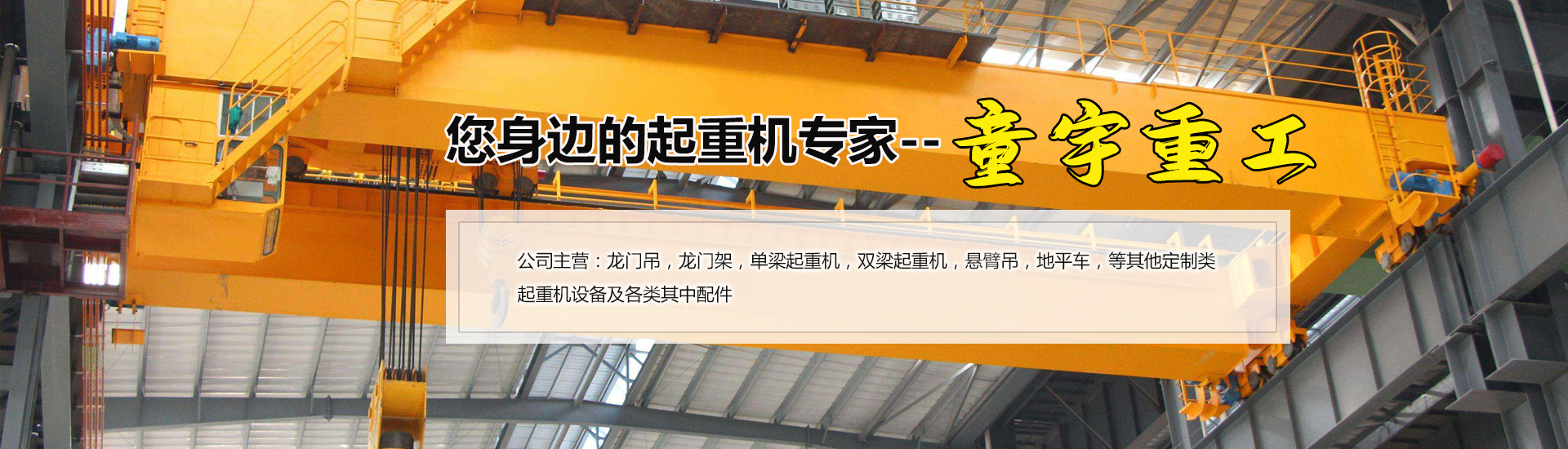
Bridge cranes are equipment used to lift heavy loads with hooks (or sometimes grabs or electromagnetic disks). They have a bridge-like appearance, with the bridge girder suspended on tracks by roller frames at both ends. The rollers move along the tracks, propelling the girder's movement. Structurally, bridge cranes are mainly composed of three parts: the metal structure, mechanical transmission, and electrical equipment.
The metal structure section primarily consists of bridge girders, walkways, and cabins. It primarily bears heavy loads, accommodates mechanical and electrical equipment, and forms the complete bridge crane assembly.
(2) The mechanical transmission section mainly includes the large vehicle part and the small vehicle part. The large vehicle part encompasses the large vehicle running mechanism, etc., while the small vehicle part includes the small vehicle frame running mechanism, lifting mechanism, etc.
(3) Our electrical equipment includes protective panels (distribution boards), controllers, collecting devices (power conduits), motor lighting, as well as various safety devices such as limit switches, interlocked switches, and grounding.
Section II: Safety Protection for Crane Operations
Bridge crane bridge structures, trolley lifting mechanisms, and other equipment that are not easily accessible for frequent inspections must be managed according to the relevant regulations as special equipment. In accordance with relevant regulations and the actual conditions of the factory, unified requirements for the bridge cranes within the factory units have been established, including the addition of overload limiters, upper limit position limiters, track cleaning plates and supports, conductive slider protective plates, grounding, and track end stops, among other safety protective devices. Additionally, unified technical requirements for these protective devices have been formulated. For example:
(1) The system emits an alarm signal when the lifting load reaches 90% of the rated load; it automatically shuts off the power and triggers an alarm when the lifting load reaches the rated load.
(2) The lifting equipment should automatically disconnect the power supply to the lift when it reaches its maximum position.
(3) Install protective plates beneath the end beams at the large conveyor line to prevent accidental contact between lifting equipment or wire ropes and the conveyor line; also, set up protective plates between the ladder/bridge and the conveyor line.
(4) Stoppers are set at the end of the track to prevent the bridge from derailing.
Safety Precautions for the Metal Structure of the Zhai Shi Crane
During the operation of the bridge crane, it is essential to ensure that the main girder does not experience excessive downward deflection or deformation. Otherwise, the following hazards may arise:
(1) The small vehicle fails to stop accurately after braking, causing it to skid. Additionally, it can overload the motor and lead to its burnout during uphill climbing.
(2) The walking mechanism's drive shaft was twisted and overstrained, leading to the shearing of the coupling connection bolts and even shaft breakage.
(3) Caused deformation of the small vehicle's track, leading to wheel derailment and even derailment accidents; resulted in cracks on the under cover plate and web of the main beam, posing a serious threat to safe operation.
Four: Safety Precautions for the Mechanical Part of the Bridge Crane
Regular inspections of bridge crane components are necessary to prevent accidents.
(1 Uneven wear in the groove of the pulley can lead to uneven contact with the steel cable, which may cause operational accidents; excessive wear on the pulley shaft can lead to the shaft breaking. If the degree of wear exceeds the specified limits, the shaft must be replaced.
(2) Coils that exceed the wear limit or exhibit fatigue cracks are prone to breakage; severe wear on the coil key can lead to key detachment or breakage, which in severe cases might cause heavy objects to fall.
Under these circumstances, it should be replaced.
(3) Worn-out small shafts, spindle cores, brake drums, brake pad materials, as well as fatigue cracks in rods and springs can easily lead to brake failure; replacements are recommended.
(4) If the dangerous cross-section at the hook opening is worn beyond the standard, or if the tail or threaded end is worn, or fatigue cracks appear on the hook surface, it can easily lead to hook breakage. Therefore, hooks should be inspected 1 to 3 times a year, and any issues should be addressed promptly with replacements.
(5) If the wheel spokes or tread of the crane's wheels have fatigue cracks, or if the wheel rim or tread wear exceeds the standard, it is prone to cause wheel damage, and in severe cases, it may lead to the crane derailing.
If oil is present on the track, if the motor starts too abruptly, or if the wheel pressure is uneven, it is prone to cause slippage in the small vehicle's running mechanism. Deviations in the vehicle's path, unequal wheel diameters, excessive installation errors in wheels, deformation during the vehicle's manufacturing process, and uneven wheel pressure all contribute to uneven distribution of the wheels' load, and adjustments are necessary.
(7) Kowloon conducts regular inspections of the crane's bearings for temperature, sound, and lubrication; if the reducer emits an abnormal sound, it should be promptly repaired or replaced.
(8) Excessive deviation in the transmission system, frame misalignment and deformation, excessive installation errors in the track and wheels, and oil accumulation on the track can all easily lead to issues with the sled's operation. These issues must be addressed promptly through adjustments, cleaning, and corrections.
Safety Precautions for Bridge Crane Electrical Equipment
The driving motor of a bridge crane achieves the forward and backward, left and right, and up and down movement of the hook through reduction and transmission mechanisms. To ensure work safety, it is necessary to set up the required electrical protection systems, such as the main disconnect switch, emergency shutdown switch, short-circuit protection, overload protection, and limit protection. Regularly check the motor's sound and heat generation, as well as the normal operation of the electromagnet. Ensure the controller and contactors are flexible and functional. It is essential to: 1) Prevent accidents such as heavy objects falling or colliding due to operational errors or electrical faults in controllers, protection panels, etc.; 2) Prevent electric shock accidents caused by touching exposed power conductors or damaged insulation, and poor grounding; 3) In flammable and explosive areas, use explosion-proof electric cranes.
Six: Inspection and Testing of Bridge Cranes
Generally, bridge cranes should be inspected annually.
(2) All overhead cranes newly installed, subject to major repairs, modifications, or that have been in non-operation for more than one year in the past two years, must undergo testing in accordance with the crane testing regulations. They may only be put into use after passing the test.
(3) Load tests include no-load tests, static load tests, and dynamic load tests.
Seven: Matters to be noted in inspection and testing work
Inspection and testing must be conducted by designated personnel. Safety training for relevant staff is mandatory before work commences, ensuring they are aware of the procedures and requirements. Clear division of responsibilities should also be established.
(2) Inspecting bridge cranes in accordance with mechanical, electrical, and high-altitude work safety regulations
(3) When starting the car, the signal must be given by the controller only after confirming safety.
(4) Besides in emergency danger situations where anyone can give the stop signal, only the commander is allowed to issue command signals.
During testing, personnel should stand in a safe position.
(6) Emergency safety measures should be established for situations involving urgent dangers.
