
公司主营:Mining Communication Cable MHYVP, Mining Communication Cable MHYV, Mining Communication Cable MHYVRP
13292661877

Product Center
Company Qualification
MHYA22 Mining Signal Cable Manufacturer


Details Introduction
Mining communication cables cable type classification
If categorized by cable type, communication cables are classified as follows:
Single conductor: Refers to the original communication cable, single conductor circuit, with the earth as the return line.
2. Symmetrical Cable: Consists of a loop formed by two conductors that are ideally identical.
3. Coaxial Cable: Consists of two conductors, an inner and an outer, arranged in a single axis, with the outer conductor encasing the inner conductor while both are insulated.
MHYV cables have become a staple in the mining communication field due to their excellent communication performance, user-satisfying durability, and relatively straightforward installation and maintenance process. Although alternative products may exist under certain conditions, the advantages of MHYV cables in the unique working environment of mines are unmistakable.
Mining communication cables generally have the Coal Mine Safety Certification, complying with relevant safety standards for coal mine production, ensuring product safety and reducing risks during use.
Mining communication cables play a crucial role in fire rescue operations as well, used for transmitting signals of fire-fighting equipment, rescue instructions, and personnel location, enhancing the efficiency and safety of the rescue efforts.
In airport and port areas, mining communication cables are used to connect equipment and systems such as flight navigation systems, security check systems, and shipping logistics systems, ensuring their normal operation and safe operation.
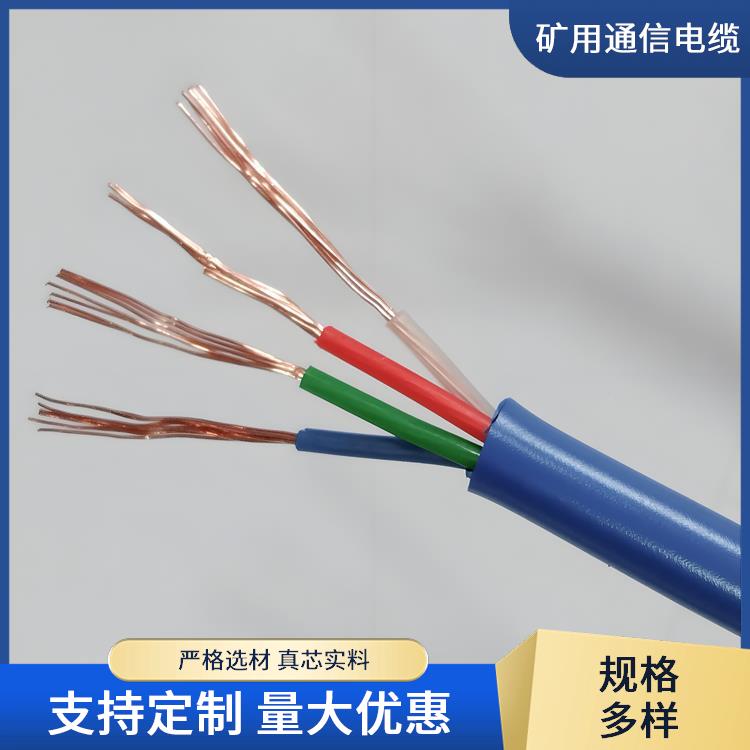
1. A seemingly simple communication cable, upon closer inspection of the cable, one would discover that the technology staff has put quite a bit of "thought" into it. Structurally, communication cables are generally divided into the core and the sheath. The sheath, in turn, can be further divided into the jacket and the outer sheath. The core consists of the insulated conductive core wire and necessary shielding, filling, and binding strips (threads). Visually, the cross-section of the core is usually circular;
2. The cable core is the main component responsible for information transmission. To protect the cable core from moisture, external mechanical damage, and electrical interference, a sheath is added to the outside of the cable core. Additionally, an outer protective layer may be required as needed.
3. Initially, people usually used lead as the sheath because it's soft, easy to manufacture and install, and offers moderate shielding. However, technicians ultimately chose aluminum. The reason is that lead is too heavy and difficult to transport. Aluminum, on the other hand, provides better shielding than lead and is much lighter. Of course, everything has its pros and cons. Aluminum is more challenging to manufacture compared to lead and is also more susceptible to corrosion.
4. In a dry environment, metal-free polyethylene or polyvinyl chloride sheathings can also be used.
5. Outside the underwater communication cables, a steel wire armor outer sheath is used, and an anti-corrosion layer is also needed on the outside of the metallic armor layer.
6. The core requires covering with a shielding layer, and then it is twisted into a cable. The shielding layer is typically a double-layered spiral of steel tape.
毕经理 (Mr.)
13292661877
13292661877
13292661877@wo.cn
Dacheng County Biyanshama Industrial Zone
b2b.china9.net © Zhongshang 114 Hebei Network Technology Co., Ltd.Address: Room 6009, Oriental New World Center, No.118 East Zhongshan Road, Qiaoxi District, Shijiazhuang City, Hebei ProvincePlatform Service Hotline: 4006299930