


I. Composition of Rolling Mill Equipment
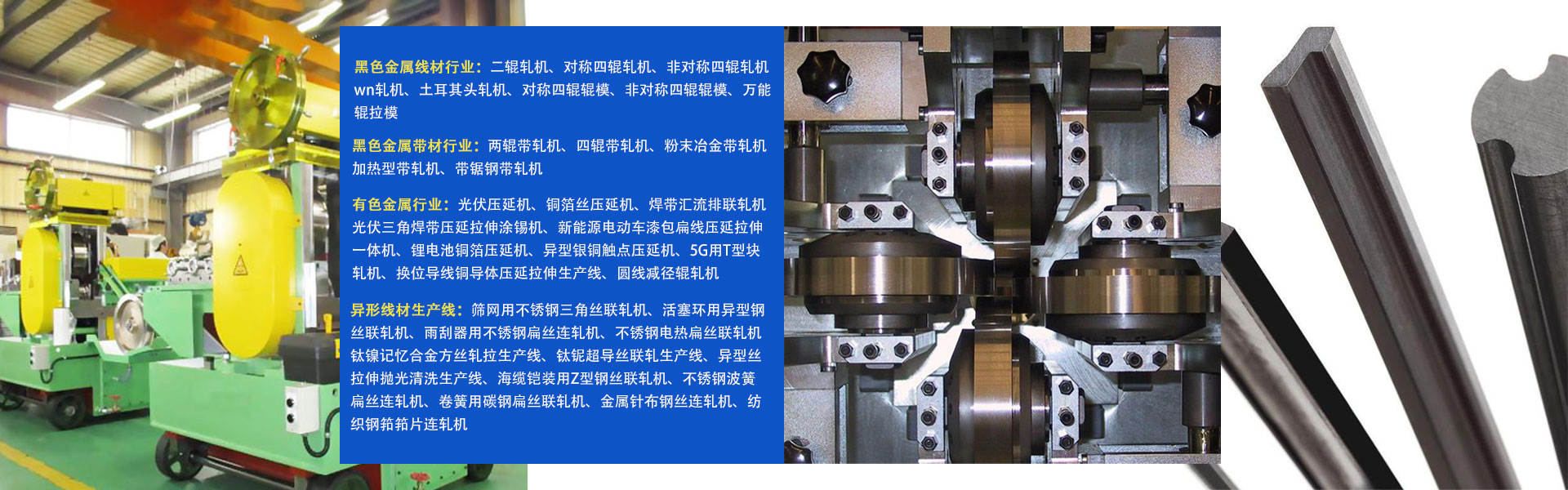
The composition of rolling machinery and equipment can be divided into two main categories: main equipment and auxiliary equipment.
1. The main equipment refers to the machinery that directly causes plastic deformation to rolling stock, also known as the main machine line. It includes: the working seat (rolls, bearings, roll adjustment devices, guide devices, and frames, etc.), universal or梅花-connected shafts, gear bases, reducers, main couplings, and main motors.
2. Auxiliary equipment refers to various devices outside of the main machine line, which are used to complete a series of auxiliary processes. This includes cutting equipment, conveyors, coiling machines, straighteners, and more. There is a wide variety of auxiliary equipment, and with high levels of workshop mechanization, the proportion of auxiliary equipment to the total weight of the workshop's equipment also increases.
Section II: Rolling Mill Classification
With the continuous development of the roller industry, there is a wide variety of steel products, and rolling mills can be categorized based on their application, structure, and layout.
1. Categorized by Usage
Roller mill sizes are related to product dimensions. For bloom and billet mills, the roller diameter is used to indicate the mill size, while plate rolling mills are sized by the roller body length. Tube rolling mills are represented by the large outer diameter of the tube they roll. As shown in the following figure:
(1) Billet mill - A rolling mill that processes steel ingots into raw materials for finished rolling mills, including square billet initial rolling mill, square billet slab initial rolling mill, and slab initial rolling mill, etc.
(2) Billet Rolling Mill: This mill also supplies raw materials to finished product rolling mills, but the raw material is not ingots. It is generally divided into two types: continuous and transverse.
(3) Section steel rolling mills, including rail beams, large, medium, and small rolling mills, as well as wire rod rolling mills.
(4) Hot-rolled strip mill, including thick plate rolling mill, wide strip rolling mill, and tandem cold rolling mill, etc.
(5) Cold Rolled Strip Mills, including cold rolling mills for single sheet steel production, wide strip cold rolling mills for coil production, and narrow strip cold rolling mills for coil production.
(6) Steel Pipe Rolling Mills - Including hot-rolled seamless pipe rolling mills, cold-rolled steel pipe rolling mills, and welded pipe rolling mills.
(7) Special-purpose rolling mills, including wheel rolling mills, ring-hub rolling mills, steel ball rolling mills, periodic cross-section rolling mills, gear rolling mills, and screw rolling mills, etc.
The aforementioned classification methods are essentially categorized by the cross-sectional shape of rolling mill products.
2. By Construction Type
Rolling mills can be classified by their construction, characterized by the number of rolls and their position within the mill frame: mills with horizontal rolls, mills with rolls that are perpendicular to each other, and mills with oblique roll arrangements and other special designs.
(1) The two-roll mill is a simple and reliable structure, powered by a DC motor, and serves as a reversible roughing mill for two-roll reversing operations, capable of rolling ingots back and forth into various rectangular billets. The two-roll reversing mill is also suitable for rolling rail beams and medium-thick plates. A continuous rolling mill is formed by a group of two-roll stands driven by either DC or AC motors, which can produce billets and section steel, characterized by high productivity. It is also used in the processes of tandem rolling of thin plates, cold rolling of strip steel, and cold rolling leveling.
(3) The three-high rolling mill allows rolling in both directions on the same bed without reversing the mill. Driven by an AC motor through a reducer and gear housing, multiple three-high rolling mills can be powered to achieve reciprocating multi-pass rolling. It is used for billet production and structural steel manufacturing.
(4) Three-high Lauter Mill - This mill features an intermediate roll with a smaller diameter than the top and bottom rolls, floating between them. The mill is powered by a motor that drives the top and bottom rolls, while the middle roll is transmitted by friction. The workpiece can be rolled back and forth multiple times.
(5) Double-stand rolling mill - Similar in function to a three-roller mill, but with more convenient roller adjustment and die configuration, suitable for horizontal small and medium-sized steel rolling mills.
(6) The four-high rolling mill consists of two larger supporting rolls and two smaller working rolls. The smaller working rolls reduce the contact area and lower the rolling force. The supporting rolls provide support, minimize the bending of the working rolls, and enhance the rigidity of the mill. To ensure stability, the working rolls are often offset slightly towards the rolling direction to prevent the crossing of the roll centerlines due to bearing clearance. The four-high rolling mill is commonly used for strip and plate rolling.
(7) To cater to the high-precision development of cold-rolled strip sizes, multi-roll mills such as six-roll, twelve-roll, and twenty-roll mills have emerged. The twenty-roll mill can produce thin strip steel and metal foil with several micrometers in thickness. Additionally, to enhance the rigidity of the mill and simplify its structure, various types of multi-roll mill configurations have been developed. The off-center eight-roll mill, in particular, features small working roll diameters and the ability to roll thin materials. It has a simple structure and can be modified from a four-roll mill. The working rolls are positioned at a certain eccentric location, with the center roll and side support rolls maintaining the stability of the working roll axis. The support rolls are driven by the motor through a gear housing.
(8) Twenty-high Rolling Mill
(9) Planetary Rolling Mill - Originating in the 1950s, the planetary rolling mill is characterized by its high reduction capacity (reduction rate of 90-95%), and is used for producing hot-rolled steel coil. The mill base consists of feeding rolls and planetary rolls. The feeding rolls apply a certain reduction to the billet, creating a thrust to push the workpiece into the planetary rolls for rolling. The planetary rolls are composed of twenty working rolls and one support roll. The twenty working rolls are connected by a synchronous mechanism and are driven by bearing seats, allowing them to rotate around the support rolls in a planetary motion. The working rolls have a rolling relationship with the workpiece, similar to the rolling relationship between the roller of a rolling bearing and the outer ring. The workpiece undergoes rolling by dozens of working rolls in succession, resulting in a significant deformation due to accumulated deformation. This type of rolling mill is commonly used overseas for the production of stainless steel strips.
(10) Vertical Roller Milling Machine – This machine features vertical roller rolls, suitable for processing the edges of thick plates. In the rolling process of strip steel, it is used for controlling the width of the steel strip. In continuous rolling mills for billets or profile steel, vertical roller mills are alternately arranged on the rolling line with horizontal position mills, which eliminates the steel turning operation in the die system.
(11) The H-beam rolling mill features opposing rolls between the two horizontal rolls, allowing for simultaneous rolling in both height and width directions of the workpiece. This mill is specifically designed for producing large, thin-walled H-beams.
(12) The eccentric rolling mill features two rolling rolls arranged at an angle and rotating in the same direction, with the workpiece rotating and advancing simultaneously. It is used for seamless steel tube piercing machines and straighteners.
(13) The 45° Rolling Mill - It is used for continuous rolling mills, where the roller axes are alternately arranged at approximately 45° angles to the horizontal. The axes of the rolls between the bases are perpendicular to each other, and the main motor drive system is located on both sides of the rolling mill. The 45° rolling mill is used for high-speed wire rod rolling mills, pipe sizing machines, and reducing mills.
(14) Special Rolling Mills - These are rolling mills designed for different products, such as steel ball rolling mills, periodic cross-section rolling mills, hub rolling mills, wheel rolling mills, and more.
