



One, Product Name:
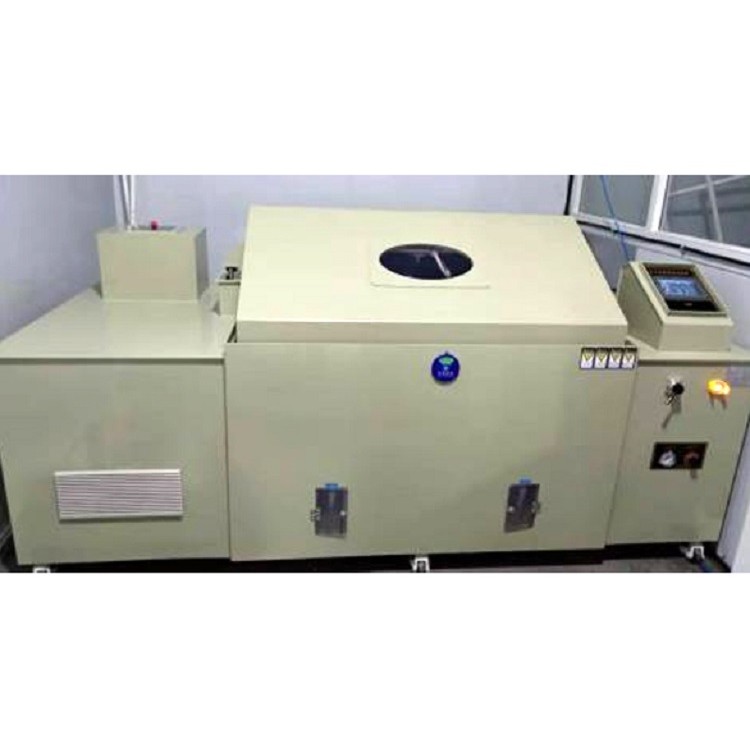
Compound Salt Spray Test Chamber | Salt Dry and Wet | Cyclic Corrosion Test Chamber | Humid Salt Spray Test Chamber
II. Product Applications:
The programmable composite salt spray tester breaks through the concept of traditional salt spray chambers. In addition to the usual functions of a salt spray tester, it also incorporates the functionality of alternating (cyclic) salt spray testing, providing environments for testing dendritic corrosion and fibrous corrosion, and is equipped with test environments such as hot air drying, humidity, forced drying, and salt spray. Compared to traditional salt spray chambers, the cyclic corrosion effects of salt spray, drying, and humidity are more realistic, as products are transported, stored, and used in both dry and wet environments. Therefore, the accelerated corrosion tester should more realistically simulate this environment, and international research also indicates that cyclic corrosion is very close to outdoor corrosion in terms of corrosion rate, structure, and morphology, and has a good correlation with outdoor corrosion. It is also included in the category of common tests, and an increasing number of automotive industry tests require the combination of salt spray, drying, and humidity in a multi-step cyclic process.
Section 3: Material of the Case
Test Tank: 10mm thick heat-resistant HC PVC or PP plate products.
2. Cover for Test Tank: 10 mm high-temperature resistant HC PVC or PP panel products.
3. Shell exterior: 10mm imported PVC or PP board products, with a stainless steel frame in the middle layer to reinforce the overall rigidity and load-bearing capacity of the testing machine.
4. Saturated Drum: 3mm SUS#304 stainless steel plate, with water level indicator included.
Heater: Utilizing specially customized corrosion-resistant titanium metal electric heating pipes.
6. Imported Multi-blade High-Pressure Blower.
7. Pumps: Utilize imported corrosion-resistant pumps.
8. Solenoid Valve: High-performance.
Four, Meets Standards:
Meets Standards: RELATEU STANDARDS CNS3627, 3885, 4519, 7669, 8886; JIS D-0201, H-8502, H-8610, K-5400, Z-2371, ISO 3768, 3769, 3770; ASTM B-117, B-268, GB/T 2423, GJB 150.
Salt Spray Test: NSS, ACSS
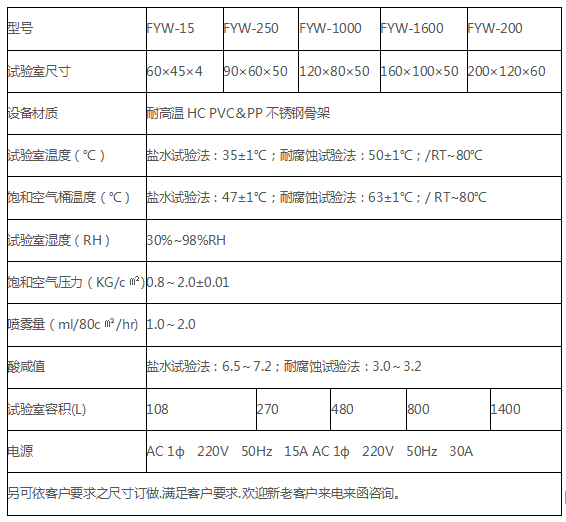
Laboratory: 35℃±1℃; Saturated Air Drum: 47℃±1℃.
2. Corrosion Resistance Test: CASS
Laboratory: 50℃ ±1℃; Saturated Air Drum: 63℃ ±1℃.
3. Hot Air Drying Test
1). Test temperature range: Room temperature +10℃ to 70℃ ±1℃.
2). Test humidity range: Less than 30% RH.
3). The air inside the outdoor temperature box of the test room is heated by an air heater using a blower, then it enters the test room, thereby creating a low humidity environment inside. The temperature of the test room is controlled by the heater within the temperature box. (SSR Drive)
4. Humidity and Heat Test
Test temperature range: Room temperature +10℃ to 60℃ ±1℃.
2). Test humidity range: adjustable from 60%RH to 98%RH.
3). Employed steam injection method, where water is heated to produce steam and then blown into the test room by a blower. The microcomputer processor of the IPC-1000 controller, which plays a primary control role, performs fine motion control when the humidity reaches the required value. If the humidity exceeds the value, dry hot air is introduced to dilute the moisture, and excess humidity is expelled outside the test room. Electronic positioning fine motion humidification system.
4). Static room temperature cooling is achieved through the introduction of external air, maintaining the laboratory temperature consistent with the outdoor temperature.
V. Technical Specifications