




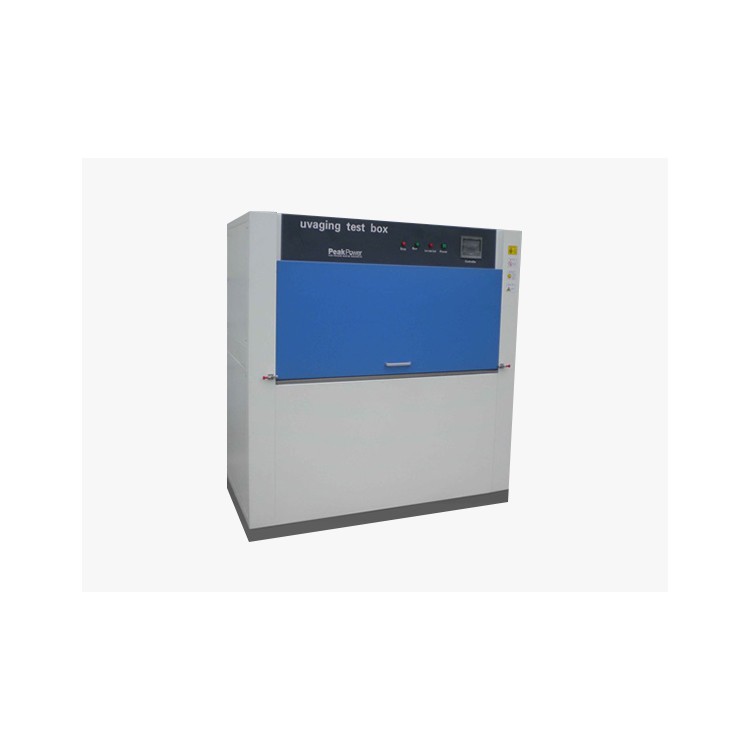


Horizontal UV aging test chamber application:
Horizontal UV aging test chambers can replicate the destructive effects of sunlight, rain, and dew. The equipment conducts tests by exposing the test materials to a controlled cycle of alternating sunlight and humidity, while simultaneously increasing the temperature. The device uses UV fluorescent lamps to simulate sunlight and can also mimic the effects of humidity through condensation or spray淋. It is an essential testing equipment for industries such as aviation, automotive, home appliances, and scientific research. Suitable for schools, factories, research institutions, and other units.
Horizontal UV aging test chamber body structure:
Outer Shell Material: SUS stainless steel plate with electrostatic powder coating; Inner Liner Material: SUS stainless steel plate
Lid Material: SUS stainless steel plate with electrostatic powder coating.
A total of 4 or 8 UV-A or UV-B lamps are installed at the top of the studio.
The heating method is an inner pot water tank, which heats up quickly with even temperature distribution.
The lid is a flip-top design, easy to open and close.
Automatic water replenishment for the inner tank to prevent damage from empty heating tube burning.
The sample stand is made of stainless steel or aluminum alloy.
The test box bottom is equipped with high-quality, fixable PU rolling casters.
The drainage system utilizes vortex and U-shaped sedimentation devices for drainage.
The sample surface is parallel to the plane of the ultraviolet lamp.
The sprinkler-type equipment is internally equipped with automatic sprinkler heads, with adjustable water pressure.
If the lamp is on and the box door is opened, the machine will automatically cut off the power supply to the lamp and enter a balanced cooling state to prevent injury to the human body.
Over-temperature protection inside the box: When the internal temperature of the box is too high, the machine will automatically cut off the power and enter a balanced cooling state.
UV aging cabinet control system:
The humidity and temperature control gauge features a fully imported high-precision digital microcomputer integrated controller from (South Korea); Accuracy: 0.1℃ (display range); Resolution: ±0.1℃; Temperature sensor: PT100 platinum resistance thermometer.
Control Method: Heat balance temperature and humidity control method.
Humidity and temperature control utilizes a P.I.D. + S.S.R. system for synchronized channel coordination control.
Fusesafe switch; Overheat; Low water level; Overload; Leaking; Full-shielded terminal; Automatic shutdown protection;
Horizontal UV Aging Cabinet Model and Parameters
Studio Size: 450×1170×650mm
Dimensions: 580×1280×1450mm
Temperature Range: RT +10℃ to 70℃
Humidity Range: 90~98% R·H
Humidity Uniformity: ±2%
Temperature uniformity: ±2℃;
Temperature fluctuation: ±0.5℃
Humidity fluctuation: ±2%
Sample Rack Dimensions: 1000*500 flat tray, suitable for any three components.
Bowl water depth requirement: 25mm, automatic control.
Effective Irradiation Area: 1000×500mm
UV wavelength: UV-A range is 315-400nm; UV-B range is 280-315nm.
UV aging box test time: 0~999H, adjustable.
Blackboard Temperature: 40℃ to 75℃
Ultraviolet light and dew time can be alternated as needed.
Also available for customization according to customer requirements: non-standard testing chambers. Laboratory
Horizontal ultraviolet aging chamber meets the standard
This horizontal UV aging box is suitable for performance reliability tests of various industrial products. It is designed and manufactured in accordance with the relevant standards, including GB/T14522-93 "Chinese National Standard -- Artificial climate acceleration test methods for plastics, coatings, and rubber materials used in mechanical industrial products," GB/T16585-1996 "Chinese National Standard -- Artificial climate aging (fluorescent ultraviolet light) test methods for vulcanized rubbers," and GB/T16422.3-1997 "Test methods for laboratory light source exposure of plastics."
Meets all current UV aging test standards, including ASTM D4329, D499, D4587, D5208, G154, G53; ISO 4892-3, ISO 11507; EN 534; prEN 1062-4, BS 2782; JIS D0205; SAE J2020, and more.
