
Daily Operational Guidelines for Recirculating Water Treatment System Operators
Section 1: Procedure for Adding Medication
1. Drug Addition Principles
Ensure precise, timely, and quantified addition of reagents.
(2) When employing intermittent effluent discharge, it is necessary to add chemicals after the effluent is discharged.
(3) Prior to each medication preparation, the medication bucket must be thoroughly rinsed before pouring the medication in. Additionally, the bucket should be rinsed 2 to 3 times after the medication is added.
(4) If using two algaecides, they should be alternated and the intervals between additions should be evenly distributed.
(5) No scale and corrosion inhibitor should be added on the same day as the algicide is introduced.
(6) Detailed records of daily medication addition and effluent exchange processes.
2. Method of adding medication
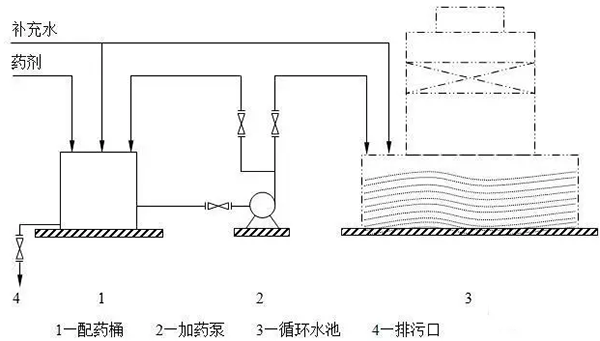
Based on the current system status and the characteristics of the chemicals, the algaecide can be directly added to the settling pond. The method of adding scale and corrosion inhibitors is as follows: a dosing tank is installed next to the circulating cooling water settling pond. The tank has a replenishment pipe at the top and a drain at the bottom. After the chemicals are added to the dosing tank and diluted with make-up water, they are continuously and evenly added to the settling pond in a gradual manner using a metering pump (as shown in Figure 1).
3. Dosage Point
Do not add the chemicals near the drain outlet in the settling pond to prevent them from being directly flushed away without entering the recirculating water system; allow the chemicals to mix in the pond for a designated period to ensure even distribution; avoid adding chemicals near the intake of a single pump, as this can lead to uneven concentration distribution.
4. Method of Adding Medication
The method of adding scale and corrosion inhibitors: Measure the chemical agent and add it to the clean mixing drum. Add make-up water while stirring to dilute the agent by approximately 3-5 times (dilution is to balance the dosing time; it can be omitted as needed). After stirring and mixing uniformly, start the dosing pump to adjust the dosing valve, allowing the agent to be added continuously and evenly into the sedimentation tank, ensuring it is completed within 20-24 hours.
(2) Algaecide Addition Method: Operate using a shock intermittent dosing method, directly adding the chemical in measured quantities to the sedimentation basin, maintaining a consistent concentration of the algaecide in the circulating water for a period of time to achieve effective sterilization and scaling removal.
5. Cautionary Notes
Please neatly stack water treatment chemicals according to batch numbers in the warehouse to avoid confusion and misuse.
(2) Refer to the water quality test results (concentration factor, turbidity, total phosphorus) in comparison with the circulating water control standards and the dosing schedule, and perform effluent discharge, exchange, or dosing operations as required.
(3) When adding medication, operators must wear protective gear to prevent direct contact with the skin and eyes. In case of accidental contact with the skin, the area should be immediately rinsed thoroughly with plenty of water.
(4) The method of adding water treatment chemicals must be strictly followed according to relevant requirements, and production work should be well-managed.
Two, necessary controls are implemented over the effluent discharge volume, supplementary water volume, and dosing amount to meet the required standards.
When turbidity exceeds 20 mg/L, increase the effluent discharge volume, enhance the bypass flow, and replenish clean water until the recirculating water turbidity is less than 20 mg/L.
3. According to the current system status, it is recommended to operate at an increased concentration ratio to save water and reduce chemicals. If the concentration ratio exceeds 4 times, increase the effluent discharge, add clean water, and replace it until the concentration ratio is less than 4 times.
4. Total Phosphorus Control in Recirculating Cooling Water. It is advisable to maintain the total phosphorus level in the recirculating cooling water within the range of 6 to 10 mg/L, based on the performance of the scale and corrosion inhibitor chemicals.
Due to excessive wastewater discharge, resulting in low total phosphorus levels, it is appropriate to add scale and corrosion inhibitors to reach the required total phosphorus standards, while also adjusting the wastewater discharge volume.
(2) If the recirculating water system is discharging normally but the total phosphorus level is low, it is necessary to analyze and check if the chemicals have expired or if there is an excessive deviation. If the above reasons are ruled out, increase the dosage of chemicals to meet the total phosphorus requirements.
(3) If the total phosphorus in the recirculating water exceeds 10 mg/L.
5. In the event of abnormal phenomena or issues with the circulating cooling water system and water treatment operations, it is essential to report them to the relevant personnel promptly and handle them accordingly, while ensuring thorough documentation.
Recirculating Cooling Water Index Control Range
Section 3: Circulating Cooling Water Index Control Range
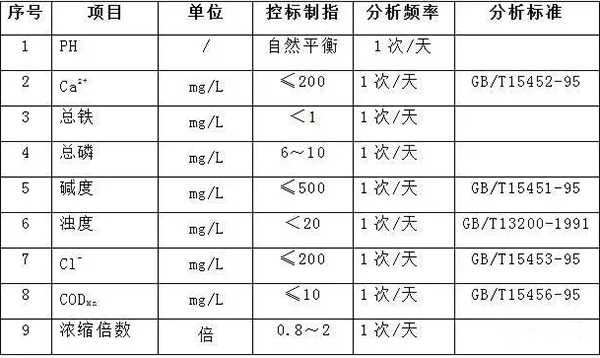
Note: The concentration ratio is approximately equal to the ratio of the Cl- mass concentration in recirculating water to that in makeup water.
Four, in the process of adding pharmaceuticals to the circulating water, it is necessary to conduct挂牌 inspections of the circulating water to monitor metal corrosion, ensuring the operation of the heat exchange equipment. Strictly control the acidity and alkalinity of the circulating water to prevent corrosion of the equipment.
