
公司主营:Polymer Material Composition Analyzer_Ne邻苯四项Detector_ROHS2.0 Ten-Item Analyzer
18550531168
Product Center
Company Qualification
Ezhou Metal Thickness Gauge


Details Introduction
Wide testing range: X-ray Fluorescence Spectrometer, a physical analytical method that is independent of the chemical bonding state of the sample. It can also analyze elements belonging to the same group in terms of chemical properties, and vacuum pumping allows testing from Na to U.
High Reliability: Due to the absence of human interference in the testing process, the instrument boasts high analytical accuracy, repeatability, and stability. Consequently, its measurement reliability is enhanced.
Satisfy Various Needs: The test software is for WINDOWS operating systems, featuring ease of use and robust functionality. It can monitor instrument status, set instrument parameters, and offers a variety of analytical methods. The flexible and diverse methods for creating working curves make it convenient to meet the testing requirements of different clients and samples.
High cost-performance ratio: Compared to chemical analysis instruments, X-ray fluorescence spectrometers have an advantage in overall operational costs, making them more acceptable to more businesses and manufacturers.
Simplified: Low technical requirements for personnel, easy and convenient operation, and simple maintenance.
The Thick 8000 Coating Thickness Gauge is a newly designed instrument meticulously crafted for coating thickness measurement. Mainly used for: measuring the thickness of metal coatings, determining electroplating liquid and coating content; as well as detecting the contents of precious metals like gold, platinum, silver, and various ornaments.
1. Performance Advantages
Precise 3D platform
Sample Observation System
Image Recognition
Easily achieve deep groove sample inspection
Four micro孔 focused collimators, auto-switch
Dual protective measures for seamless collision prevention
Utilizing large-area high-resolution detectors, effectively reducing detection limits and enhancing test accuracy.
Fully automatic intelligent control mode, one-touch operation!
Auto-power-on automatic exit from self-check, reset
Automatic exit of the sample stand after opening the cover, lift the Z-axis testing platform for easy sample placement
Close the lid, lower the Z-axis test platform, and automatically complete the focusing.
Directly click on the panoramic or partial view images to select test points.
Click the "Test" button on the software interface to automatically complete the test and display the results.
2 Technical Specifications
Elemental analysis range covers any metal coating from sulfur (S) to uranium (U)
An analysis of up to five coatings can be performed simultaneously.
Ultra-thin and testable down to 0.005μm
The analysis content typically ranges from 2ppm to 99.9%.
Coating thickness is generally within 50μm (varies by material type).
Multiple selectable analysis and identification models
Mutual Matrix Effect Correction Model
Multivariate Nonlinear Recycling Program
Long-term job stability with high reliability
Temperature range of 15℃ to 30℃
Power: AC 220V, 5V; recommended to configure an AC purification and voltage stabilizing power supply.
Instrument Dimensions: 576(W) x 495(D) x 545(H)
Weight: 90 kg
Method of Determination
(1) Selection and Installation Method: Ensure the power is OFF, make contact with the material of the object to be measured, and install the LEP-J or LHP-J probe.
(2) Adjustment: Confirm that the object to be measured has been adjusted. Adjust if not.
(3) Measurement: Apply a certain load to the end of the probe, i.e., use [a point-contact constant-pressure method]. Grasp and
The part close to the measuring department should be pressed down quickly at a perpendicular angle to the measuring surface. The following measurements, each time...
Start leaving 10 or more from the front end of the probe. When continuously measuring planes using a tubular object, using a probe adapter allows for more stable measurements.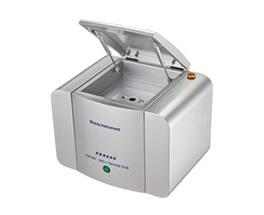
Coating Thickness Gauge
Technical Specifications
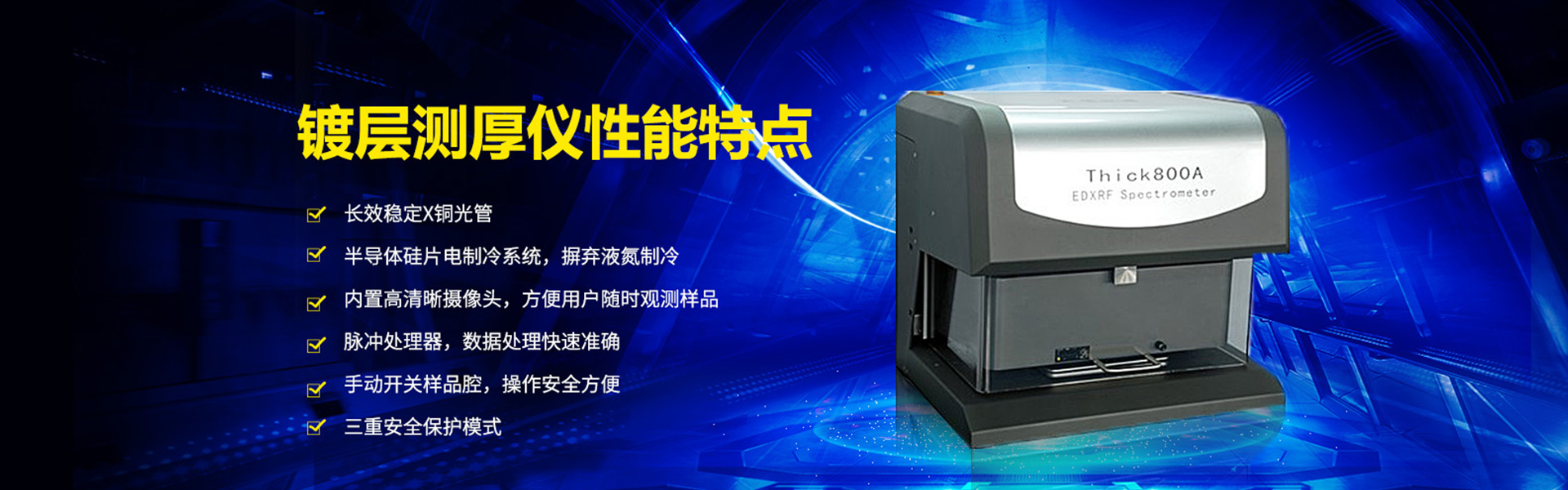
Model: Thick 800A
Element analysis range covers from sulfur (S) to uranium (U).
Analyzes over 30 elements, with a five-layer plating.
Analysis content is generally from ppm to 99.9%.
Coating thickness is generally within 50μm (varies by material).
A variety of selectable analysis and identification models.
Mutual matrix effect correction model.
Multivariate Nonlinear Recovery Program
Temperature range: 15℃ to 30℃.
Power: AC 220V, 5V; it is recommended to configure an AC purification and voltage stabilizing power supply.
Dimensions: 576(W) x 495(D) x 545(H)
Sample Room Dimensions: 500(W) x 350(D) x 140(H)
Weight: 90 kg
Performance Features
Meets testing requirements for various sample thicknesses and irregular surface samples
φ0.1 micro-hole collimator can meet the requirements for tiny test points
High-precision platform for locating test points, with repeated positioning accuracy less than 0.005
Utilizes high-precision laser positioning, capable of automatic height measurement.
Laser positioning determines the spot location, ensuring alignment of the test point with the spot.
The mouse controls the platform, where the mouse click indicates the point to be measured.
High-resolution probe for more accurate analysis results.
Excellent radiation shielding effect
Test Port High Sensitivity Sensor Protection
Standard Configuration
Open sample chamber.
Precision 2D sample platform, with movable detectors and X-ray tubes for 3D capability.
Dual laser positioning device.
Lead glass shield.
Si-Pin Detector.
Signal Detection Electronic Circuit
High and low voltage power supplies.
X-ray tube.
High-precision Height Sensor
Sensor Protection
Computers and inkjet printers
Application Fields
Gold, platinum, silver, and other precious metals, as well as jewelry content testing.
Thickness measurement of metal coatings, determination of electroplating solution and coating content.
Primarily used in precious metal processing and jewelry manufacturing; banks, jewelry sales and inspection agencies; electroplating industry.
When determining salt (NaCl) with different devices, the information obtained from the fluorescence X-ray device indicates that the substance is composed of sodium (Na) and chlorine (Cl), while the information from the X-ray diffraction device suggests the substance is made up of (NaCl) crystals. On the surface, it may seem that an X-ray diffraction device (XRD) capable of determining crystalline states would be preferable. However, when dealing with substances containing multiple compounds, it's challenging to make a definitive determination with just the diffraction device (XRD). One must first obtain elemental information using the fluorescence X-ray device (XRF) before proceeding with qualitative analysis.
Non-destructive film thickness testing and metal element analysis are areas that many quality engineers and project developers are unfamiliar with, often asking, "Can this equipment analyze this metal composition?" For testers, they are often limited by the non-programmable nature of film thickness equipment and the strong specificity required for metal composition analysis, resulting in their familiarity with the equipment being confined to mere operation.
Principle of magnetic induction, which is the use of the magnitude of magnetic flux passing through the non-magnetic coating and into the ferromagnetic substrate from the probe to measure the coating thickness. It can also be determined by measuring the corresponding magnetic resistance, which represents the coating thickness. Thicker coatings result in higher magnetic resistance and lower magnetic flux. Thickness gauges utilizing the principle of magnetic induction require a non-magnetic coating thickness on the ferromagnetic substrate. Generally, the permeability of the base material should be above 500μ. If the coating material also has magnetic properties, the difference in permeability between the coating and the base material should be sufficiently large. When the probe with the coil wrapped around the core is placed on the sample to be measured, the instrument automatically outputs a test current or signal. Early products used a pointer gauge to measure the magnitude of the induced electromotive force, and the instrument amplified this signal and converted it into coating thickness. The circuit design incorporates new technologies such as frequency stabilization, phase locking, and temperature compensation, using magnetic resistance to modulate the measurement signal. Equipment with this technology also employs a patented integrated circuit design, introduces microcomputers, significantly improving measurement accuracy and repeatability.
Coating thickness is a critical technical specification for electroplating products, affecting both product quality and production costs. The Thick800A Coating Thickness Gauge is a membrane thickness testing instrument developed with years of experience, specifically for the coating industry. It comes with a platform, supports fully automated software operation, and performs multi-point testing for more accurate results.
In accordance with the standard technical document GB/Z 20288-2006 "General Requirements for Sample Splitting of Hazardous Substances Detection in Electronic and Electrical Products": The surface treatment layer should be separated from the main body as much as possible (plating). For plating that cannot be separated, an initial screening of the surface treatment layer can be conducted (using X-ray fluorescence spectrometry (XRF)). If the screening is passed, no further splitting is required; if not, non-mechanical separation methods can be used (such as using chemical solvents that dissolve the surface treatment layer but not the main material). When conducting RoHS testing on the plated samples, first use the EDX1800B instrument to directly perform the plated RoHS test. If it passes, the sample meets the RoHS standard. If the plating fails, proceed to the next stage of splitting tests.
Meets testing requirements for samples of various different thicknesses and irregular surfaces.
The φ0.1 orifice collimator meets the requirements for micro-testing points.
High-precision platform can locate test points, with repeatable positioning accuracy less than 0.005.
Utilizes high-precision laser for automatic height positioning during testing
Locate the laser to align the spot with the test point.
Mouse-controlled platform; the point clicked by the mouse is the test point.
High-resolution probe for more accurate analysis results.
Excellent radiation shielding effect
High-sensitivity sensor for testing mouth height protection
The elemental analysis range spans from sulfur (S) to uranium (U).
Can analyze over 30 elements, with a five-layer plating.
The analysis content is generally between ppm and 99.9%.
Coating thickness is generally 50μm or less (varies by material).
Multiple selectable analysis and identification models.
Mutual matrix effect correction model.
Multivariate Nonlinear Recycling Program
The temperature range is from 15°C to 30°C.
Power: AC 220V, 5V; it is recommended to configure an AC purification and voltage stabilizing power supply.
Dimensions: 576(W) x 495(D) x 545(H)
Sample Room Dimensions: 500(W) x 350(D) x 140(H)
Weight: 90 kg
Open sample chamber.
Precision 2D sample platform with movable detectors and X-ray tubes for 3D capability.
Dual laser positioning device.
Lead glass shield.
Si-Pin Detector
Signal Detection Electronic Circuit
High and low voltage power sources.
X-ray Tube.
High-precision Height Sensor
Protective Sensor
Computers and inkjet printers
Thickness Gauge, also known as X-ray thickness gauge, operates on the principle that when matter is exposed to X-rays or particle beams, it becomes unstable due to the absorption of excess energy. To return to a stable state, this substance must release the excess energy, which is then emitted as fluorescence or light. The principle of a fluorescence X-ray coating thickness gauge or composition analyzer is to measure the energy and intensity of this emitted fluorescence for qualitative and quantitative analysis.
刘小姐 (Mr.)
18550531168
18550531168
2845938008@qq.com
860 Qingyang North Road, Zhou Town
b2b.china9.net © Zhongshang 114 Hebei Network Technology Co., Ltd.Address: Room 6009, Oriental New World Center, No.118 East Zhongshan Road, Qiaoxi District, Shijiazhuang City, Hebei ProvincePlatform Service Hotline: 4006299930
