
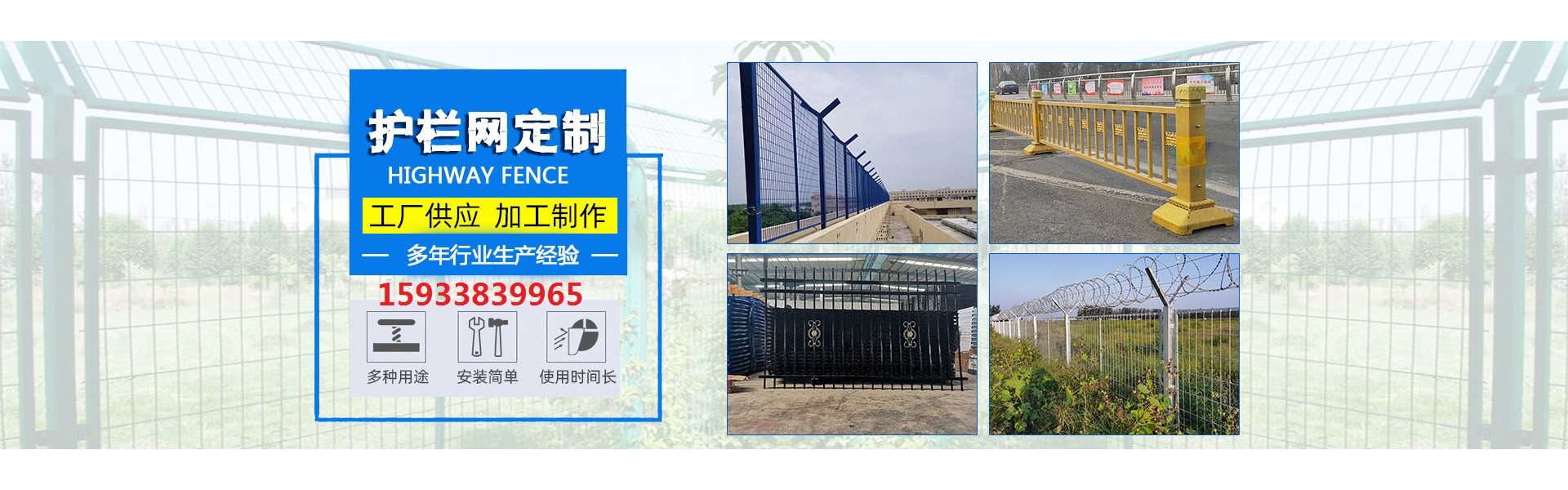

Railway guardrails are crucial traffic infrastructure, demanding higher standards of safety and practicality. The posts are available in galvanized steel pipes, peach-shaped posts, dovetail posts, and C-shaped steel, while the mesh panels come in options like plastic-coated wire mesh, PVC-coated welded wire mesh, woven mesh, steel mesh, and perforated mesh. The general structure consists of posts and frames connected by fasteners, which can also be directly connected to posts using mesh panels, bolted, or riveted with connectors, allowing for adjustable angles.
Material Selection: Low-Carbon Steel Wire
Woven: Welded construction; features a simple grid structure that is easy to transport and install,不受terrain undulations, particularly well-suited for mountainous, sloping, and winding areas.
Manufacturing Process:
Firstly, select the finished wire drawn from the coil; welding or weaving is primarily dependent on the skilled techniques and operational abilities between technicians and production machinery. A high-quality mesh should ensure that every welding or weaving point is well connected. Furthermore, the selection of materials for the frame should include angle iron and round steel, with different types of angle iron and round steel used for various applications of guardrails. Paying attention to the evenness of the powder coating is also crucial, as well as the quality of the paint.
Primarily used for protective barriers along highways, railways, and bridge sides; safety measures at airports, ports, and docks; and for isolation and protection in municipal construction projects such as parks, lawns, zoos, ponds, roads, and residential areas.
Advantages:
1. The pillars are made of concrete castings, resulting in low construction costs.
High strength and excellent overall stability.
3. The colored plastic layer offers excellent corrosion resistance and decorative effects.
4. The overall netting boundary is harmonious and aesthetically pleasing.
5. Rail closures, highway guardrails, development zone fences, and area perimeter fences.
6. Corrosion-resistant, anti-aging, and UV-resistant features.
Specification of the frame fence mesh:
Web Height x Web Width (Center Distance): 1.8m x 3.0m; 2m x 3m; 2.6m x 2.8m; 3m x 3m
Standard Pillar Requirements: φ48 × 2.5mm/2.0mm/1.8mm
Fiber Diameter Range: 3.0mm to 5.0mm
Aperture Size: 50mm x 200mm; 70mm x 150mm
Proper Considerations for Railway Fence Net Construction
1. Contractors must accurately understand various construction drawings during installation. The precise locations of all pipelines embedded in the subgrade must be adhered to, and no damage to underground facilities is permitted during the construction process.
2. If the pillar is driven too deep, it should not be pulled out to correct it. Instead, the foundation needs to be compacted again before driving it in, or the pillar's position should be adjusted. During construction, when approaching the depth, attention should be paid to controlling the impact force of the hammer. For railway guardrails, flanges should be installed, with attention given to the positioning of the flange and the control of the pillar's top elevation.
3. Railway guardrails are a part of the safety facility installation engineering for railways and are an important component of the appearance quality of expressways. The inherent quality of railway guardrails lies in the raw materials and the processing process, while its appearance quality depends on the construction process. During construction, attention should be given to the preparation of construction work and the combination of pile drivers.


