


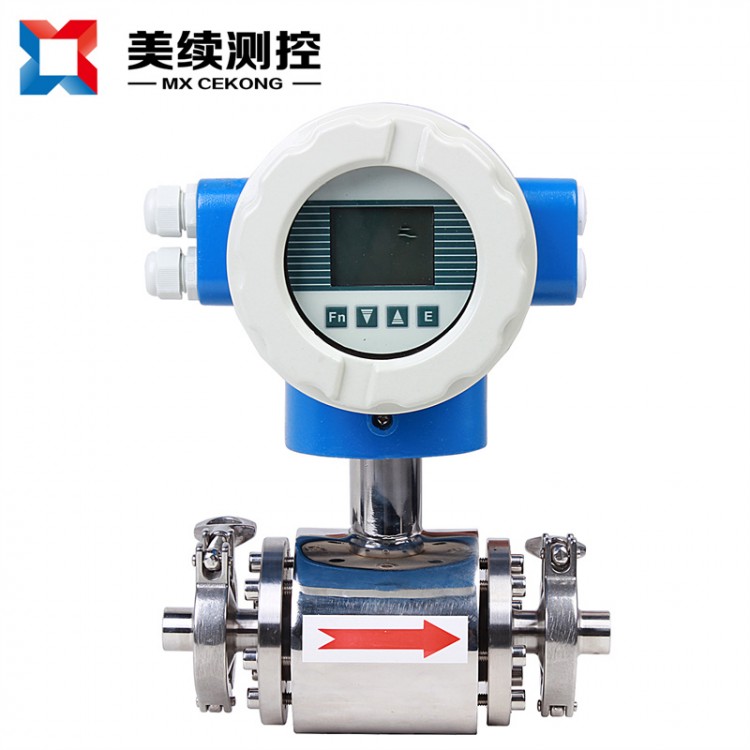

Shanghai Meixu Electromagnetic Flowmeters MX-LL-116-01 Series (Electromagnetic Flowmeters, abbreviated as EMF): Flow meters that conduct flow testing based on Faraday's Law of Electromagnetic Induction (Faraday's Law: When a conductor moves across the magnetic field lines, an induced electromotive force perpendicular to both the magnetic field direction and the conductor's movement is induced at both ends of the conductor). The advantages of electromagnetic flowmeters include low pressure loss and a wide range of measurable flow rates. The flow ratio is generally above 20:1, suitable for a wide range of industrial pipe diameters, up to 3m in size. The output signal and measured flow are linear, with high accuracy. They can measure solutions of acids, alkalis, salts, water, wastewater, corrosive liquids, and flow with conductivity ≥5 μs/cm.

Application Fields
Petroleum & Chemical Engineering, Iron & Steel Metallurgy
Water Supply and Drainage, Irrigation
Water Treatment, Wastewater Treatment Plants (Environmental Pollution Control, Chemical Wastewater, Electroplating Wastewater)
Slurry, pulp, and other fluids
Distillation Deactivation Engineering System
Papermaking (pulp), slurry, food, and other industrial and agricultural production process flow measurement and control
Product Features?Unaffected by changes in fluid density, viscosity, temperature, pressure, and electrical conductivity, the linear measurement principle allows for high-precision measurement.The measuring tube has no restrictive flow or moving parts, resulting in minimal pressure loss and no additional energy loss.
High-definition backlit LCD display, full Chinese menu operation, easy to use, simple to operate, easy to learn and understand.
With conductivity measurement function, capable of determining if the flow meter is empty pipe, featuring self-check and diagnostic capabilities.
Internal calculator displays positive cumulative flow, negative cumulative flow, and instantaneous flow separately.
Insertable electromagnetic flowmeter, easy to install, allows for in-service, pressure tapping without flow interruption, offering installation and price advantages.
Low installation requirements; the front straight pipe must be greater than 5D, and the length of the rear straight pipe needs to be greater than 3D (D is the inner diameter of the instrument). Note: 1. The flow/rate data in the table is approximate, and the yellow area indicates the recommended flow meter for measuring flow/rate.
2. Flow Rate and Volume Conversion Formula: Flow rate v = 354 * flow volume q / D²
In the formula: q - m³/h, v - m/s, D(DN) - mmElectrodes are used to obtain flow-related electrical signals and come into direct contact with the medium being measured. When selecting the electrode material, consideration must be given to the compatibility between the electrode material and the medium, including factors such as the material's corrosion resistance, passivation, and wear resistance.Parameter specifications
