


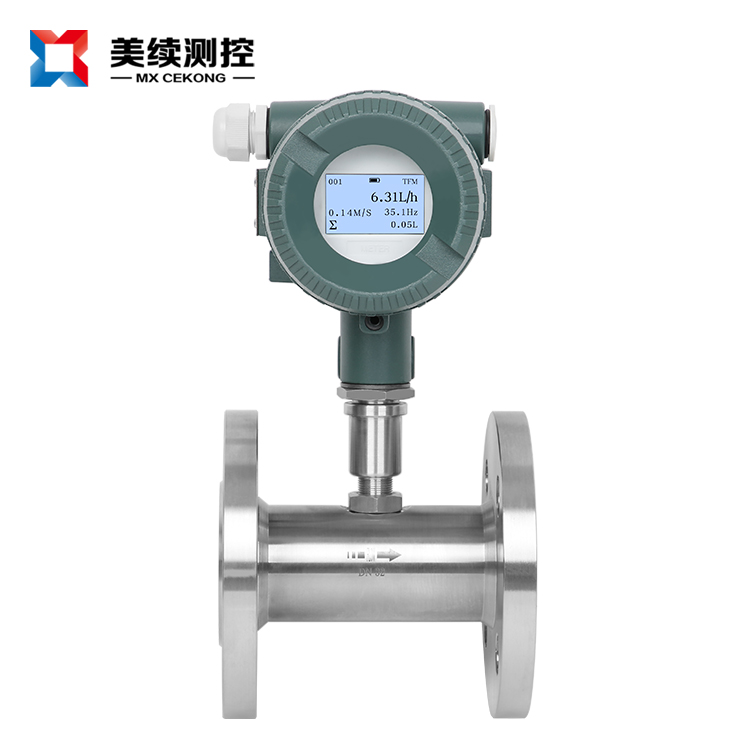

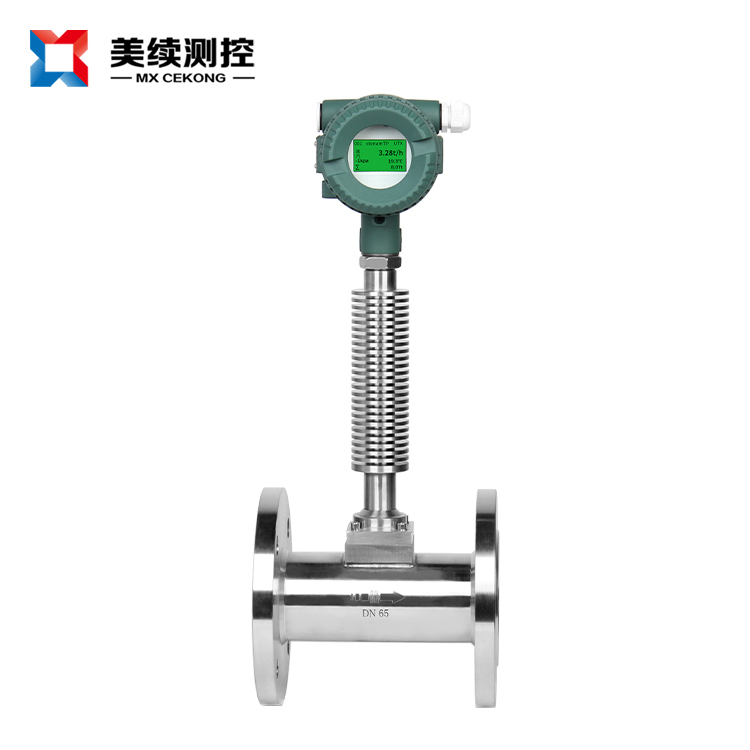
Shanghai Mei Xu Turbine Flow Meters mx-ll-116-03 Series - Liquid Turbine Flow Meters measure flow using turbines. They convert flow velocity into turbine rotational speed, then transform the speed into a proportional electrical signal. These flow meters are used to detect instantaneous flow and total integrated flow, with output signals in the form of frequency, making them easy to digitize. The inductive coil magnet is fixed together on the housing. As the ferromagnetic turbine blades pass the magnet, the magnetic circuit's magnetic resistance changes, generating an induced signal. The signal is then amplified and shaped before being sent to a counter or frequency meter to display the total integrated flow. Pulse frequency is also converted to voltage-frequency to indicate instantaneous flow. The turbine's rotational speed is proportional to the flow rate, and the number of rotations is proportional to the total volume passed. The output of the turbine flow meter is a frequency-modulated signal, which enhances the anti-interference capability of the detection circuit and simplifies the flow detection system. Its range ratio can reach 10:1, with an accuracy within ±0.2%. Turbine flow meters with small inertia and compact size can have a time constant as low as 0.01 seconds. Liquid turbine flow meters are precision flow measurement instruments. When paired with corresponding flow totalizing instruments, they can be used to measure liquid flow and total volume.
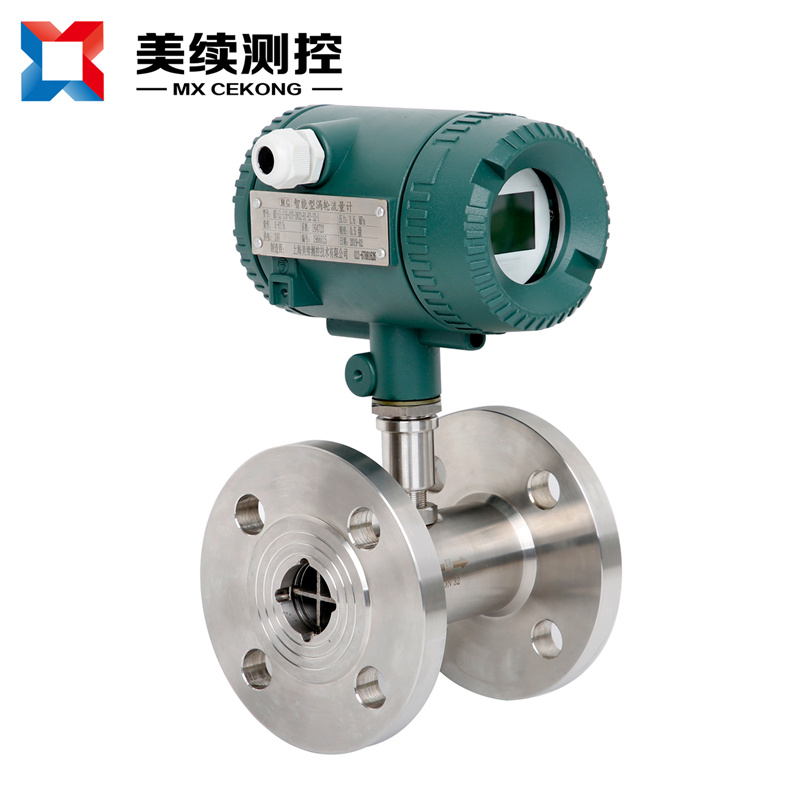
The Shanghai Meixu Turbine Flow Meters MX-LL-116-03/02 series are advanced turbine flow meters that have absorbed cutting-edge technology from international flow measurement instruments and undergone optimized design. They feature a simple and lightweight structure, high accuracy, excellent reproducibility, sensitive response, and easy installation, maintenance, and operation. Suitable for measuring liquids in closed pipes that are non-corrosive to stainless steel 1Cr18Ni9Ti, 2Cr13, alumina Al2O3, and hard alloy, and free of fibers, particles, and other impurities, with a kinematic viscosity less than 5×10^-6 m²/s at working temperature. For liquids with a kinematic viscosity greater than 5×10^-6 m²/s, the flow meter can be calibrated with actual liquid before use. When paired with a display instrument with special functions, it can also achieve functions such as quantitative control and over-flow alarm. Widely used in the measurement and control systems of the petrochemical, chemical, metallurgical, scientific research, and other fields, it is an ideal instrument for flow measurement and energy conservation.
Unique Advantages
The Difference Between Liquid Turbine and Electromagnetic Flow Meters: Electromagnetic flow meters can only measure media with conductivity, whereas turbine flow meters do not require it. Turbine flow meters can measure pure water, oil, and other non-corrosive media. Turbine flow meters offer higher accuracy and greater durability compared to metal rotor flow meters.
Application Fields
Petroleum & Chemical Industry, Iron & Steel Metallurgy
Water Supply and Drainage, Irrigation Engineering
Water Treatment, Wastewater Treatment Plants (Environmental Wastewater Control, Chemical Wastewater, Plating Wastewater)
Slurries, sludges, pulp, and other fluids
Distillation Deactivation Engineering System
Pulp and paper, slurry, food, and other industrial and agricultural production process flow measurement and control
Product Features
High precision, generally up to ±1%r, ±0.5%r, with high precision models reaching ±0.2%r.
High repeatability, with high accuracy achievable through regular or online calibration, making it a preferred flowmeter for trade settlement.
Wide range, medium and large diameters up to 1:20, small diameters at 1:10.
Compact and lightweight structure, easy to install and maintain, with high throughput capacity.
Suitable for high-pressure measurement; no need to drill holes on the instrument housing, making it easy to fabricate high-pressure models.
Bore specification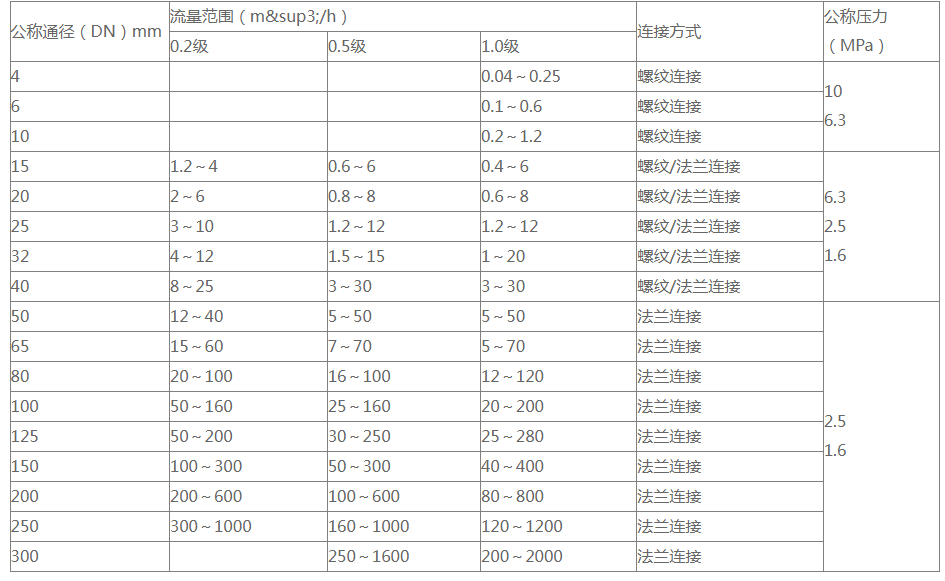 Parameter specifications
 Selection Guide
